

Astronomers utilizing the James Webb Space Telescope (JWST) have uncovered pronounced atmospheric variations between the morning and evening sides of the ultra-hot exoplanet WASP-121 b. Rather than a simple day-night division, the boundary regions display distinct characteristics depending on the time—dawn or dusk.
This breakthrough arises from transit spectroscopy, which examines starlight filtered through a planet’s atmosphere during its passage across its host star. As detailed in a recent Nature Astronomy publication, this technique now enables detailed differentiation of atmospheric features along a planet’s limb instead of averaging them together.
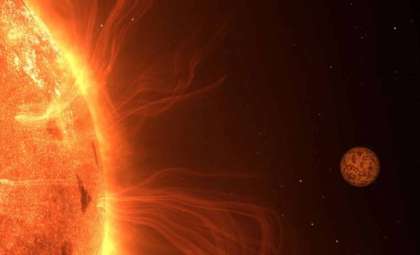
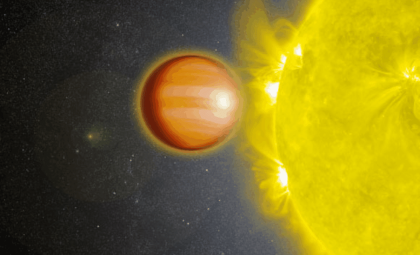
WASP-121 b, a gas giant nestled extremely close to its star, endures one side scorched by relentless stellar heat and the other cloaked in perpetual night. This setup generates intense temperature contrasts and powerful atmospheric flows that shape both thermal and chemical distributions.

Distinct Dawn and Dusk Atmospheric Characteristics
By employing JWST’s NIRSpec instrument, scientists monitored infrared light changes during transit events. Findings published in Nature Astronomy reveal that the planet’s evening terminator absorbs significantly more starlight than the morning side, highlighting physical differences between these two sectors.
As WASP-121 b rotates approximately 30 degrees during its transit, researchers can distinguish signals from the leading (morning) and trailing (evening) limbs. The evening side consistently exhibits amplified absorption, implying elevated temperatures or a more expanded atmosphere. Lead author Cyril Gapp of the Max Planck Institute for Astronomy remarked:
“With its unprecedented observational quality, JWST gives us the most detailed glimpses into distant planets to date. By measuring how star light absorption changes as WASP-121 b rotates, we probe its atmosphere longitude by longitude.”
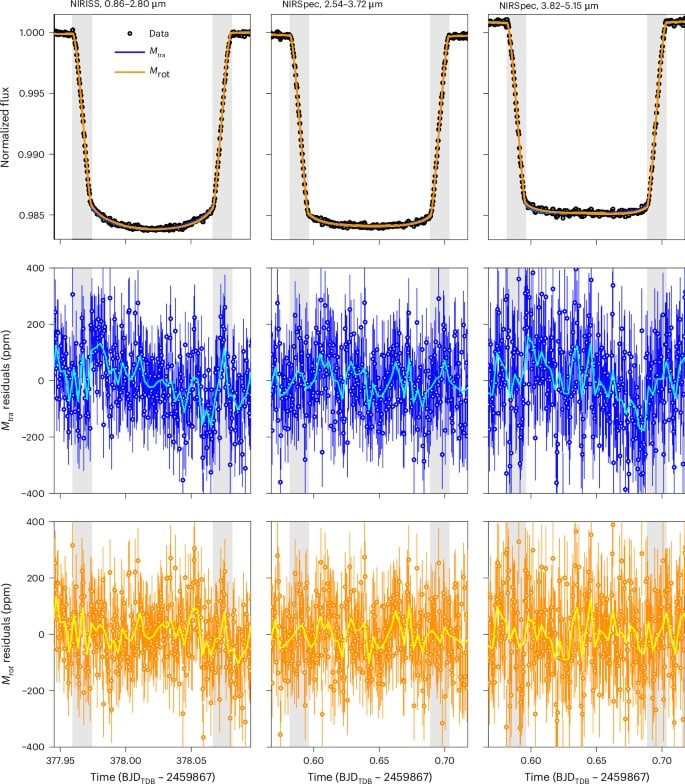
The observed asymmetry is attributed to powerful winds that carry heat from the blazing dayside toward the cooler nightside, shifting the hottest region towards the evening terminator and producing the uneven pattern detected.
Varied Molecular Responses Across the Atmosphere
The data also indicate diverse molecular behaviors throughout the atmosphere. Carbon monoxide (CO) signatures intensify towards the transit’s conclusion. Researchers caution this may reflect temperature-driven changes in gas absorption rather than an abundance variation.
Conversely, water molecules display a different trend, with evidence suggesting depletion in segments of the upper atmosphere. Given WASP-121 b’s searing temperatures, water molecules may dissociate into hydrogen and oxygen, altering overall chemical makeup.
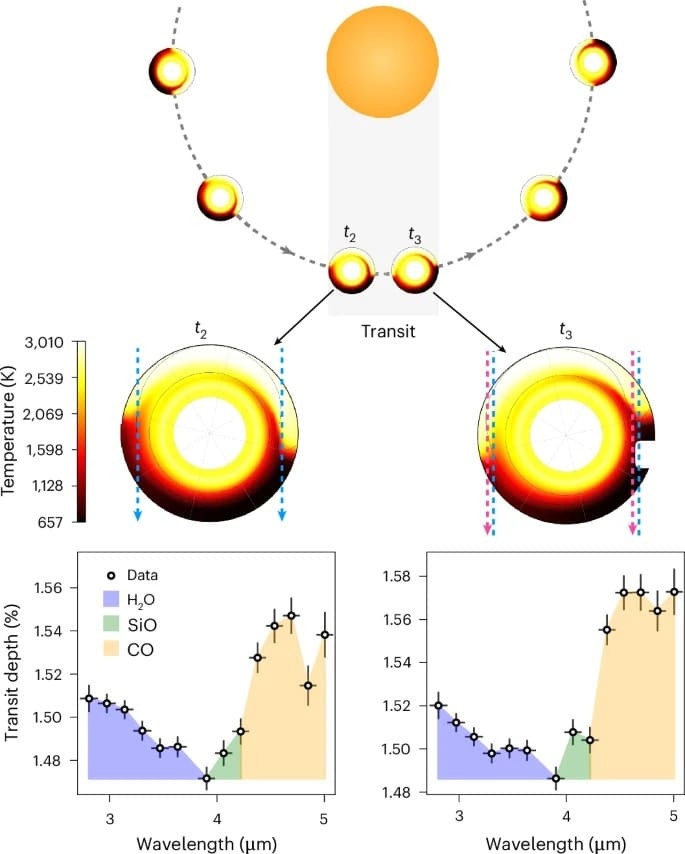
The temperature gradient across WASP-121 b is stark—the dayside soars to approximately 2770 K (about 2500°C), while the nightside cools to near 1000 K (around 725°C). Co-author Tom Evans-Soma of the University of Newcastle commented:
“WASP-121b is particularly extreme, with average temperatures on the dayside hemisphere being around 2770 Kelvin, while those on the nightside are closer to about 1000 Kelvin.” This difference drives strong global winds that redistribute heat across the planet.
Atmospheric Models, Clouds, and Remaining Challenges
Attempts to replicate the JWST findings with atmospheric models succeeded in capturing the overall pattern but fell short of fully reproducing the marked morning-evening disparity. The actual planet’s atmosphere displays a more pronounced variation.
A plausible reason involves the presence of mineral clouds, probably composed of silicates. These clouds are thought to form more readily on the cooler morning side, obstructing infrared emissions from deeper atmospheric layers and making that region appear cooler in observations.
Including simplified cloud dynamics in models yields results that better match the telescope’s data. Nevertheless, simulating cloud formation and behavior under such harsh conditions remains complex, leaving some aspects unresolved.
- Categories:
- Astronomy








0 comments
Sign in to Comment