
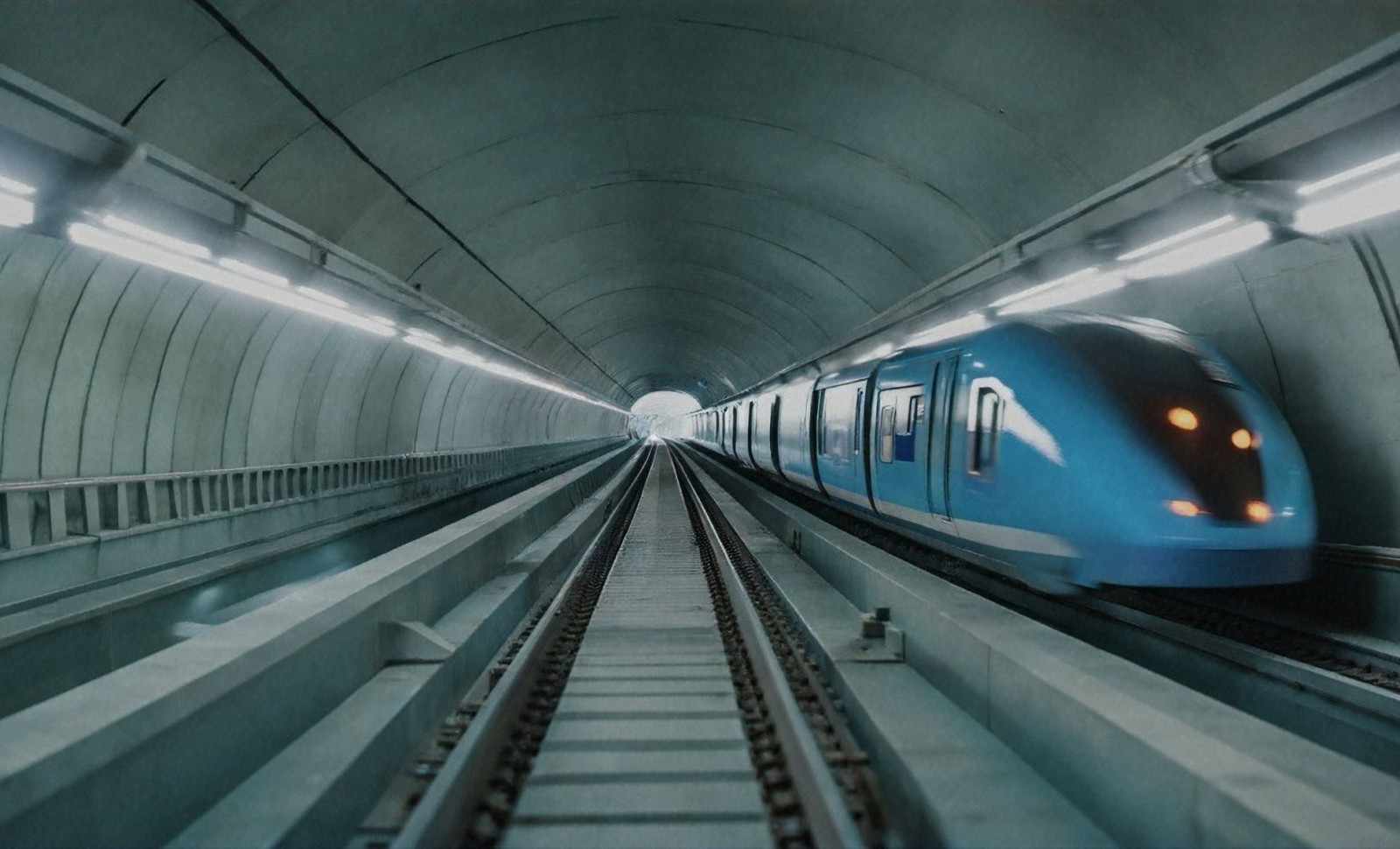
Situated over 100 meters beneath the sea floor in southern China, engineers are progressing on what stands as the deepest underwater tunnel ever built for a high-speed rail system. Using the Chinese-engineered Shenjiang-1 tunnel boring machine, the excavation has surpassed 4 kilometers after four years nonstop.
This tunnel is part of the upcoming Shenzhen-Jiangmen high-speed rail corridor, a 116-kilometer route projected to shorten travel between these cities to under an hour. According to CGTN, the construction hit an unprecedented depth of 113 meters below seabed in April 2026.
Located under the Pearl River Estuary, one of southern China’s busiest maritime zones, the project contends with intense water pressure, fractured rock formations, and multiple underground faults that pose significant engineering challenges.

Setting a New Benchmark in Subsea Tunnel Depths
Spanning between Dongguan and Guangzhou, the tunnel stretches 13.69 kilometers beneath waterways of the Pearl River system. Reports from CGTN confirm the tunnel established a world record by reaching 113 meters under the seabed earlier this year.
Excavation is expected to reach its maximum depth of 116 meters, where hydraulic forces present major design hurdles. The tunnel boasts a diameter exceeding 13 meters, making it one of the largest structures constructed at such depth.
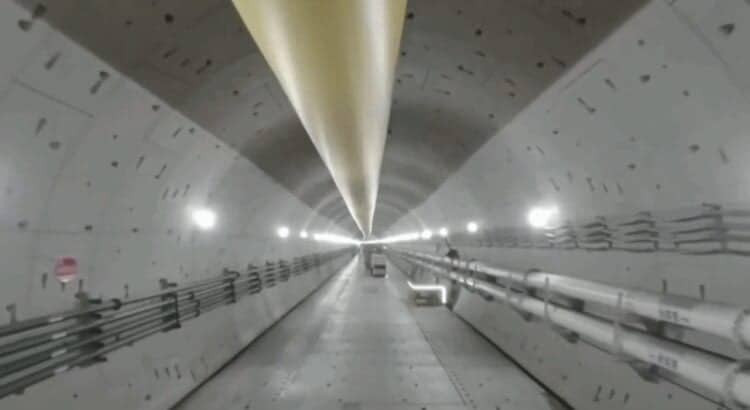
The entire rail line will ultimately cover 116 kilometers, directly connecting the cities of Shenzhen and Jiangmen in southern China.
The Shenjiang-1 Advances Through Complex Seabed Formations
The project utilizes the domestically built Shenjiang-1 tunnel boring machine, specially engineered for deep underwater excavation. Over the past four years, it has steadily moved through unstable seabed layers below the estuary.
Chinese state media cited by CGTN reports that the route crosses 13 distinct geological layers, five complex composite geological types, and six fault zones, all imposing constant mechanical and pressure challenges on excavation equipment.
The boring machine employs two slurry circulation systems: one lubricates the cutting head to minimize friction, and the other transports extracted material to the surface for processing and reuse in construction.
Continuous Progress Under the Estuary Floor
Following the boring machine, construction crews install prefabricated concrete tunnel segments. Each piece is about two meters wide, with nine segments forming a complete ring lining the tunnel.
This coordinated approach of simultaneous excavation and lining installation enables steady progress despite the challenging underwater environment. Workers maintain these efforts ceaselessly beneath the estuary floor.
“We are now at a stage where transport integration is prioritised, so various means of transport need to take one another into account,” stated David Feng, an independent Chinese railway specialist.
This tunnel is a vital component of a larger infrastructure initiative linked to the Guangdong-Hong Kong-Macao Greater Bay Area. Once it becomes operational, the Shenzhen-Jiangmen rail line will integrate into China’s coastal high-speed network, which already exceeds 45,000 kilometers—the most extensive globally.
- Categories:
- Tech




0 comments
Sign in to Comment