

On June 27, 2026, asteroid 152637 (1997 NC1) will make one of its nearest passes to Earth in more than four centuries. Astronomers worldwide are monitoring this event using a combination of ground-based observatories and radar instruments, coordinated notably by the Virtual Telescope Project. At approximately 0.01715 astronomical units away, the asteroid poses no danger but offers a unique chance for detailed scientific study. Such a close approach will not be repeated until June 28, 2133.
A Millennia-Spanning Close Passage
The approach of asteroid 152637 (1997 NC1) in 2026 is remarkable due to its rarity and distance from Earth, rather than any risk it presents.
The asteroid will come within about 2.56 million kilometers—around 6.5 times the distance between Earth and the Moon—categorizing it as a close yet safe visitor. Orbital reconstructions indicate this is the asteroid’s closest approach since at least the 1600s, showcasing a long-term gravitational interplay affecting its orbit.

Belonging to the Aten group of asteroids, it crosses Earth’s orbit while spending part of its trajectory closer to the Sun. Its size estimates vary from about 900 meters to possibly 1.5 kilometers, depending on surface reflectivity, but it remains far from any impact risk in the foreseeable future.
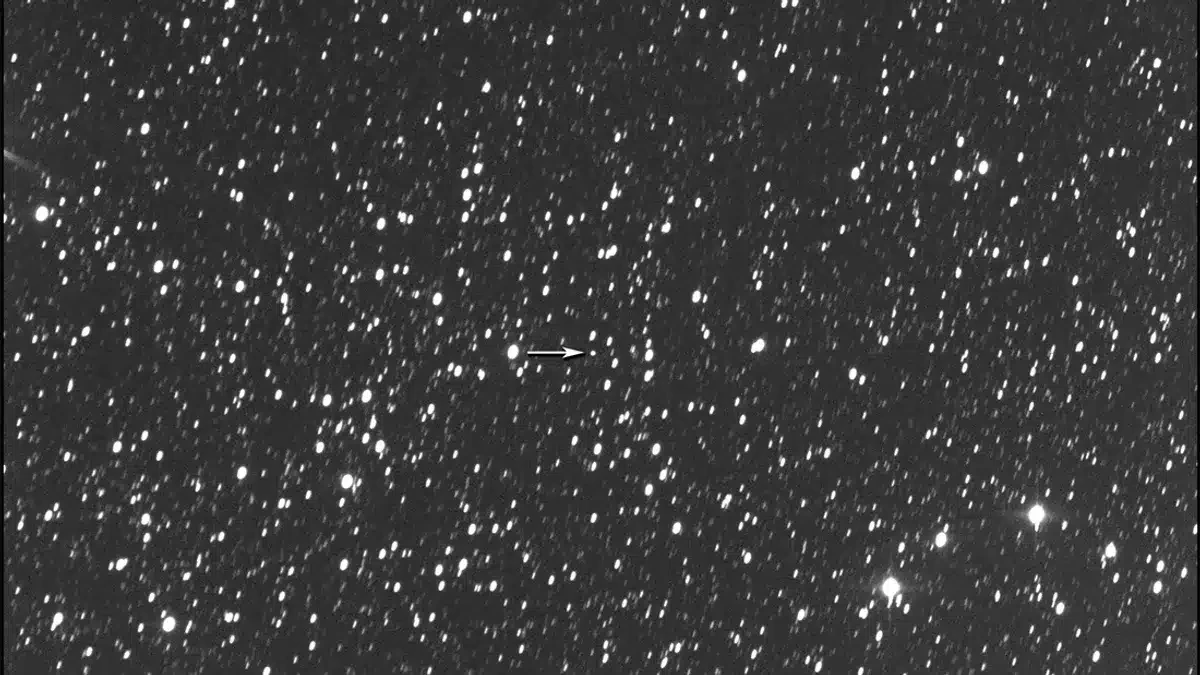
This 2026 encounter is part of a cyclical pattern where similar-sized near-Earth asteroids approach Earth roughly every ten years, though not always this closely. Scientists are particularly interested in how centuries of gravitational effects have influenced its path. The flyby offers an important reference point for updating orbital models that track the behavior of near-Earth objects.
Moreover, the event provides a real-world check for predictions, with the next similarly close flyby expected over a century later in 2133.
Observing the Asteroid with Earth-Based Technologies
Efforts to monitor the asteroid include optical telescopes and radar observations aimed at better defining its physical characteristics.
The Virtual Telescope Project has been instrumental in following its approach, offering scheduled imaging sessions and public observation opportunities.
These optical data complement radar tracking campaigns designed to clarify uncertainties about the asteroid’s size, spin, and surface properties.
NASA explains:
“Visible light from the sun reflects off the surface of the rocks. The more reflective, or shiny, the object is (a feature called albedo), the more light it will reflect.”
“Darker objects reflect little sunlight, so to a telescope from millions of miles away, a large dark asteroid can appear the same as a small, light one.”
This brightness ambiguity challenges diameter estimates when relying solely on visible light. Different surface reflections can create similar appearances, complicating size assessments.
Radar imaging from facilities like the Goldstone Solar System Radar will improve these measurements by directly mapping the asteroid’s shape and rotational state. Radar data provide precise distance and velocity information independent of sunlight reflection.
Combining optical and radar measurements will deliver one of the most comprehensive data sets for this asteroid, enhancing near-Earth object population models.
Insights Expected from Radar Investigations
Radar observations during the 2026 pass are set to refine currently uncertain physical parameters of asteroid 152637 (1997 NC1), especially its true size and surface details.
Optical data produce a broad range of size estimates due to varying albedo assumptions. Radar pulses bouncing off the asteroid can reveal its shape at high resolution.
This approach also uncovers rotational dynamics, surface texture, and structural irregularities—key information for improving long-term orbit prediction, especially as thermal and gravitational effects subtly alter trajectories.
While classified as potentially hazardous because of its orbit’s proximity to Earth, no impact threat is forecast for at least the next 100 years.
The 2026 flyby will provide calibration data to compare past radar models against fresh observations. Any discrepancies may offer new understanding of asteroid evolution.
Such updates are vital for planetary defense databases that track near-Earth asteroids, making this close encounter an important event for global monitoring efforts.
Viewing Opportunities From Earth
As it nears Earth, asteroid 152637 (1997 NC1) will reach about magnitude 10, making it accessible to enthusiasts equipped with small telescopes under clear skies.
Observers in northern latitudes will enjoy earlier views near its closest approach, while southern observers will have better visibility during its outbound phase. The Moon’s brightness may interfere, diminishing contrast for amateur stargazers.
Its relatively slow motion allows for several nights of tracking, inviting coordinated observation by both professionals and amateurs. Live streams and imaging events are planned by astronomy groups around June 26 and 27.
This collaborative observation effort enhances understanding by collecting positional and physical data from a wide geographic array, illustrating how astronomy blends public participation with scientific research.
A Window into Centuries of Orbital Evolution
The 2026 Earth flyby of asteroid 152637 (1997 NC1) offers more than just a close view; it serves as a key data point embedded within centuries of orbital changes.
Its path, influenced by ongoing gravitational pulls from planets, demonstrates the slow transformation of small Solar System bodies. Each encounter allows scientists to test and refine orbital models, improving the accuracy of long-term predictions.
This pass, the nearest since the 1600s, provides a rare chance to calibrate current scientific models. Observations in 2133 will continue this timeline, building a generational dataset.
For researchers, the significance lies in the high-precision data gathered through multiple observation methods. Detailed optical and radar results will clarify lingering questions about size, composition, and rotation.
Such advances feed into wider efforts tracking near-Earth asteroids, underscoring how celestial mechanics unfold gradually over human lifespans.
- Categories:
- News









0 comments
Sign in to Comment