

Astronomers have identified an extraordinary meteorological event on the far-off gas giant WASP-127b: winds exceeding the speed of sound, reaching an incredible 33,000 kilometers per hour (20,500 miles per hour). This remarkable observation shatters all previous planetary wind speed records, dwarfing those found in our own Solar System and revealing new aspects of extreme exoplanetary climates.
An Enormous World with Unusual Atmospheric Conditions
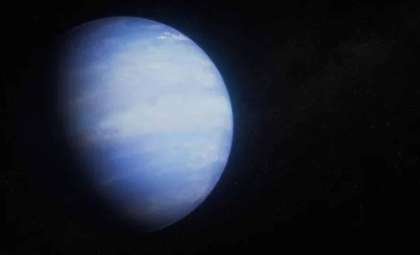
First spotted in 2016, WASP-127b is a notably inflated gas giant, somewhat larger than Jupiter but considerably lighter. Its thick, expansive atmosphere makes it ideal for in-depth atmospheric research. Unlike Earth, where winds stem from temperature gradients and rotation, atmospheric phenomena on WASP-127b are shaped by far more intense forces.
The planet is thought to be tidally locked to its star, so one hemisphere constantly faces the star while the other is cloaked in permanent darkness. This arrangement leads to extreme atmospheric dynamics as winds circulate heat from the scorching day side to the frigid night side. Even so, the measured wind velocities took scientists by surprise.

The Swiftest Jetstream Ever Observed Beyond Earth
Using the European Southern Observatory’s Very Large Telescope (VLT) in Chile, researchers detected jetstream winds moving near 9 kilometers per second along the planet’s equator. Lisa Nortmann, who leads the team from the University of Göttingen, remarked on the discovery:
“Part of the atmosphere of this planet is moving towards us at a high velocity while another part is moving away from us at the same speed. This signal shows us that there is a very fast, supersonic, jet wind around the planet’s equator.”
To compare, the quickest winds recorded in our Solar System, such as those on Neptune, reach approximately 1,800 kilometers per hour (1,118 miles per hour). The winds on WASP-127b are nearly 18 times faster, moving at velocities comparable to the swiftest meteoroids.
Unveiling the Atmospheric Structure
The breakthrough was made possible with the help of the CRIRES+ instrument attached to the VLT, allowing scientists to study how starlight interacts with the atmospheric gases. By examining specific light wavelengths absorbed and emitted by molecular species, the team detected the presence of water vapor and carbon monoxide. Even more striking was the observation that these molecules were traveling at extraordinary speeds, indicating a highly dynamic atmosphere.
The data revealed an unexpected double peak, with one side of the atmosphere moving towards Earth and the other side receding, confirming a supersonic jetstream encircling the equator instead of a simple heat transition from day to night.
Intricate Weather Systems Emerge
Alongside the astonishing wind speeds, the study detected temperature differences across the atmosphere. The poles appeared cooler than the equatorial region, and the thermal contrast between morning and evening hemispheres suggested sophisticated atmospheric circulation. Fei Yan, co-author from the University of Science and Technology of China, noted: “This shows that the planet has complex weather patterns, just like Earth and other planets of our own system.”
These observations challenge the prior belief that exoplanet atmospheres are mostly even. Instead, WASP-127b exhibits a vibrant and tumultuous climate, characterized by intricate temperature and wind interactions.
Enhancing Our Understanding of Exoplanet Climates
Capturing such extreme weather phenomena on a remote world highlights the tremendous progress in exoplanetary science. Just a few years prior, researchers could only approximate a planet’s mass and size, leaving its atmosphere largely unexplored. Now, with advanced ground-based instruments like the VLT, scientists can chart weather patterns on planets located hundreds of light-years away.
Interestingly, achieving this level of detail remains challenging for space-based observatories such as the James Webb Space Telescope (JWST). Ground facilities like the VLT continue to be indispensable for capturing fine-scale details like wind velocity and atmospheric makeup.
David Cont, a scientist at Ludwig Maximilian University of Munich, emphasized the broader implications:
“Understanding the dynamics of these exoplanets helps us explore mechanisms such as heat redistribution and chemical processes, improving our understanding of planet formation and potentially shedding light on the origins of our own Solar System.”
- Categories:
- Space







0 comments
Sign in to Comment