

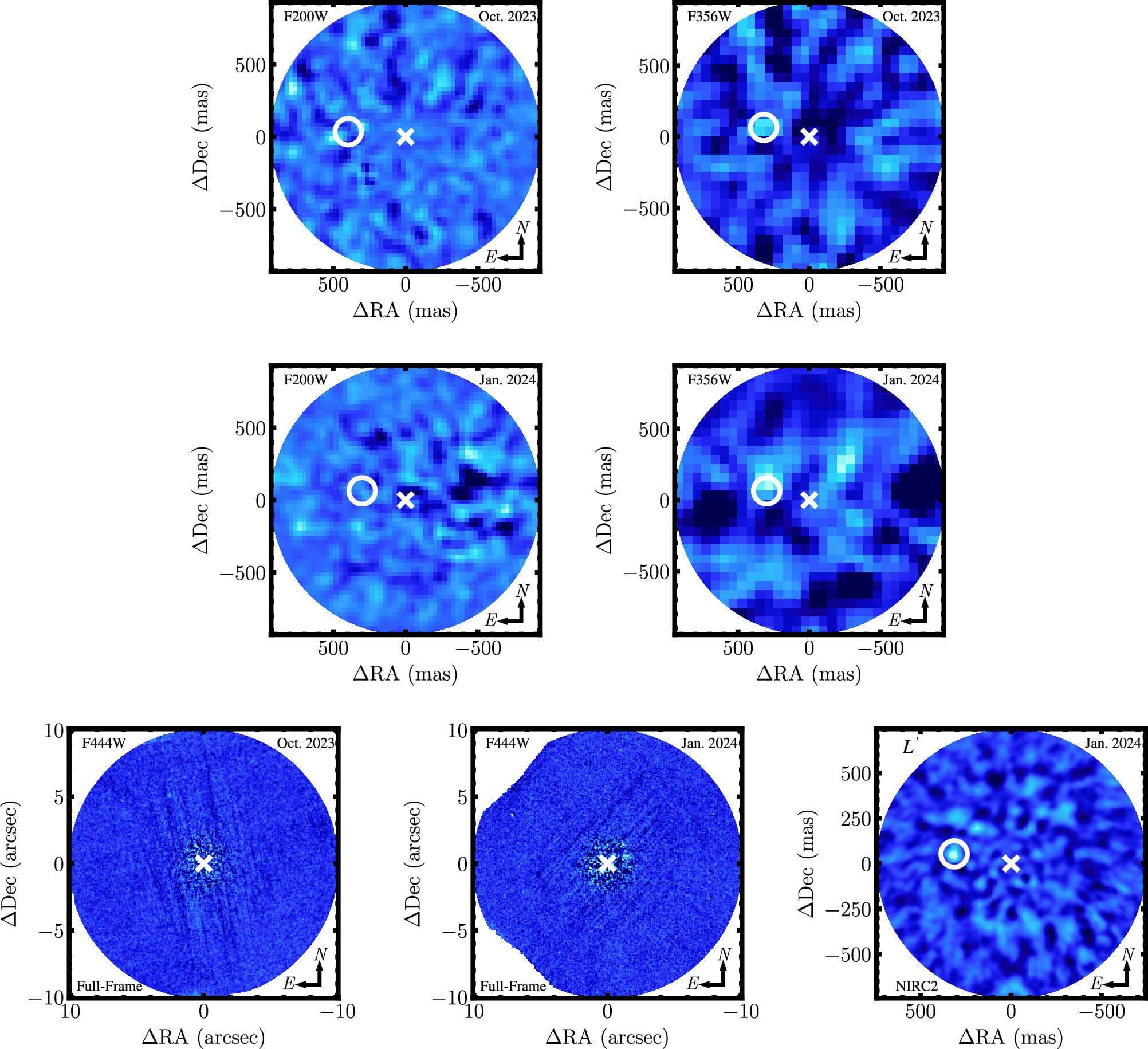
Researchers have obtained a direct photograph of AF Leporis b (AF Lep b), a youthful exoplanet orbiting a star located 88 light-years from our planet. This gas giant holds the distinction of being the lowest-mass exoplanet ever directly photographed by the James Webb Space Telescope (JWST), notable also for its close orbit around its host star. Weighing roughly 3.2 times Jupiter's mass, it was observed during a narrow observational window before its orbit brings it too near the star, making imaging impossible for at least ten years.
Examining a Young World with Pioneering Techniques
AF Lep b stands out not only for this direct imaging but because it is comparatively young at just 23 million years old. For contrast, Jupiter in our solar system is about 4.6 billion years old. This youthful age renders AF Lep b brighter, as younger gas giants retain more heat, making them easier to detect despite being close to their stars.
What complicated the detection was its tiny angular distance from the star as viewed from Earth. Kyle Franson, a researcher at the University of Texas at Austin, explains, “AF Lep b sits right at the threshold of detectability. Despite JWST's extraordinary sensitivity, it is smaller than Earth’s most massive ground telescopes, and observing longer wavelengths causes a blurring effect. It’s challenging to distinguish the planet’s faint light from the star’s glare when they're so close.”

To manage this, the team employed a coronagraph, a tool that blocks the star’s strong light, enabling the faint planetary light to emerge. Although this method reduced the planet’s light by over 90%, astronomers successfully gathered crucial observations just before the planet’s orbit renders it invisible for years. AF Lep b’s orbital period spans roughly 25 Earth years, so it may become a decade or more before it appears on the far side of the star where it can be imaged once again.
Urgency Behind the Observation
Due to the pressing nature of capturing AF Lep b before it moved behind the star, the team applied for special observational allotment called Director’s Discretionary Time. This time slot is reserved for urgent, high-impact projects. Despite fierce competition, the group secured this rare opportunity. Brendan Bowler, an astronomer at the University of Texas and co-author of the investigation, noted the importance: “Before JWST’s launch, it was uncertain if it could compete with large ground-based telescopes at such tight separations. We truly pushed the instrument’s capacity here.”
Securing images was difficult; although JWST is powerful, AF Lep b’s proximity to its star meant substantial reduction in observed light by the coronagraph. Still, the team managed to not only capture photos but also analyze the planet’s atmospheric properties. These data, collected between October 2023 and January 2024, unveil the planet’s location and atmospheric details.
Insights into the Planet’s Atmospheric Composition
Significantly, the observations revealed elevated levels of carbon monoxide in AF Lep b’s upper atmosphere. William Balmer, a Johns Hopkins University graduate student and study co-author, said, “We detected far more carbon monoxide than we anticipated. This indicates strong atmospheric updrafts transporting gas from lower layers upward.” This points toward an active atmosphere driven by convection currents that mix gases vertically.
Such vigorous atmospheric dynamics are rare among directly imaged exoplanets, particularly those with masses like gas giants in our solar system. This ability to characterize atmospheric processes on an exoplanet marks a milestone in planetary science, giving new clues about how gas giants develop and their environmental conditions early in their lifespans.
Expanding the Frontiers of Exoplanet Exploration
The successful imaging of AF Lep b highlights not only this planet’s characteristics but also the varied capabilities of the James Webb Space Telescope in exploring worlds beyond our solar neighborhood. Originally designed for distant galaxies, JWST’s capacity to image exoplanets close to their stars demonstrates its broad utility. Most exoplanets since their first discoveries in the 1990s have been found through indirect techniques, such as measuring stellar wobbles or transit dimming. Direct imaging, however, remains rare because it requires extreme sensitivity and effective starlight suppression.
AF Lep b’s brightness and relative closeness at 88 light-years made it an excellent target for JWST’s coronagraph, but capturing its image was still a formidable challenge. As Franson reflected, “JWST is among the most powerful telescopes, yet the narrow margin between the planet and star pushed our observational abilities to the edge.”
The research team anticipates many more discoveries ahead. As Bowler remarked, “These observations were made during the telescope’s second year of operation. Many more planets, both known and yet to be found, will benefit from JWST’s unique capabilities.”
This work marks a significant advance in the quest to understand exoplanets, showcasing JWST’s power and the collaborative effort behind expanding our knowledge of alien worlds. With additional observations planned, astronomers look forward to even deeper insights into planetary systems around distant stars.
- Categories:
- Astronomy ,
- News ,
- Science ,
- Nasa








0 comments
Sign in to Comment