

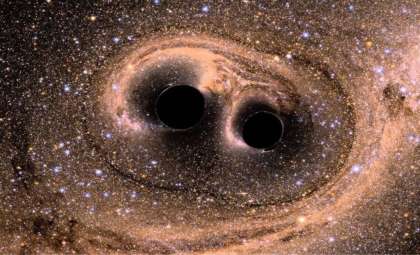
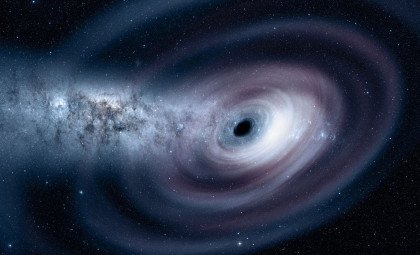
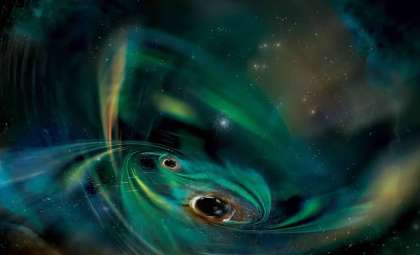
For years, astronomers have primarily regarded supermassive black holes as cosmic forces of destruction—regions where gravity dominates, matter is devoured, and intense radiation permeates the surroundings. Such harsh realms were thought to be inhospitable to planet formation. However, recent studies challenge this view, proposing that the extended disks around active supermassive black holes could potentially spawn millions of massive planets. This surprising revelation, presented in research shared on arXiv, suggests that planetary creation might be far more prolific than previously believed.
Uncovering a Planetary Nursery in Active Galactic Nuclei
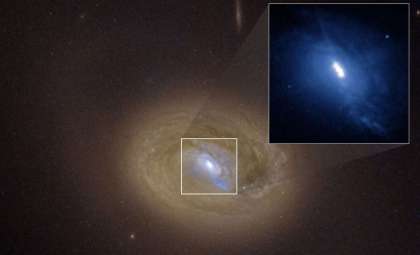
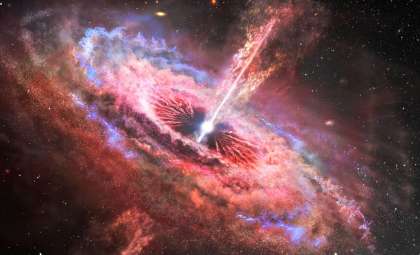
Active galactic nuclei (AGNs) are energized by supermassive black holes consuming huge quantities of gas and dust. Renowned as some of the universe’s brightest phenomena, these AGNs can outshine the combined starlight of their entire host galaxies. Typically, such environments are considered too hostile for planets to form due to extreme radiation, strong gravitational forces, chaotic gas movements, and energetic jets.
Yet, the new research reveals that the outer sections of these massive accretion disks might harbor conditions similar to those in young stellar protoplanetary disks. At an adequate distance from the black hole, temperature and density levels could allow dust particles to aggregate. Utilizing computational models, researchers simulated how dust behaves over millions of years, demonstrating that it can cluster into dense clumps that set the stage for massive planet formation.

Because AGN disks contain significantly more material than typical star disks, the number of planets born from these areas could far exceed what is produced around normal stars. Instead of forming just a few planets, these disks might generate entire populations reaching into the millions.
Streaming Instability as a Catalyst for Giant Planet Formation
The key process behind this formation is streaming instability, a phenomenon recognized in traditional planet formation that involves dust particles collecting into filaments dense enough to gravitationally collapse into planetary bodies.
The study suggests this same mechanism can operate within AGN disks on an extraordinary scale, thanks to the sheer abundance of material. Simulations forecast the birth of enormous planets, with masses equal to or greater than Jupiter.
"Our results indicate that millions of Jupiter-mass planets could emerge tens of parsecs [around 3.3 light-years per parsec] away from supermassive black holes acting as AGNs," explained Bhupendra Mishra, a researcher at the University of Colorado Boulder, during an interview with Space.com. "These massive dust-rich worlds would resemble lava spheres."
Such planets would be unlike any known types, differing greatly from Earth or the familiar gas giants in our solar system. Instead, they would be scorching, hefty objects formed from dense dust and gas accumulations in the outer zones of galactic cores. Confirming their existence would broaden the known spectrum of exoplanets and deepen our grasp of planetary formation in extreme environments.
Researchers Surprised by Vast Planetary Production
The scale of these findings astonished the scientists involved. While the theoretical possibility of planet formation near supermassive black holes has been discussed before, the magnitude revealed through these simulations was unexpected.
The research showed that the convergence of abundant raw materials and effective dust concentration could result in planet creation rates far surpassing those observed in environments around typical stars. The newly formed giant planets would likely remain stable over extensive timescales, even as they slowly migrate from their formation sites.
"We were amazed—this is the first time streaming instability has revealed such massive planet formation potential in AGN disks," stated Mishra. "My colleague, Wladimir Lyra, a renowned expert in planet formation at New Mexico State University, and I were both surprised at the scale and mass range of these planets."
This unexpected insight highlights how much remains to be learned about the peripheries of AGN disks. These regions are less understood than conventional protoplanetary disks, presenting a promising frontier for future investigation. Should this model withstand peer review, it could transform how astronomers approach the study of planet formation under the universe's most extreme conditions.
The full findings are accessible as a preprint on arXiv for further evaluation and debate within the scientific community.
Prospects for Observing These Massive Hidden Worlds
The theoretical proposal gains substantial weight when a plausible observational method exists. Detecting planets orbiting active supermassive black holes is tremendously challenging due to their great distances, the crowded environments, and overpowering emissions from the AGNs themselves.
One promising technique is gravitational lensing, a relativistic effect predicted by Einstein where massive objects bend and magnify background light. Clusters of planets within AGN disks may generate subtle lensing impacts detectable with future advanced instruments.
"Gravitational lensing may offer a way to spot these planet clusters in AGN disk outskirts, although such detections require a degree of good fortune," Mishra noted. "While challenging, I believe these planets could be observed if we deepen our understanding of this model."
The primary hurdles include not only the detection of the planets but also identifying suitable AGNs where such signals can be measured. Cutting-edge observatories and refined data analysis methods in upcoming decades may provide the needed sensitivity to reveal these mysterious planetary populations across distant galaxies.
- Categories:
- Astronomy


0 comments
Sign in to Comment