

On the early morning of Wednesday, August 14, 2024, observers worldwide will have the chance to witness a remarkable astronomical event: a close planetary pairing between Jupiter and Mars.
This occurrence, known as a planetary conjunction, happens when two planets appear near one another in the Earth’s sky due to their orbital positions.
During this conjunction, the immense gas giant Jupiter and the reddish rocky planet Mars will be separated by only about one-third of a degree—narrower than the diameter of the full moon—offering an impressive spectacle just before dawn.

Understanding the Science Behind the Close Planetary Approach
A planetary conjunction takes place when two planets line up along our line of sight, making them appear adjacent from Earth's point of view. This effect arises from the way planets orbit the Sun at different speeds and distances.
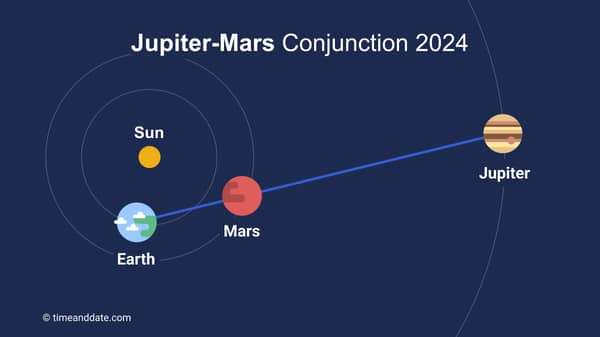
Although Jupiter and Mars are separated by hundreds of millions of miles, their orbital paths create the illusion from Earth that they are nearly touching.
Tips for Viewing the Jupiter-Mars Conjunction
Maximizing your viewing experience requires some planning. The prime time to see this pairing is during the early morning hours of Wednesday, August 14.
Both planets will become visible just before 1 a.m. local time, rising in the eastern sky against the backdrop of the Taurus constellation. By around 3 a.m., the conjunction will be ideally positioned for observation.
NASA reports that the best viewing conditions will be in regions across the contiguous United States with clear, dark skies.
This conjunction doesn’t require any optical instruments; both Jupiter and Mars will be bright and clearly visible to the naked eye as luminous points.
For a more immersive spectacle, binoculars or a telescope are excellent tools, enabling viewers to see both planets within the same field. Despite their apparent closeness, these worlds are actually about 300 million miles apart.
Why Planetary Conjunctions Are Infrequent and Fascinating
Planetary conjunctions involving bright planets like Jupiter and Mars are uncommon and draw attention from amateur and professional skywatchers alike. Since the year 2000, there have been only 11 occurrences of such close approaches between these two planets. Their scarcity results from the precise orbital alignments needed.
The planets’ paths must align exactly, an event that happens only at specific intervals, lending these conjunctions their uniqueness.
The upcoming August 14, 2024, conjunction stands out because of the unusually close proximity of Jupiter and Mars, a phenomenon that won’t be matched until November 15, 2026, when they’ll appear farther apart.
Why This Event Captivates Astronomy Fans
Anyone passionate about the night sky or astronomy will find the August 14 Jupiter and Mars conjunction an unmissable event. It not only offers a breathtaking view but also encourages public engagement with the wonders of our solar system.
Such occurrences serve as compelling reminders of the grandeur and scale of the cosmos, fostering curiosity and a deeper appreciation for celestial phenomena.
For scientists, planetary conjunctions present opportunities to study planetary motions and observe unique visual arrangements. For casual observers, it’s a perfect chance to connect with the universe and witness the captivating movements of our neighboring worlds.
Insights into Our Solar System from this Conjunction
The close appearance of Jupiter and Mars highlights the constantly changing nature of our solar system. The Sun’s gravitational influence governs planetary orbits, generating complex movements that occasionally align to create these stunning sky events.
Watching this conjunction offers a better understanding of how planets travel through space and the intricate gravitational forces at work. It reminds us of the interconnectedness between celestial bodies and how subtle orbital shifts can produce spectacular phenomena visible from Earth.
- Categories:
- Astronomy ,
- News ,
- Space ,
- Nasa









0 comments
Sign in to Comment