

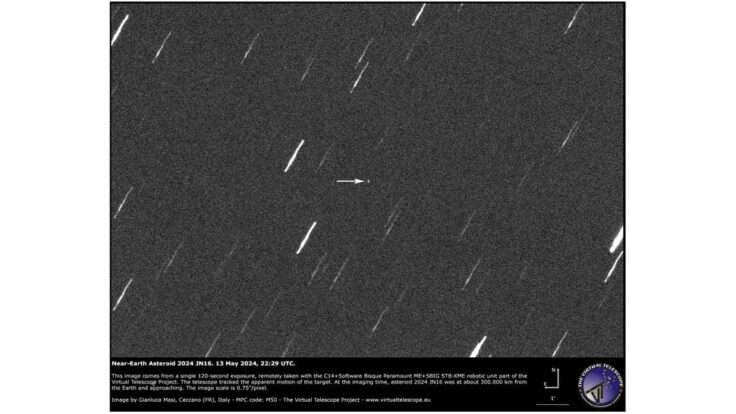
On May 14, a small asteroid roughly the size of a compact car, named 2024 JN16, passed extremely close to our planet. This rare occurrence allowed astronomers to closely monitor an object coming within just 18,500 kilometers of Earth’s surface—closer than many satellites that orbit at around 36,000 kilometers altitude.
Initial Detection and Features
2024 JN16 was initially identified by amateur astronomer Gennadiy Borisov at the MARGO observatory in Crimea. With a diameter under four meters, this space rock belongs to the Apollo asteroid group, which is characterized by their Earth-crossing orbital paths. Apollo asteroids are intriguing due to their close proximity to Earth and relatively short cosmic lifespans, approximately 10 million years, because of their higher likelihood of collisions within the solar system.
Close Approach Observations
The asteroid reached its nearest point at 11:50 AM Paris time, shining at a magnitude of 13, bright enough to be seen with telescopes. This allowed researchers to study its path and physical details carefully. Notably, during the flyby, 2024 JN16 passed inside the Moon’s orbit and appeared at about half the distance of geostationary satellites, providing a unique observational opportunity.

Current Location and Ongoing Monitoring
Following the close pass, 2024 JN16 has moved quickly away and is now over 300,000 kilometers from Earth, situated near the Serpens constellation. At present, its detection requires advanced long-exposure imaging due to its faint visibility.
This brief visit from 2024 JN16 underscores the complex and ever-changing environment of our solar system. It also highlights the crucial role that cooperation between amateur enthusiasts and professional scientists plays in tracking near-Earth objects (NEOs), which is essential for assessing potential hazards and advancing space research.
https://theskylive.com/where-is-2024jn16
- Categories:
- Astronomy ,
- News ,
- Space











0 comments
Sign in to Comment