
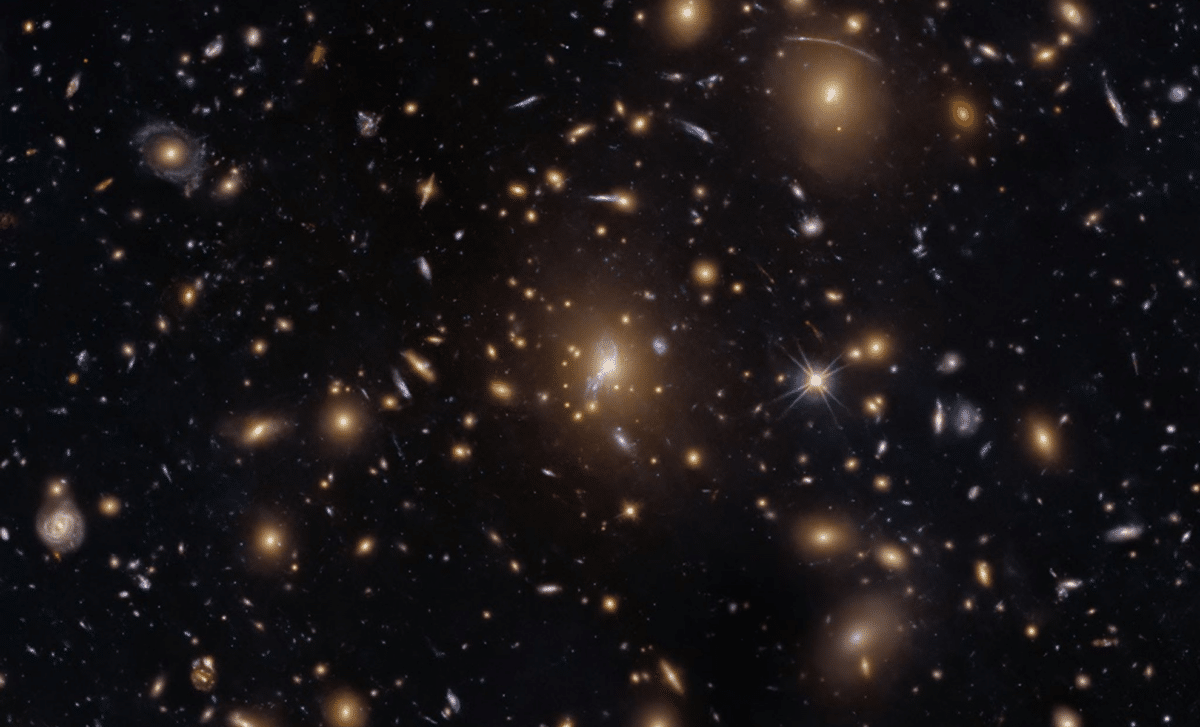
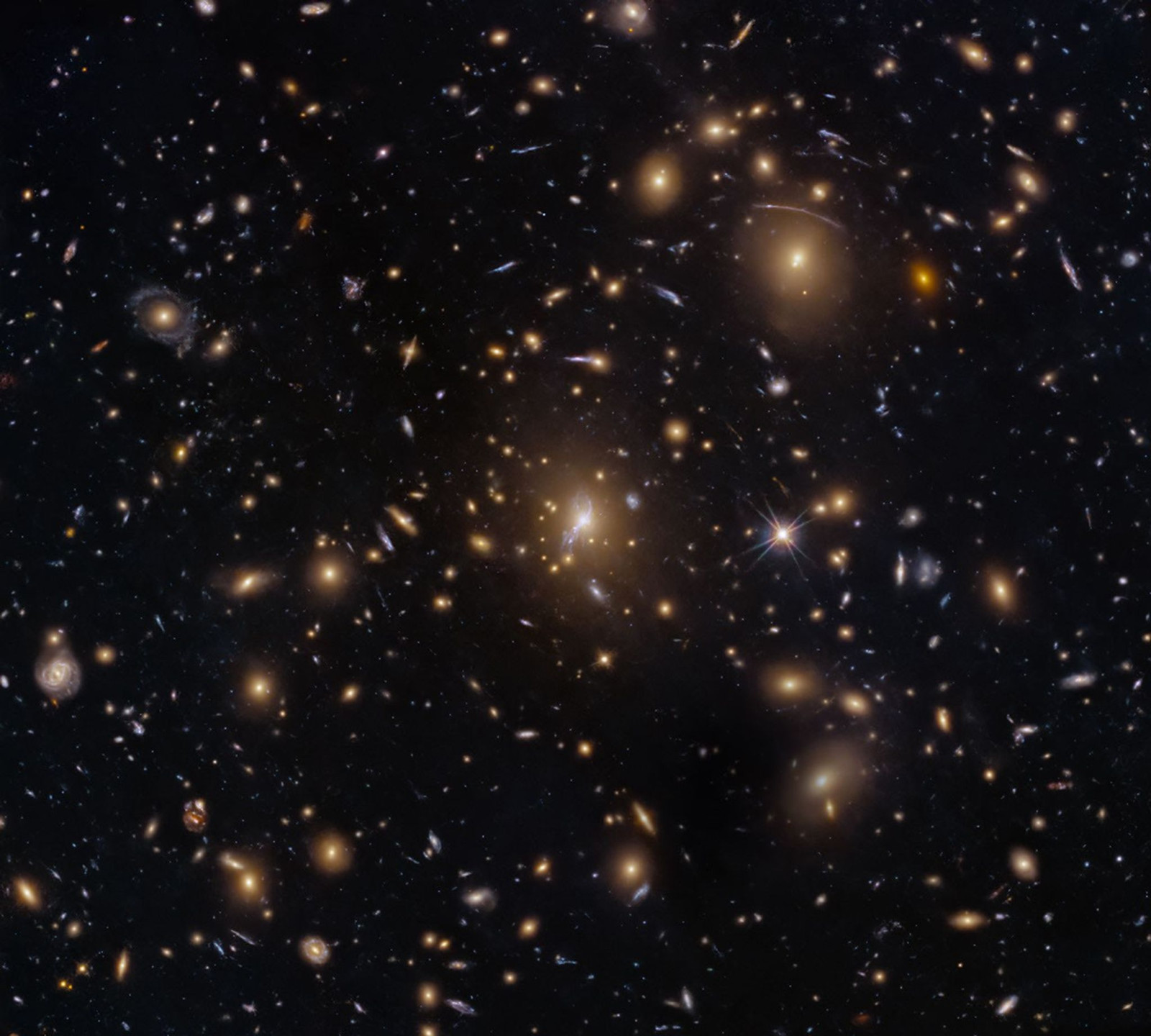
A recent photograph captured by NASA’s Hubble Space Telescope showcases MACS0329-0211, an enormous galaxy cluster whose powerful gravitational field allows scientists to study regions of the universe far beyond ordinary observational limits. This cluster is more than just a striking array of galaxies—it acts as a cosmic lens, bending and intensifying light from distant celestial objects billions of light-years away.
A Dense Collection of Galaxies Crafting an Astounding Cosmic Display
At a cursory glance, the image appears to show a wide spread of bright spots dispersed throughout the cosmos. Upon closer examination, many of these lights are whole galaxies congregated within MACS0329-0211. This cluster includes a rich variety of galaxy types, ranging from massive elliptical shapes to intricately detailed spirals with distinct arms. Some galaxies are oriented edge-on, manifesting as slim beams of light, while others face Earth head-on, revealing their full form. The complexity evident here emphasizes the vast scale of galaxy clusters, which are among the universe’s largest gravitationally bound systems. Each galaxy contains billions of stars, collectively forming a gravitationally influenced environment honed over billions of years.
Gravitational Lensing Transforms the Cluster Into a Natural Magnifier
A key scientific highlight visible in the photo is the faint luminous arcs encircling parts of the cluster. These arcs are a result of gravitational lensing, a process where an immense mass curves the trajectory of light passing nearby. The strong gravitational pull of MACS0329-0211 acts as an enormous lens, bending and enhancing the light from galaxies positioned far behind it.

Several of these light arcs are clearly visible in the upper-right segment of the image, where background galaxies are stretched into curved formations. Scientists study these features closely as they reveal otherwise unreachable faint objects. In some instances, lensing exposes galaxies from the earliest eras of cosmic evolution. Near the photo’s center, a bright, twisted figure-eight pattern emerges, likely created by another distant galaxy distorted by the cluster’s immense gravity. These remarkable arcs elevate the image from a visual wonder to a potent instrument for research.
The Instruments and Efforts Behind NASA and Hubble’s Discovery
Based on information shared by NASA, this observation was part of a study focusing on galaxy clusters bright in X-ray emissions. To achieve this, astronomers utilized Hubble’s two main cameras: the Advanced Camera for Surveys and the Wide Field Camera 3. These tools captured images in both visible and infrared light, enabling researchers to analyze diverse properties of the cluster and its galaxies. Hubble’s multi-wavelength capability is crucial, as visible light reveals galactic structures and shapes, while infrared can peer through cosmic dust and detect fainter, more ancient objects whose light has shifted due to the universe’s expansion. By merging these observations, scientists form a detailed understanding of the cluster’s makeup and dynamics. The resulting image not only provides stunning visual clarity but also yields data essential for studying mass distribution, probing dark matter, and refining theories of cosmic progress.
- Categories:
- News




0 comments
Sign in to Comment