
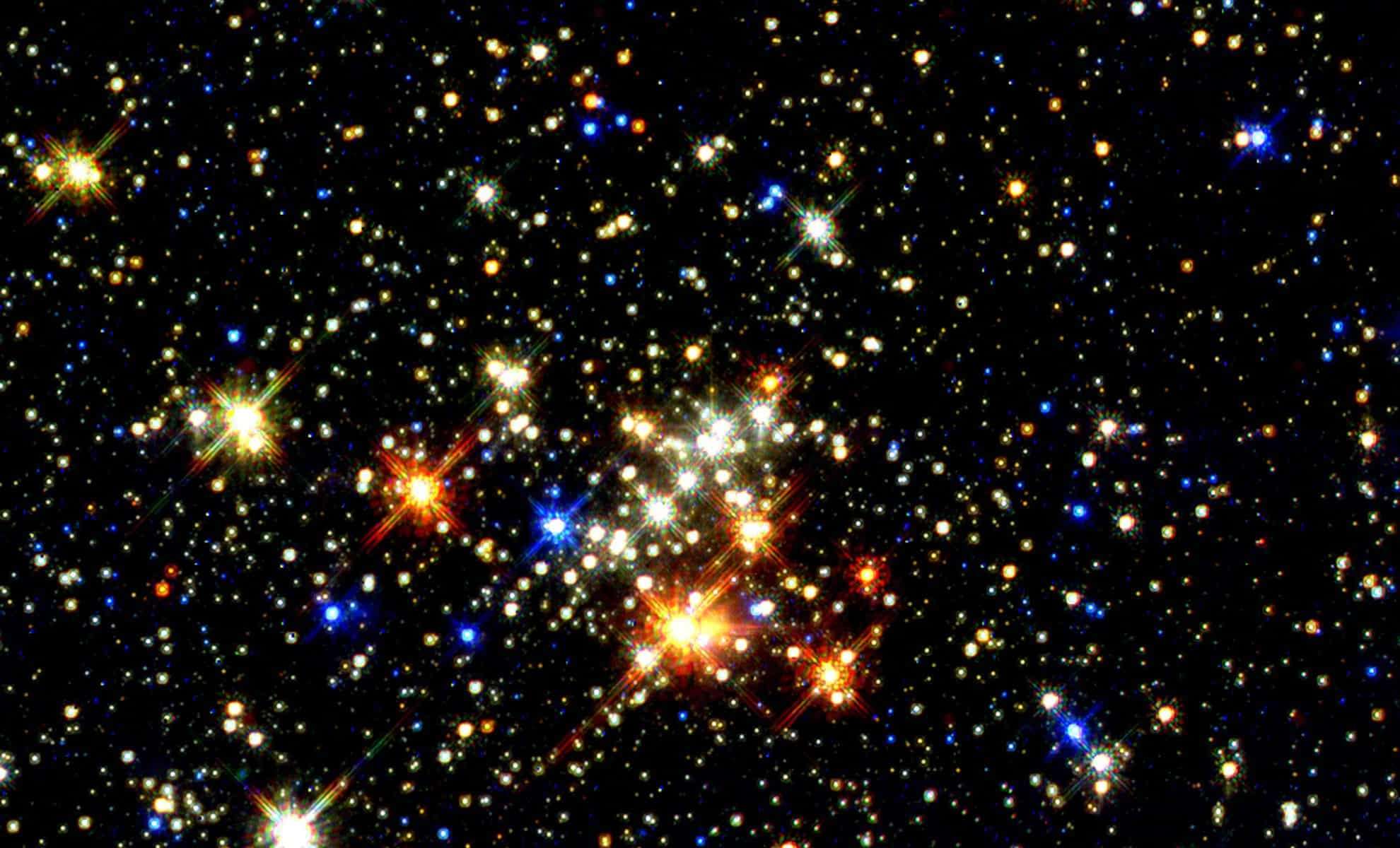
Scientists have uncovered an extraordinary mini-halo feature within the Abell 3558 galaxy cluster through extensive radio wave studies. This unusual radio emission resides at the cluster's core and was identified after in-depth observations using cutting-edge radio instruments.
Exploring the Vast and Intricate Abell 3558 Cluster
Abell 3558, also known as A 3558, is an enormous galaxy cluster located around 700 million light-years from Earth. With a redshift near 0.047, this cluster hosts thousands of galaxies gravitationally bound together. As one of the universe’s largest gravitational assemblies, such clusters offer astronomers vital insights into galaxy development and cosmic evolution.
This latest study, led by Keegan Trehaeven from Rhodes University in South Africa, examined the diffuse radio signals emanating from Abell 3558’s core. Previous detections of this emission were explored in far greater detail, utilizing instruments such as the MeerKAT radio telescope and the Upgraded Giant Metrewave Radio Telescope (uGMRT), capturing data across several radio frequency bands.

Extensive Emission Detected through Advanced Observations
Published on July 10, 2025, via the arXiv server, the observations revealed that the radio emission extends over an astonishing 1.8 million light-years—ranking among the largest radio emissions observed in galaxy clusters.
The emission exhibits a radio power of 68 ZW/Hz at 1.4 GHz, indicating a robust radio signal more complex than previously understood. Additionally, astronomers discovered a subtle northern elongation of the emission surpassing the cluster’s inner cold front boundary.
Investigating the Source of the Mini-Halo’s Radio Emission
The origin of Abell 3558’s diffuse radio emission is a crucial question in this research. The team identified a spectral index of 1.18 within the emission, indicating variations in radio frequency intensity across the cluster. Close to the X-ray cold front, a flatter spectral region suggests turbulent re-energizing of gases, potentially driven by gas sloshing—where gravitational impacts disturb the intracluster medium, stirring turbulent motions.
Outside the flatter emission zone, researchers observed a steeper spectral slope filling an X-ray cavity, an area marked by higher temperature and reduced pressure. These signs point to extensive sloshing-induced turbulence shaping the complex and sprawling radio emission.
Mini-Halo Confined by Chilly Fronts in the Cluster Core
From the observations, the scientists deduced that the diffuse radio signals form a mini-halo structure characteristic of dynamically settled clusters without recent major mergers. Mini-halos are believed to be energized primarily by turbulence associated with gas sloshing, complemented by feedback from active galactic nuclei (AGN).
Within Abell 3558, this mini-halo appears confined by cold fronts—denser, cooler gas regions in the cluster’s core. The alignment of the radio emission with zones of low-entropy gas supports the hypothesis of large-scale sloshing turbulence contributing to the mini-halo’s formation.
- Categories:
- News









0 comments
Sign in to Comment