
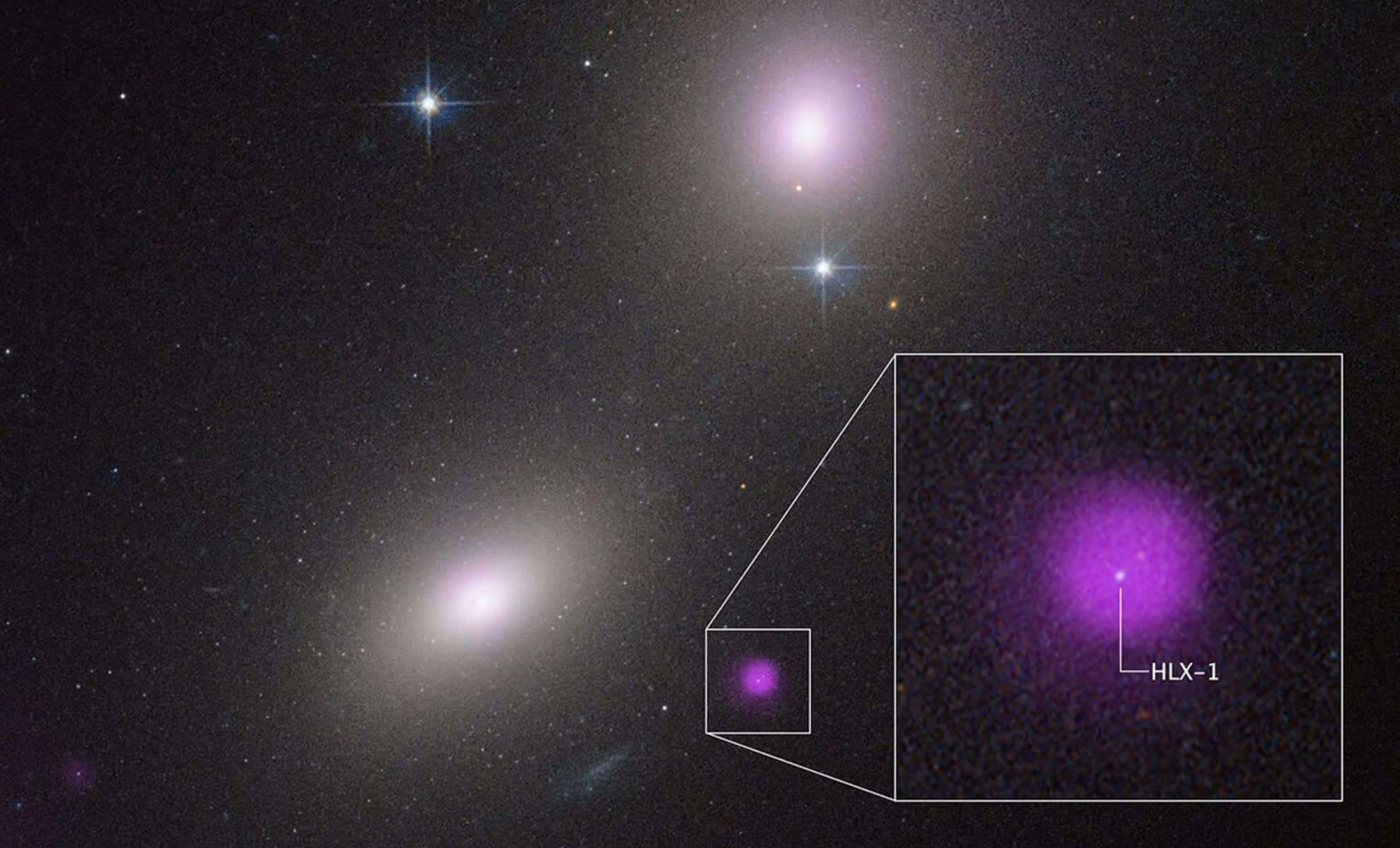
Scientists utilizing data from NASA’s Hubble Space Telescope alongside the Chandra X-ray Observatory have identified a seldom-seen intermediate-mass black hole (IMBH) within a compact star group of the remote NGC 6099 galaxy. This black hole, named NGC 6099 HLX-1, lies roughly 40,000 light-years from the galaxy’s nucleus, about 450 million light-years away in the Hercules constellation. Its detection arose from observing a tidal disruption event, where it consumed a star and emitted a powerful X-ray flare. Published in The Astrophysical Journal, this finding advances understanding of IMBHs, which have been notoriously difficult to detect due to their relatively quiet nature.
Cracking the Puzzle of Intermediate-Mass Black Holes
Intermediate-mass black holes occupy the mass range between stellar black holes—up to about 100 solar masses—and the supermassive black holes that dominate galactic centers at billions of solar masses. With masses spanning several hundred to a few hundred thousand Suns, these IMBHs have long eluded astronomers. Unlike their larger counterparts, they lack sufficient accretion material to generate prominent radiation, making them challenging to spot.
The discovery of NGC 6099 HLX-1 represents a significant stride in black hole research. Lead author Yi-Chi Chang from National Tsing Hua University, Taiwan, explained, “X-ray sources emitting such intense luminosity beyond galaxy nuclei are uncommon and serve as essential markers for uncovering hidden IMBHs. They fill a vital gap in our understanding of black hole evolution between stellar mass and supermassive black holes.” This discovery offers valuable clues about the development and dynamics of intermediate black holes and their importance in cosmic evolution.


How Tidal Disruption Events Reveal Hidden Black Holes
When an IMBH draws in a nearby star, the star undergoes immense gravitational forces that tear it apart in a dramatic tidal disruption event (TDE). This cataclysmic process produces a burst of radiation, offering astronomers a rare chance to detect the otherwise invisible black hole. Since black holes typically remain dark unless actively consuming matter, observing these energetic episodes is critical for their identification.
For NGC 6099 HLX-1, an intense X-ray glow signaled the disruption. The Chandra X-ray Observatory initially noted an unusual X-ray source in 2009. Subsequent detailed observations by Hubble and the XMM-Newton observatories uncovered the event’s full extent. The source’s brightness surged by about 100 times in 2012, before gradually fading over subsequent years.
Roberto Soria, co-author and scientist at the Italian National Institute for Astrophysics (INAF), reflected on the findings: “If an IMBH is feeding on a star’s gas, how long does the process take? HLX-1 was relatively bright in 2009, then peaked drastically in 2012, followed by a decline. The key question now is whether these flares repeat or if this was a singular event fading away.”
Tracking changes in the black hole’s brightness offers valuable data on how IMBHs consume matter and emit energy, aiding in refining theoretical models of their behavior.
IMBHs Provide Vital Clues to Black Hole Origins
The detection of NGC 6099 HLX-1 could illuminate the broader mystery of how black holes form and evolve. One theory proposes that IMBHs serve as progenitors to supermassive black holes, gradually expanding through mergers with smaller black holes until reaching colossal sizes found at galactic centers.
An alternate hypothesis suggests that in the early universe, dense gas clouds within dark matter halos could collapse directly into supermassive black holes, bypassing the intermediate stages of star formation. Support for this scenario has grown with observations from NASA’s James Webb Space Telescope, which revealed massive black holes emerging shortly after the Big Bang, counter to slower growth models.
Understanding the role of IMBHs remains vital. Soria noted, “If we are fortunate, future discoveries of free-floating black holes brightening due to tidal disruption events will allow statistical studies, revealing their population numbers, disruption rates, and how larger galaxies develop through smaller galaxy mergers.” This emphasizes the necessity for ongoing monitoring to grasp galaxy and black hole evolution throughout cosmic history.
- Categories:
- News







0 comments
Sign in to Comment