

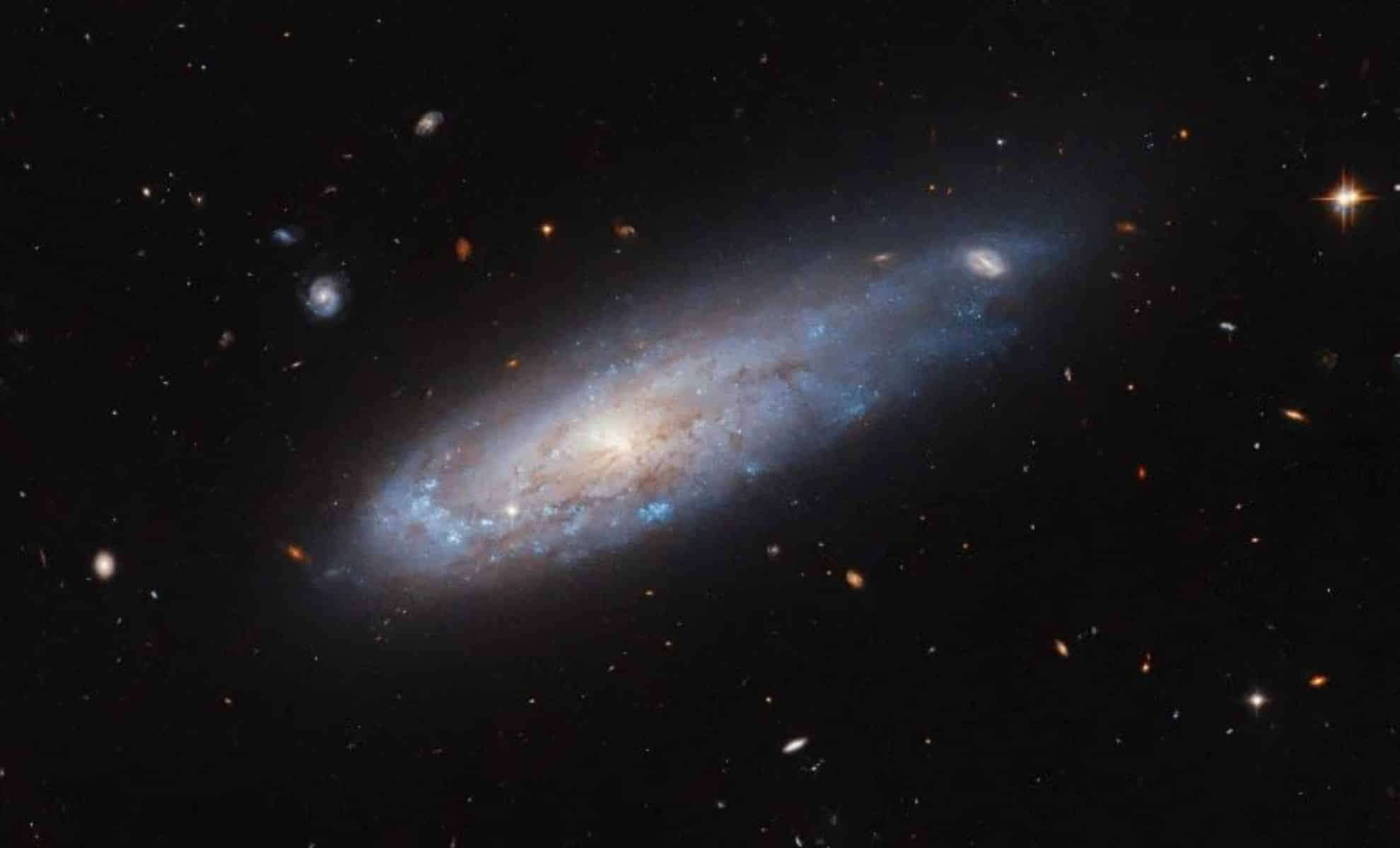
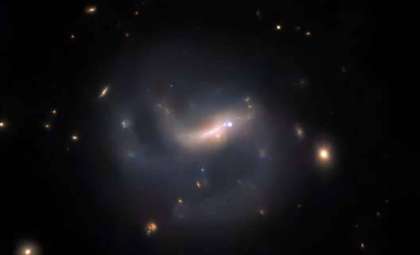
The Hubble Space Telescope has unveiled a striking image of the spiral galaxy IC 3225, appearing as if it’s hurdling through space propelled by powerful cosmic forces.
Situated in the crowded Virgo galaxy cluster, roughly 100 million light-years away, IC 3225 offers astronomers a vivid illustration of how intense gravitational dynamics impact galaxies within dense clusters. As this galaxy zooms through the cluster, it experiences ram pressure stripping—a process that strips away gas from its disk, leaving behind a tail reminiscent of a comet’s trail.
Understanding the Movements Within the Virgo Cluster
IC 3225 resides in the extensive Virgo galaxy cluster, a massive collection of over 1,300 galaxies. This environment is enveloped by a hot, diffuse gas known as the intracluster medium, which fosters energetic gravitational interactions between its member galaxies. While they traverse this medium, galaxies like IC 3225 undergo strong ram pressure, which strips away their interstellar gas and alters their morphology. The recent Hubble photo of IC 3225 clearly shows its disk compressed on one side, signaling that it has been shaped by this stripping effect.

Researchers studying this image observed that IC 3225 appears as if it’s been propelled at high speed, trailing gas that resembles a comet’s tail. Although the galaxy is not currently positioned near the cluster’s densest regions—where ram pressure forces are most intense—its distorted shape reveals evidence of past encounters with these powerful environmental effects.
Ram Pressure Stripping’s Role in Halting Star Formation
Ram pressure stripping plays a pivotal role in the evolutionary trajectory of cluster galaxies. As IC 3225 moves through the surrounding hot intracluster gas, frictional forces remove the galaxy’s gas, which is essential for sustaining star formation. This depletion can progressively reduce the galaxy’s ability to birth new stars, changing its physical characteristics.
Observations indicate enhanced star formation on the side of IC 3225 facing its direction of travel, likely caused by gas compression due to ram pressure. This phenomenon is typical for galaxies subjected to this process. Conversely, the galaxy's opposite side appears elongated, revealing the stresses exerted by the cluster’s gravitational field. Ongoing interactions may continue reshaping IC 3225’s disk and modulating its star formation activity as it journeys through the Virgo cluster.
Gravitational Encounters and Galaxy Transformation
The image of IC 3225 provides compelling evidence of the formidable cosmic forces that influence galaxy morphology. Alongside ram pressure stripping, gravitational encounters with neighboring galaxies probably contribute to IC 3225's distorted shape. Given the dense nature of the Virgo cluster, galaxies often experience close interactions that lead to further structural changes. Astronomers hypothesize that a near-miss encounter with another galaxy might have amplified IC 3225's current form, highlighting the tumultuous environment in these clusters.
One expert noted, “This twisted galaxy exemplifies the tremendous forces at play on a cosmic scale, capable of propelling and reshaping entire galaxies.” The Hubble Space Telescope, with its exceptional imaging power, continues to document such dramatic galactic events, enhancing our understanding of how galaxies evolve within the universe’s bustling clusters.
- Categories:
- Astronomy ,
- News ,
- Nasa




0 comments
Sign in to Comment