
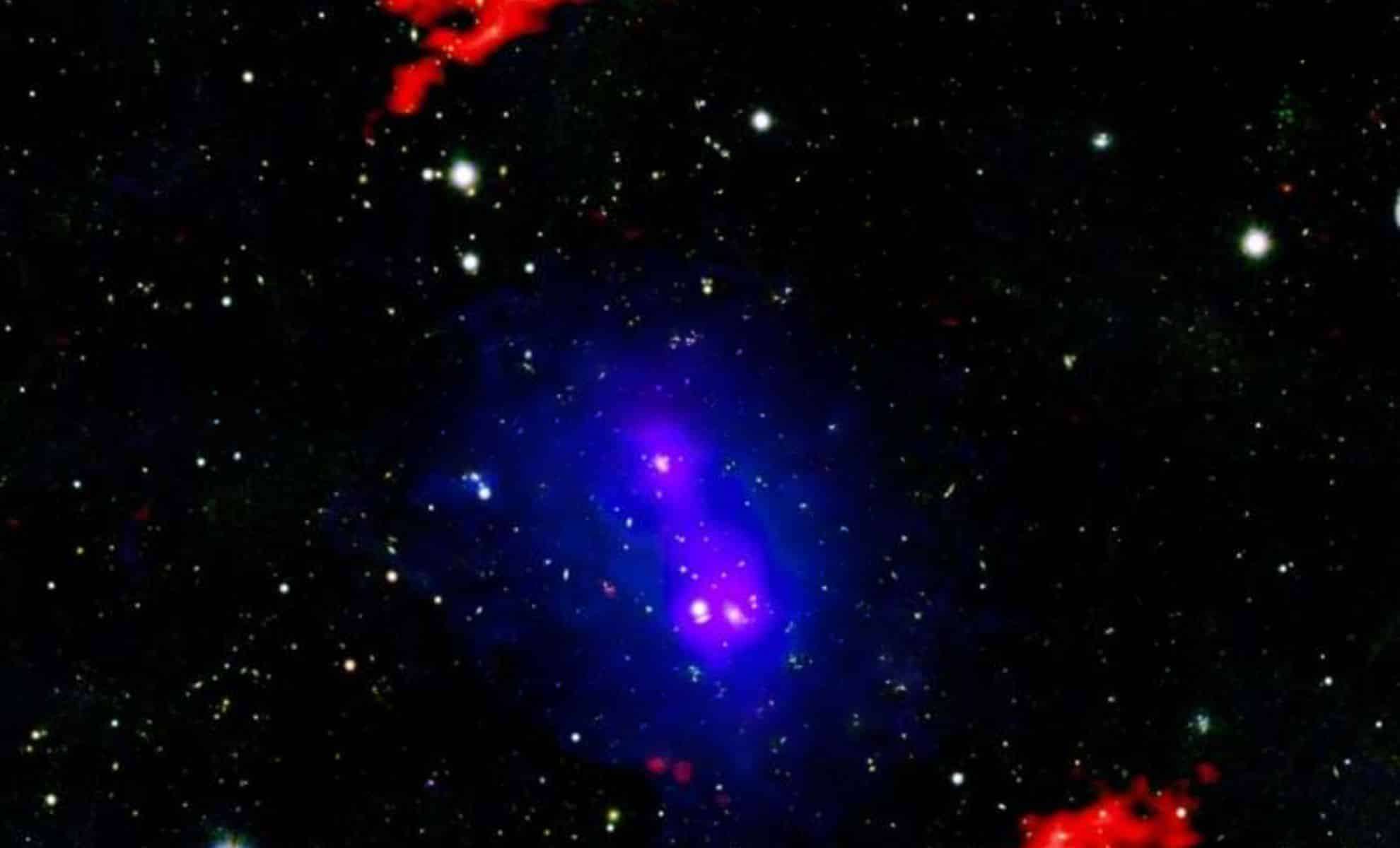
NASA’s Chandra X-ray Observatory, alongside other cutting-edge telescopes, has revealed a remarkable cosmic phenomenon: two enormous galaxy clusters, known as PSZ2 G181.06+48.47, are not just approaching one another—they have already endured an initial impactful collision. Situated 2.8 billion light-years away, these clusters present a rare chance to examine the powerful processes governing galaxy evolution, dark matter, and the complex interplay within vast cosmic structures.
Featured in The Astrophysical Journal in June 2025, the research reveals that following their first encounter, the two clusters are now set to collide once more. This finding offers new perspectives on the behavior of galaxy clusters and enriches our comprehension of some of the universe’s most profound phenomena.
An Uncommon Cosmic Interaction: A Pair of Galaxy Clusters in Collision
Galaxy clusters rank among the universe's grandest assemblies, made up of thousands of galaxies, vast quantities of heated gas, and elusive dark matter. Bound by gravity, their interactions shed light on the cosmos' intricate workings. The recent observation of PSZ2 G181.06+48.47 stands out as one of the most captivating in recent years. At a distance of 2.8 billion light-years, this cluster has been closely monitored as it experiences a rare, complex encounter with another cluster.

Following a collision that took place around one billion years ago, the clusters have been moving apart. Yet fresh observations from NASA’s Chandra X-ray Observatory and ESA’s XMM-Newton telescope indicate that their separation is slowing, placing them on a trajectory toward a second collision. This stage opens an unprecedented window for scientists to explore the evolving dynamics as these massive structures interact once again.
Shockwaves Marking a New Phase in the Collision
The merging of galaxy clusters generates shockwaves and disturbances in the superheated gas occupying the space between them. These shock fronts are vital to understanding the energy released in these colossal events. In the case of PSZ2 G181.06+48.47, researchers identified shockwaves analogous to those formed when aircraft surpass the speed of sound. These fronts, stemming from the initial impact, continue expanding and their interaction with surrounding gas reveals fundamental details about the involved forces.
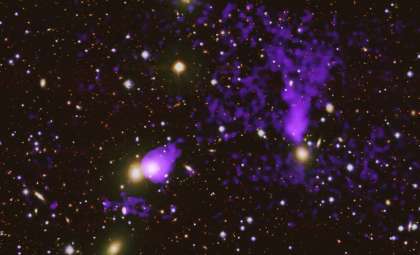
Combining data from Chandra and the LOw Frequency ARray (LOFAR), scientists observed unique shock fronts along the cluster’s periphery. NASA’s Chandra X-ray Observatory captured X-ray emissions in purple hues, while XMM-Newton contributed complementary X-ray data in blue. These, paired with LOFAR’s radio signals highlighted in red and visual data from Pan-STARRS, form a comprehensive image illustrating the collision’s scope.
Remarkably, the shock fronts have spread across a staggering distance of 11 million light-years—the largest separation recorded for shockwaves from galaxy cluster collisions. These structures, generated by gas disturbance during the initial encounter, continue outwards, providing fresh insights into the physics governing interactions among massive galaxy clusters.
- Categories:
- News





0 comments
Sign in to Comment