

Astronomers have uncovered six red dwarf stars exhibiting surprisingly high concentrations of lithium, an element typically depleted as these stars age. This finding suggests these stars may have recently absorbed rocky planets, leaving behind an uncommon chemical signature.
The discovery arose from investigations of red dwarfs within stellar clusters, where stars share a common origin and similar characteristics in age and composition. Detecting planetary consumption by a star is challenging because such events usually eliminate direct evidence. Instead, scientists look for subtle chemical, kinematic, or physical hints long after the fact.
Lithium Anomaly Emerges Among Vast Star Samples
Leading the research, Robin Jeffries from Keele University utilized data from the Gaia-ESO Spectroscopic Survey (GES), which collected detailed elemental metrics for thousands of Milky Way stars. Their analysis, published in Monthly Notices of the Royal Astronomical Society, centered on red dwarfs found in clusters, stars known to rapidly deplete lithium early in their lives.

Out of a refined sample of 318 red dwarfs with detectable lithium, six stars stood out with lithium levels far exceeding typical expectations.
“We found that a few of the red dwarf stars we studied contained lithium, a chemical element that should not be there,” Jeffries said in a statement published by the Royal Astronomical Society. “Therefore even a small amount of lithium stands out clearly in these stars – a bit like throwing paint onto a blank canvas.”
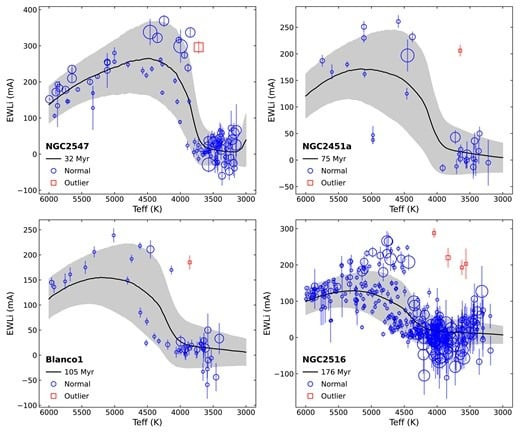
This atypical chemical presence immediately sparked interest. In older red dwarfs, fresh lithium typically indicates recent external enrichment rather than a leftover from formation.
Red Dwarfs as Unique Natural Laboratories
Investigations into stars engulfing planetary bodies fall under the field called necroplanetology. This research often targets stars at advanced evolutionary stages when remnants of consumed planets can be easier to detect.
Red dwarfs offer a novel viewpoint. They are smaller, cooler, and dimmer than sun-like stars and burn fuel much more slowly. While the Sun’s expected lifespan is around 10 billion years, red dwarfs may endure for tens to trillions of years.

A key advantage of red dwarfs is their rapid destruction of lithium. Thus, any lithium detected in these stars’ atmospheres likely represents recent addition, rather than primordial material.
This trait provides a valuable diagnostic measure. The appearance of lithium in a typical red dwarf can indicate recent external events, such as the consumption of planetary debris.
Ruled Out Other Explanations for Lithium Surplus
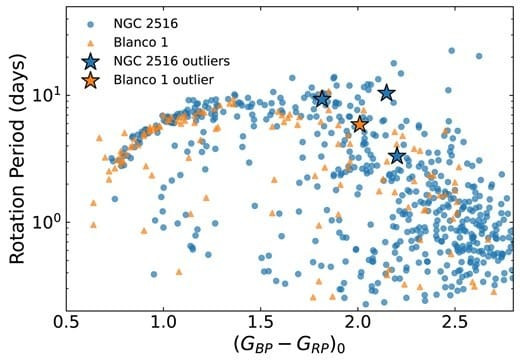
Prior to attributing the lithium excess to planetary ingestion, the research team explored alternative explanations. One hypothesis was that these stars might be younger and recently entered the clusters, as younger stars maintain higher lithium levels naturally. Analysis of stellar motion and color confirmed the stars were genuine long-term cluster members.
The team also tested whether stellar traits like rapid spin or intense magnetic fields might prevent lithium depletion by altering internal processes. However, the lithium-containing stars were found to be some of the slowest rotators, discounting this possibility.
The final analysis involved modeling whether an injection of lithium-rich material could produce the observed chemical patterns. Results indicated that swallowing an estimated three to ten Earth masses of rocky material could account for the enhanced lithium levels. This hypothesis fits the data best, supporting the idea these stars recently consumed planetary bodies.
- Categories:
- Astronomy









0 comments
Sign in to Comment