
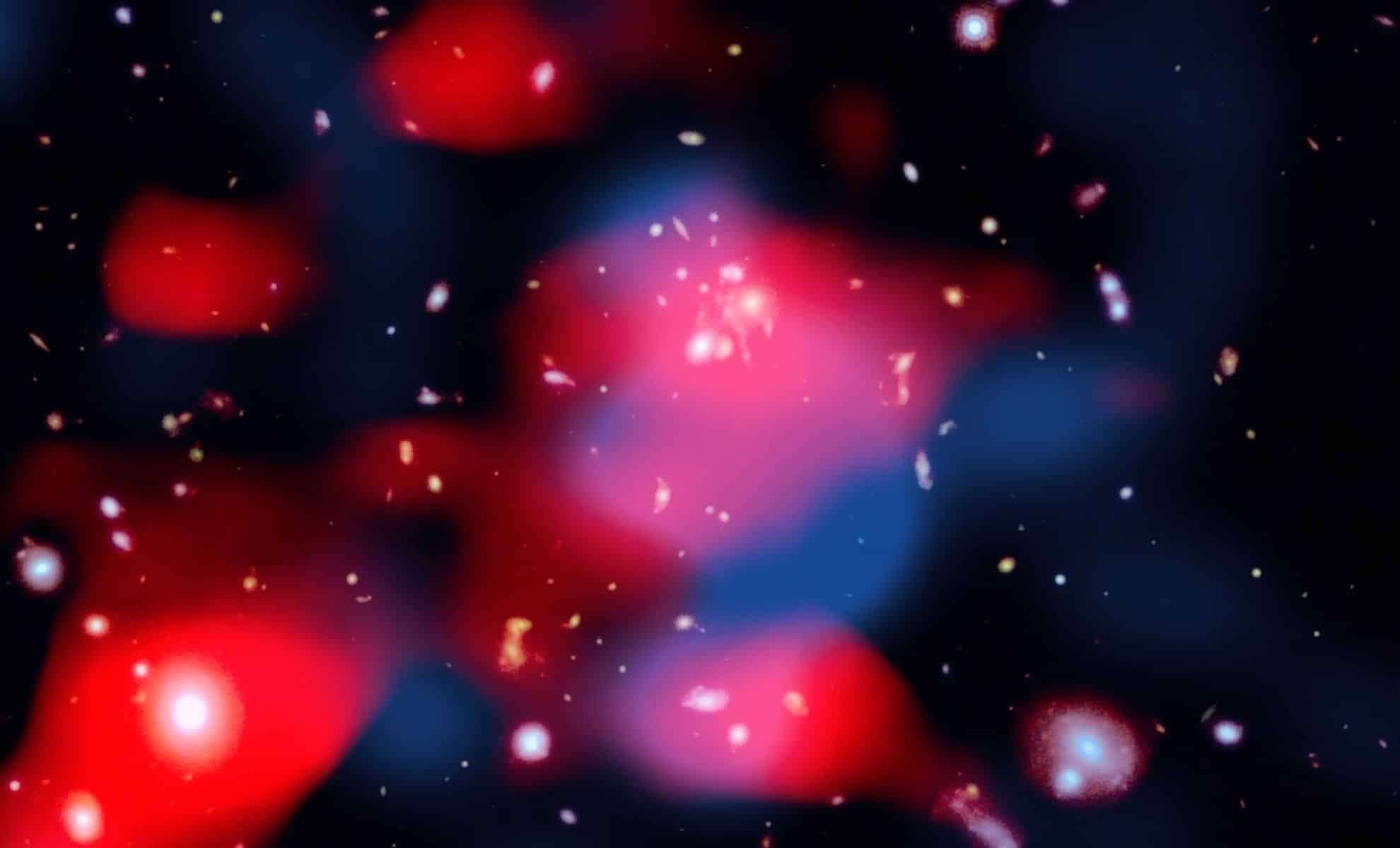
In a recent publication in The Astrophysical Journal Letters, scientists have reported the identification of a “mini halo” encircling one of the farthest known galaxy clusters. Positioned roughly 10 billion light-years from Earth, this mini halo of energetic particles and magnetic fields extends the known range for such features by a factor of two. This advancement sheds new light on the formation of galaxy clusters and reveals conditions prevalent in the cosmos’s formative eras.
The discovery was made by an international collaboration led by Julie Hlavacek-Larrondo at the Université de Montréal and Roland Timmerman from Durham University. Utilizing the advanced capabilities of the Low Frequency Array (LOFAR), a continent-wide radio telescope system across Europe, the researchers were able to detect this elusive phenomenon. Their findings deepen our comprehension of the intricate dynamics within galaxy clusters and underscore the long-lasting impact of energetic cosmic events.
Defining a Mini Halo
A mini halo is a sprawling, diffuse envelope of energized particles enveloping entire galaxy clusters. These particles produce radio emissions that can be captured by specialized Earth-based radio telescopes. The newly discovered mini halo spans over a million light-years, setting a new record for distance observed. Unlike localized emissions tied to individual galaxies, mini halos form a collective presence around the cluster as a whole.

The mini halo detected around the SpARCS1049 cluster is not connected to any single galaxy but instead originates from a broad area suffused with high-energy particles and magnetic fields. This landmark finding expands our understanding of the large-scale cosmic mechanisms responsible for shaping galaxy clusters.
Investigating Energetic Phenomena in Space
Because of its extraordinary distance, this mini halo offers critical clues about energetic processes that shaped the early universe. As Hlavacek-Larrondo explains, “Discovering such an extensive cosmic environment suggests that galaxy clusters have been enveloped by energetic particles since ancient cosmic times.” This challenges previous assumptions about the timelines of these high-energy conditions.
Scientists propose two main origins for the mini halo’s energetic particles. One hypothesis involves the jets emitted by supermassive black holes at galaxy centers, which might expel streams of particles into the cluster’s surroundings. However, how these particles retain their energy while traveling vast cosmic distances remains a puzzle.
The alternative explanation centers on collisions among charged particles within the hot plasma permeating the cluster. These high-velocity interactions could generate the observed energetic particles. Both scenarios emphasize the key contribution of intense energetic activities in the early cluster environment.
Probing the Early Cosmos Through Mini Halos
This extraordinary mini halo not only marks a milestone in astrophysics but also offers a novel approach for investigating the early universe. According to Timmerman, “Detecting such a pronounced radio signature at this epoch means energetic forces and particles have profoundly influenced galaxy clusters throughout most of cosmic history.” This finding substantiates that high-energy mechanisms played major roles far earlier than previously recognized.
Studying this mini halo allows scientists to explore the origins of high-energy particles in the cosmos. It indicates that phenomena like black hole activity and particle collisions have operated since the universe’s infancy, significantly impacting the growth and evolution of massive galaxy clusters. “We are only beginning to comprehend the full intensity of the early universe’s energetic processes,” Hlavacek-Larrondo observes. These insights enhance our knowledge of cosmic structure formation over billions of years, driven by both astrophysical and particle physics forces.
- Categories:
- News








0 comments
Sign in to Comment