

High atop Mauna Kea in Hawaii, the Gemini North telescope has unveiled a magnificent new view of the Perseus galaxy cluster, located roughly 240 million light-years away.
This detailed image reveals a rich variety of galaxies in different evolutionary stages, including sprawling elliptical giants, spirals, and edge-on galaxies engaged in interactions or mergers. At the heart of this cosmic assembly is NGC 1270, an enormous elliptical galaxy harboring a supermassive black hole, illustrating the tremendous forces shaping clusters of galaxies.
Galaxy Interactions Within the Perseus Cluster
Situated in the Perseus constellation, this cluster ranks among the closest massive galaxy conglomerates near the Milky Way. It contains thousands of galaxies entangled in intricate gravitational dances. The recently captured image from Gemini North highlights NGC 1270's deep red glow, a signature of ancient, cooler stars. Nestled at its center lies a supermassive black hole whose mass measures an astounding 12 billion times that of our sun. Though star formation has ceased due to depleted gas, the cluster continues to funnel material into the galaxy, fueling its black hole and contributing to cluster dynamics.

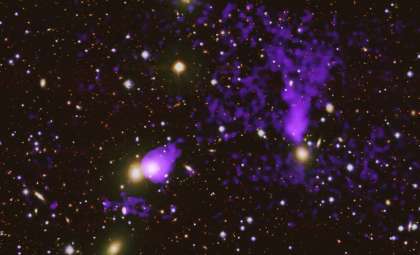
At the core of the cluster, the colossal galaxy NGC 1275 acts as a gravitational anchor, with member galaxies frequently merging or colliding due to mutual attraction. These encounters strip stars and other matter, creating a faint luminosity known as intra-cluster light (ICL), encircling NGC 1275 and extending throughout the cluster. This ICL is formed by tidal forces pulling stars away from infalling galaxies, producing a diffuse glow of unbound stars. The image also demonstrates the intricate distribution of intergalactic dust and gas that interacts with galaxies as they move across the cluster, adding layers of complexity to this cosmic tableau.
Revealing Dark Matter and the Role of Intra-cluster Light
Intra-cluster light in Perseus offers astronomers vital insight into the gravitational environment of galaxy clusters. Since the ICL is not centered exactly on NGC 1275, it implies distinct origins and movement patterns apart from cluster galaxies. This soft glow, together with gravitational effects observed across the Perseus cluster, supports the idea that dark matter constitutes a major influence here. Scientists believe around 85% of the cluster’s mass is dark matter, invisible to telescopes but exerting strong gravitational pull.
Dark matter creates the fundamental framework of galaxy clusters, bending light through gravitational lensing and causing observable distortions near massive structures. By mapping star positions and ICL distribution, researchers can pinpoint where dark matter's gravitational grip is strongest, despite it being invisible in ordinary light.
Capturing Perseus’ Dynamic Environment with Gemini North
The cluster’s intra-cluster space is filled with incredibly hot gas—reaching temperatures surpassing 1.8 million degrees Fahrenheit (1 million degrees Celsius)—which emits intense X-rays. NASA’s Chandra X-ray Observatory has revealed how supermassive black hole jets in galaxies like NGC 1275 generate bubbles in this hot gas, sending ripples throughout the cluster. These pressure waves have been converted into sound waves, uncovering some of the lowest-frequency tones ever measured, nearly 57 octaves below middle C on a piano.
This environment gradually strips spiral galaxies of the gas needed to forge stars, causing them to age into elliptical galaxies over time. The interplay of galaxy mergers and black hole activity demonstrates how galaxy clusters act as key sites for galactic transformation, molding their shape and composition.
Gemini North’s Impact on Modern Astronomy
As part of the International Gemini Observatory, the Gemini North telescope delivers cutting-edge optical and infrared imaging that sharpens our knowledge of distant galaxy clusters. Its vantage point at 13,800 feet atop Mauna Kea provides exceptional clarity, allowing it to capture fine details in remote structures such as those found in Perseus. Gemini North complements other observatories, enriching our understanding of the cosmic web's growth and structure.
Beyond clusters, Gemini North has also advanced planetary science by detecting rock-forming elements on exoplanets and producing direct images of distant worlds. These milestones enable astronomers to compare planetary systems and evaluate how common Earth-like worlds might be in the universe.
- Categories:
- Astronomy ,
- News ,
- Space








0 comments
Sign in to Comment