
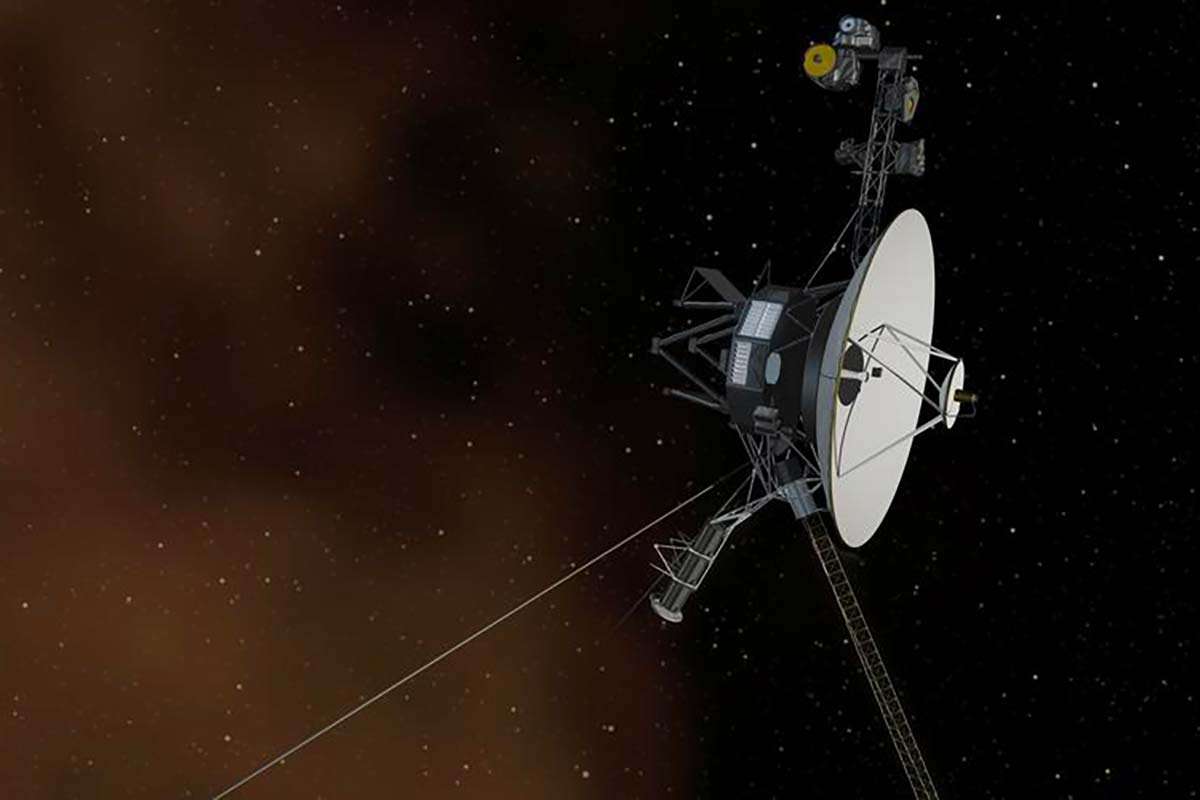
Following a five-month communication gap, Voyager 1 has begun transmitting valid data once again to Earth. NASA revealed that the probe, currently about 24 billion kilometers away, experienced a problem related to one of its data formatting computer chips. This malfunction caused unreliable transmissions starting last November, until the recent resolution.
On avait perdu le contact avec la sonde Voyager 1, partie de la Terre il y a 46 ans et qui vogue maintenant à plus de 24 milliards de kilomètre de nous, après avoir quitté le système solaire.
On vient de re-rentrer en contact avec la sonde. Thread en images👇 pic.twitter.com/B3dxoospDm— Eric Lagadec✨🌍 (@EricLagadec) April 23, 2024
Add Cosmo Herald as a Preferred Source

NASA’s Troubleshooting and Recovery Efforts
Using tried-and-true methods from previous technical interruptions, NASA successfully reestablished contact with Voyager 1, monitoring its condition remotely. Despite the immense distance, engineers on Earth continue to send commands, and the spacecraft remains operational in the uncharted interstellar environment.
Voyager 1: A Milestone in Space Exploration
Launched over four and a half decades ago, Voyager 1 stands as the farthest artificial object from Earth. Along with its counterpart, Voyager 2, it was designed to investigate the giant outer planets and is now journeying through the vast frontier beyond the solar system. The spacecraft carries a golden record featuring Earth’s sounds and images, meant to communicate the diversity of life and humanity to any extraterrestrial finders.
Scientific Discoveries and Legacy
The mission's data continue to deepen our understanding of the solar system's outer boundaries and the heliosphere’s nature. This ongoing mission not only adds valuable knowledge but also highlights human innovation and endurance in space exploration.
Next-Generation Missions on the Horizon
Inspired by the achievements of Voyager 1, NASA has announced plans for new probes aimed at exploring the interstellar medium in greater detail. These forthcoming missions intend to expand our grasp of the cosmos while building on the trail blazed by the Voyager spacecraft.
Prospects for Future Space Exploration
With continual technological advancements and rising interest in cosmic phenomena, upcoming projects will pave the way for more complex investigations. These may include direct studies of interstellar objects or exploration of exoplanets orbiting nearby stars.
Connecting Science with Society
Voyager 1’s journey captivates public imagination and invigorates academic circles. Leading astrophysicists like Éric Lagadec play a vital role in explaining cosmic mysteries, inspiring both students and seasoned researchers to pursue deeper astronomical studies.
Fostering Public Engagement in Space Science
Efforts to involve diverse audiences in space research are evident through educational outreach and initiatives fueled by current missions. Notably, institutions such as the European Astronaut Center have contributed by training astronauts like Sophie Adenot, the second Frenchwoman astronaut graduate since Claudie Haigneré in 1996.
Ultimately, the restoration of Voyager 1’s data transmission marks not just a technical success, but reinvigorates enthusiasm across multiple fields about humanity’s exploration of the universe. As new discoveries approach, Voyager 1’s voyage remains a profound source of inspiration and scientific challenge.
- Categories:
- News

0 comments
Sign in to Comment