
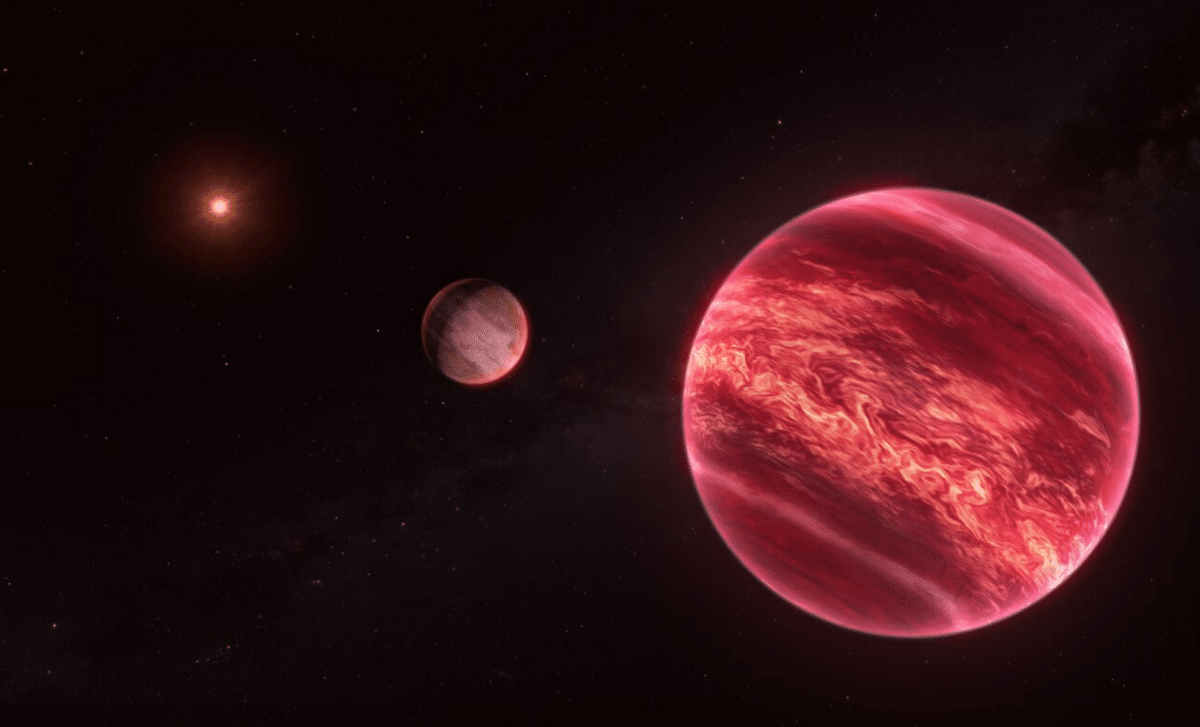
Utilizing the Very Large Telescope (VLT) from the European Southern Observatory (ESO), scientists have identified an object with a mass similar to Jupiter orbiting a brown dwarf in the CD-35 2722 system. This finding, detailed in the journal Nature, could signify the first credible detection of an exomoon beyond our solar neighborhood.
This celestial object defies conventional classifications. Although it has a planetary mass, it doesn't orbit a star directly. Instead, it revolves around a brown dwarf, which in turn orbits a star. This unusual setup is prompting astronomers to reevaluate how planets, moons, and related bodies are categorized in non-traditional systems.
Unusual Cosmic Arrangement Challenges Traditional Terms
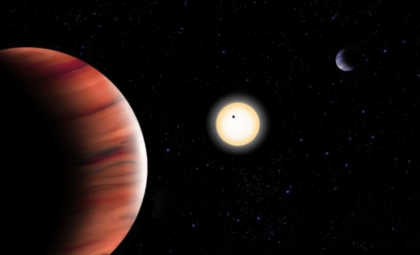
The newly spotted object belongs to the youthful CD-35 2722 system, which contains a star about half the mass of the Sun. Orbiting this star is a brown dwarf, a hybrid entity with characteristics between stars and planets. With a mass exceeding 30 times that of Jupiter, the brown dwarf is too hefty to be labeled as a planet but not massive enough to sustain star-like nuclear fusion.

Encircling this brown dwarf, astronomers detected another body with at least Jupiter’s mass. Referred to as an exosatellite, this term defines a natural satellite orbiting beyond our solar system. Although it acts like a moon by orbiting an object that itself orbits a star, its sheer size sets it apart from moons around planets within our solar system.
“It’s challenging to classify this system using familiar Solar System terminology such as ‘planet’ or ‘moon,’” explains Kevin Hoy, the ESO student in Chile leading the research. Hoy is connected with the Universidad Diego Portales and the Millennium Nucleus of Young Exoplanets and their Moons (YEMS). The object, labeled an exosatellite, has a mass at least equal to Jupiter’s, while the brown dwarf possesses over 30 times Jupiter’s mass.
“The exosatellite is clearly massive enough to be a planet, but it does not orbit a star, though it orbits an object that orbits a star,” says Hoy. “Being the third wheel in this system makes us want to call it a moon, even if it is nothing like the small, rocky moons we have in our system.”
Groundbreaking Finding Could Prompt New Category of Exomoons
This research in Nature marks an important milestone in the quest to identify moons orbiting extrasolar planets and other bodies. While thousands of exoplanets have been discovered, definitive proof of an exomoon remains elusive.
Though several potential exomoon candidates have been previously proposed, none have achieved universal scientific consensus. Employing the CRIRES+ instrument on ESO’s Very Large Telescope, the team utilized the radial velocity method—a technique instrumental in detecting some of the earliest exoplanets—to measure subtle motions in the brown dwarf caused by gravitational effects from the orbiting companion.
These observations indicate the brown dwarf may indeed have a sizable companion locked in its gravitational pull.
Alice Zurlo, director of YEMS and collaborator on the project, emphasized the discovery’s uniqueness: “The satellite we report is a giant gaseous body orbiting a very massive companion, itself several times more massive than Jupiter.”
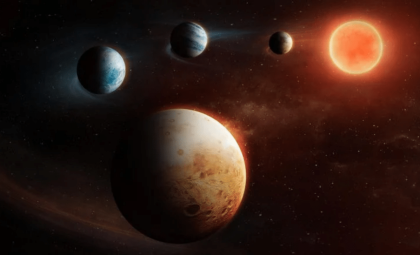
This system underscores just how diverse planetary systems can be, contrasting with the classical picture of a star surrounded by planets and smaller moons. Here, massive objects interact in ways that challenge existing labels.
“In our solar system, planets and the sun have clear distinctions, making it simple to define moons. But in CD-35 2722, where distinctions blur between stars, planets, and moons, the definitions become much more complex,” adds Zurlo, who also researches at Universidad Diego Portales.
Next-Generation Telescopes Could Unveil More Peculiar Worlds
This potential exosatellite discovery opens avenues for studying satellites orbiting nontraditional planetary bodies. Understanding these systems could shed light on how large companions develop and interact in youthful planetary environments.
The finding also raises debates about whether cosmic classifications should be rigid or evolve to reflect the vast variety of worlds found throughout the galaxy. Bodies like the companion in CD-35 2722 illustrate nature’s capability to form complex configurations beyond our solar-based classifications.
Future observatories, such as the Extremely Large Telescope (ELT) with its enormous 39-meter mirror, promise enhanced ability to detect smaller exomoons and confirm such companions with greater precision.
As astronomical instruments improve, researchers anticipate discovering more systems challenging current perceptions of planets, moons, and stars. The CD-35 2722 system may be an early window into a broader spectrum of extraordinary cosmic arrangements yet to be uncovered.
- Categories:
- Astronomy



0 comments
Sign in to Comment