
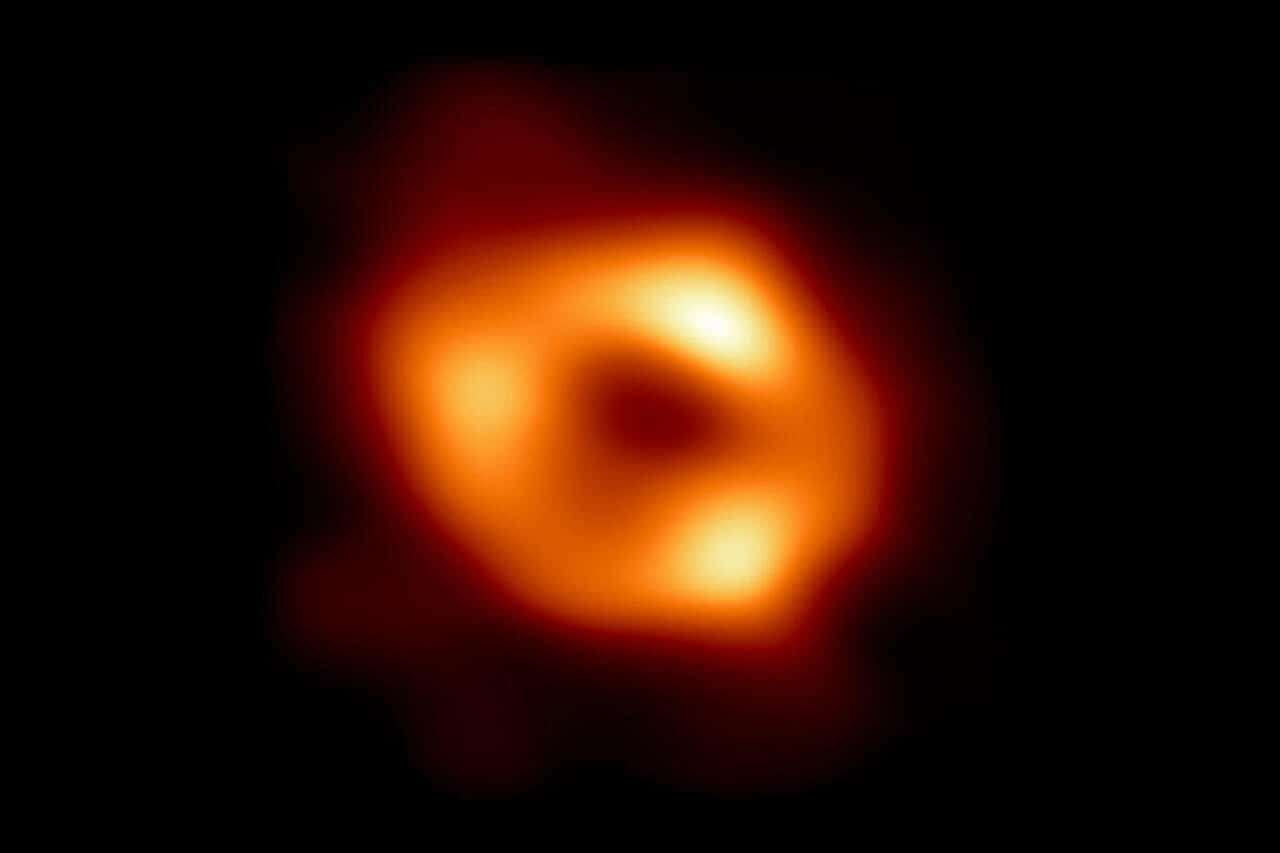
Recent investigations suggest that the Milky Way's central supermassive black hole, Sagittarius A*, was created by the fusion of two smaller black holes.
Published on September 6, 2024 in Nature Astronomy, the research conducted by scientists at the Nevada Center for Astrophysics (NCfA) sheds new light on the formation mechanisms behind supermassive black holes and the evolutionary narrative of our galaxy. Their analysis was largely based on data gathered by the Event Horizon Telescope (EHT), which produced the inaugural image of Sagittarius A* in 2022.
How Sagittarius A* Came to Be: The Impact of Black Hole Mergers
Supermassive black holes like Sagittarius A* exist at the cores of many galaxies, yet how these massive objects originate has puzzled scientists. Prevailing hypotheses include slow growth via matter accumulation or formation through the merger of smaller black holes. In this case, details from the Event Horizon Telescope highlighted Sagittarius A*’s quick rotational speed and misalignment with our galaxy’s rotation axis, signaling that a major merger likely shaped its development rather than gradual accretion.

“The high-speed, off-axis spin of Sgr A* strongly points to a past merger with another black hole that drastically changed its spin direction and magnitude,” noted Yihan Wang, who led the study. Using simulations, the team tested various formation scenarios, concluding that a 4:1 mass ratio merger, probably involving a satellite galaxy, best fits the observed traits of Sagittarius A*. This event presumably took place approximately 9 billion years ago, soon after the Milky Way merged with the Gaia-Enceladus galaxy.
Black Hole Behavior Supports Merger Hypothesis
Additional support for a black hole merger arises from Sagittarius A*’s spin orientation, which is distinctively misaligned from the Milky Way, indicating an external cause for this shift. These observations bolster the hierarchical black hole merger model, which argues that supermassive black holes grow by successive mergers. As Bing Zhang, co-author, stated, “This event not only validates the hierarchical merging concept but also offers insights into the Milky Way’s dynamic past.”
Simulation outcomes reveal that a merger with a significantly tilted orbit can recreate Sagittarius A*’s present-day features. This insight enhances our understanding of the Milky Way’s central black hole peculiarities and clarifies how galactic and black hole evolution progress through interactions with other galaxies.
Contributions of the Event Horizon Telescope
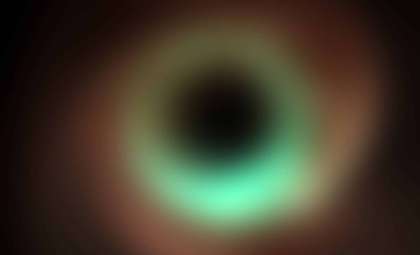
The key advance in this research stems from the Event Horizon Telescope (EHT), which connects eight radio observatories worldwide to form an Earth-sized telescope array. The 2022 capture of Sagittarius A*’s first image provided essential information regarding the black hole’s spin and orientation, enabling scientists to test the merger formation theory with unprecedented precision.
“This discovery will deepen our grasp of supermassive black holes’ growth and evolution,” remarked Wang. The EHT observations were crucial for demonstrating that Sagittarius A*’s unusual spin cannot be properly explained through standard matter accretion, reinforcing the merger scenario.
Prospects for Gravitational Wave Astronomy
The implications of these findings extend to forthcoming studies of black hole collisions. The upcoming Laser Interferometer Space Antenna (LISA), a space-based gravitational wave observatory launching in 2035, is expected to detect waves emitted from similar supermassive black hole mergers throughout the cosmos. Researchers anticipate that LISA will confirm merger events like the one responsible for Sagittarius A* and help quantify the frequency of such mergers.
“Our inferred merger frequency, aligning well with theoretical expectations, points to a promising detection rate of supermassive black hole mergers for next-generation gravitational wave detectors in the 2030s,” explained Zhang. As gravitational wave observatories improve and multiply, they will provide more data to support the role of mergers in shaping supermassive black holes.
Insights into Galactic Development
Recognizing that Sagittarius A* likely originated from a merger adds important context to the Milky Way’s evolution. Black hole mergers are generally linked to galactic collisions, events that significantly influence a galaxy’s structure and rotational dynamics. Such mergers affect how mass is distributed within a galaxy and can modify the orbital paths of stars and other matter.
By investigating the behavior of supermassive black holes, astronomers can uncover more about the historical forces that forged the Milky Way. As Zhang said, “This work not only reinforces the hierarchical merger model but also reveals new details about our galaxy’s dynamic formation history.” These findings underscore the intricate interactions that govern galaxy and black hole evolution.
- Categories:
- Astronomy ,
- News ,
- Science ,
- Space ,
- Physics






0 comments
Sign in to Comment