

A global team of scientists, spearheaded by Italy’s National Institute for Astrophysics (INAF), has leveraged the James Webb Space Telescope (JWST) to unveil a spectacular cosmic event: the interaction between a distant quasar and two sizable satellite galaxies within the PJ308-21 system.
This groundbreaking observation opens a window into the mechanisms driving galaxy formation and growth during the universe’s earliest epochs, shedding light on the evolution of cosmic structures.
Probing the Quasar and Its Galactic Neighbors
In September 2022, JWST's Near-Infrared Spectrograph (NIRSpec) targeted the PJ308-21 system, capturing unparalleled details of a quasar-galaxy merger. This quasar resides in a galaxy that formed less than a billion years after the Big Bang, and the observations achieved an exceptional level of precision.

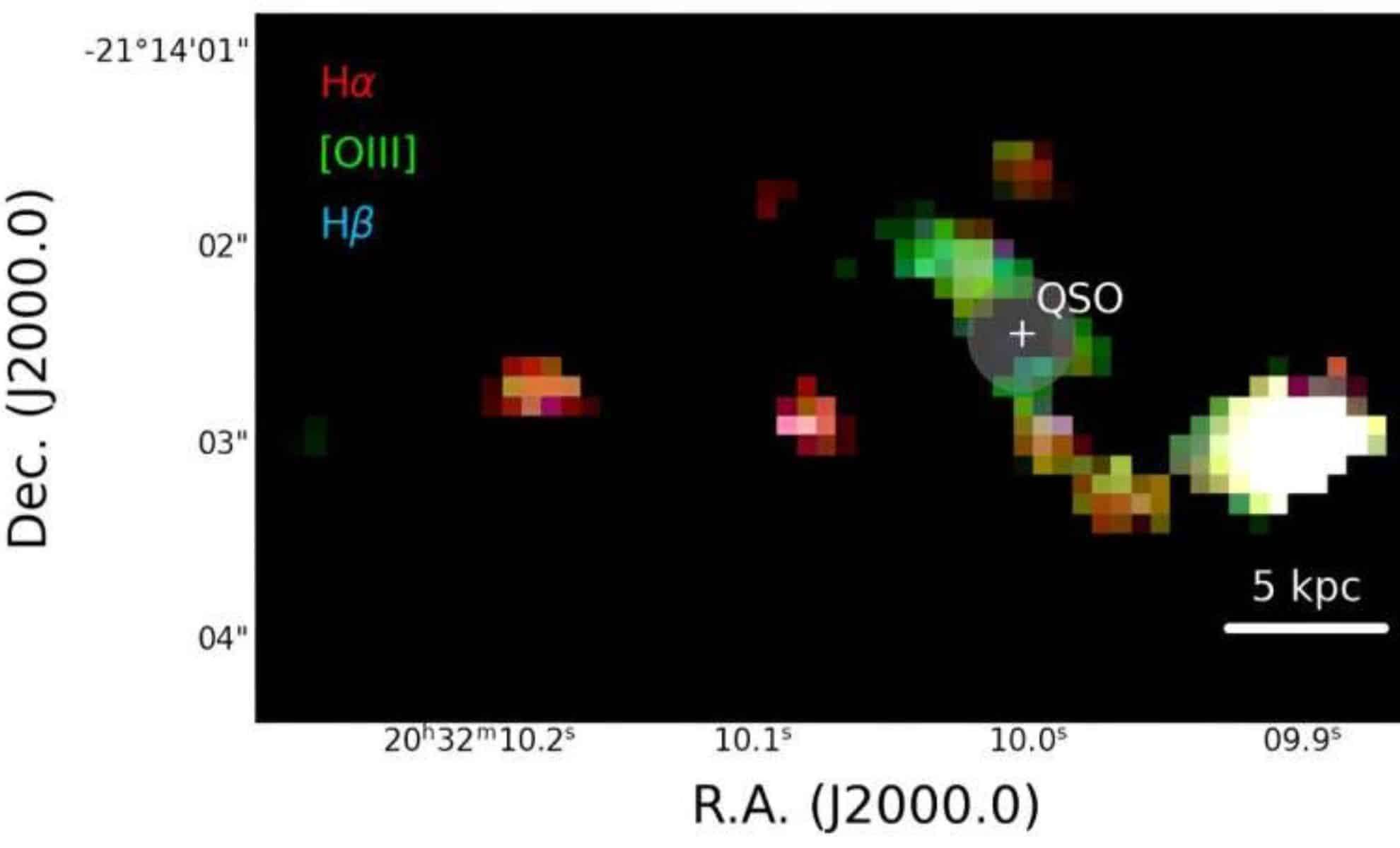
The NIRSpec data delivered spectral measurements with uncertainties below 1% per pixel, empowering researchers to analyze the characteristics of the gas in the quasar’s host galaxy and its companions. This refined dataset is vital for understanding the early phases of galactic development and the influence of quasars in those processes.
Metallic Abundance and Star-Forming Activity
The PJ308-21 host galaxy displays elevated metallicity and ionization signatures typical of an active galactic nucleus (AGN), whereas one satellite galaxy shows signs of lower metallicity and ionization driven by star formation. The second satellite demonstrates partial photoionization from the quasar alongside a high metal content.
These findings confirm that both the quasar and its surrounding satellites are substantially evolved, featuring significant mass and metal enrichment while actively growing. Roberto Decarli of INAF, leading the research, commented, “Our results reveal highly efficient and dynamic growth of black holes and their host galaxies in the universe’s first billion years, fueled by a rich galactic environment.”
Cutting-Edge Spectroscopic Techniques
This work was part of one of the nine Italian-led programs during JWST’s initial observation cycle. The team utilized integral field spectroscopy to capture spectra across the entire optical range for every pixel in the images.
The approach enabled detailed examination of gas properties within the ionized interstellar medium, including metallicity, dust levels, electron temperature and density, as well as star formation rates.
INAF astrophysicist Federica Loiacono explained, “NIRSpec’s capabilities let us, for the first time, analyze the PJ308-21 system’s optical band in detail, revealing diagnostic information about gas near the central black hole and in adjacent galaxies. For instance, we can compare hydrogen emission to metals produced by stars to measure the gas’s metal richness.”
Deep Insights Through Advanced Data Processing
The collected data allowed the team to explore the physical conditions within these ancient galaxies. By interpreting emission lines from multiple elements, they assessed the ionizing radiation sources, metallicity levels, and electron properties.
This comprehensive analysis enhances our understanding of the environmental interplay inside these galaxies and their interaction with the quasar. Loiacono noted, “Our experience reducing some of the earliest NIRSpec integral field data provides a strategic edge for Italy in future projects involving similar observations.”
Advancing Our Understanding of the Early Universe
Examining the chemical makeup and dynamics of such remote galaxies carries significant implications for unraveling cosmic history and the evolution of galactic chemistry. JWST’s data make it possible to chart metal enrichment in galaxies observed during the universe’s infancy.
Roberto Decarli stated, “Until recently, acquiring detailed metal enrichment data at these vast distances was nearly impossible. Now, with only a few hours of JWST observation, we can map this crucial information in galaxies from the universe’s dawn.”
This capability opens novel paths for studying the physical processes guiding early galaxy formation and evolution.
Transformational Discoveries Enabled by JWST
These findings not only illuminate the early growth of galaxies and supermassive black holes but also highlight the revolutionary capabilities of the James Webb Space Telescope.
The JWST offers unmatched sensitivity in near- and mid-infrared wavelengths, delivering detailed data on distant cosmic targets that were previously unattainable. Decarli shared, “The project was an ’emotional rollercoaster,’ with inventive solutions needed to conquer challenges in data processing.”
As the JWST continues its mission, it promises to reveal more profound insights into the universe’s past and the key phenomena that shaped its evolution.
- Categories:
- Astronomy ,
- News ,
- Space ,
- Aircraft




0 comments
Sign in to Comment