
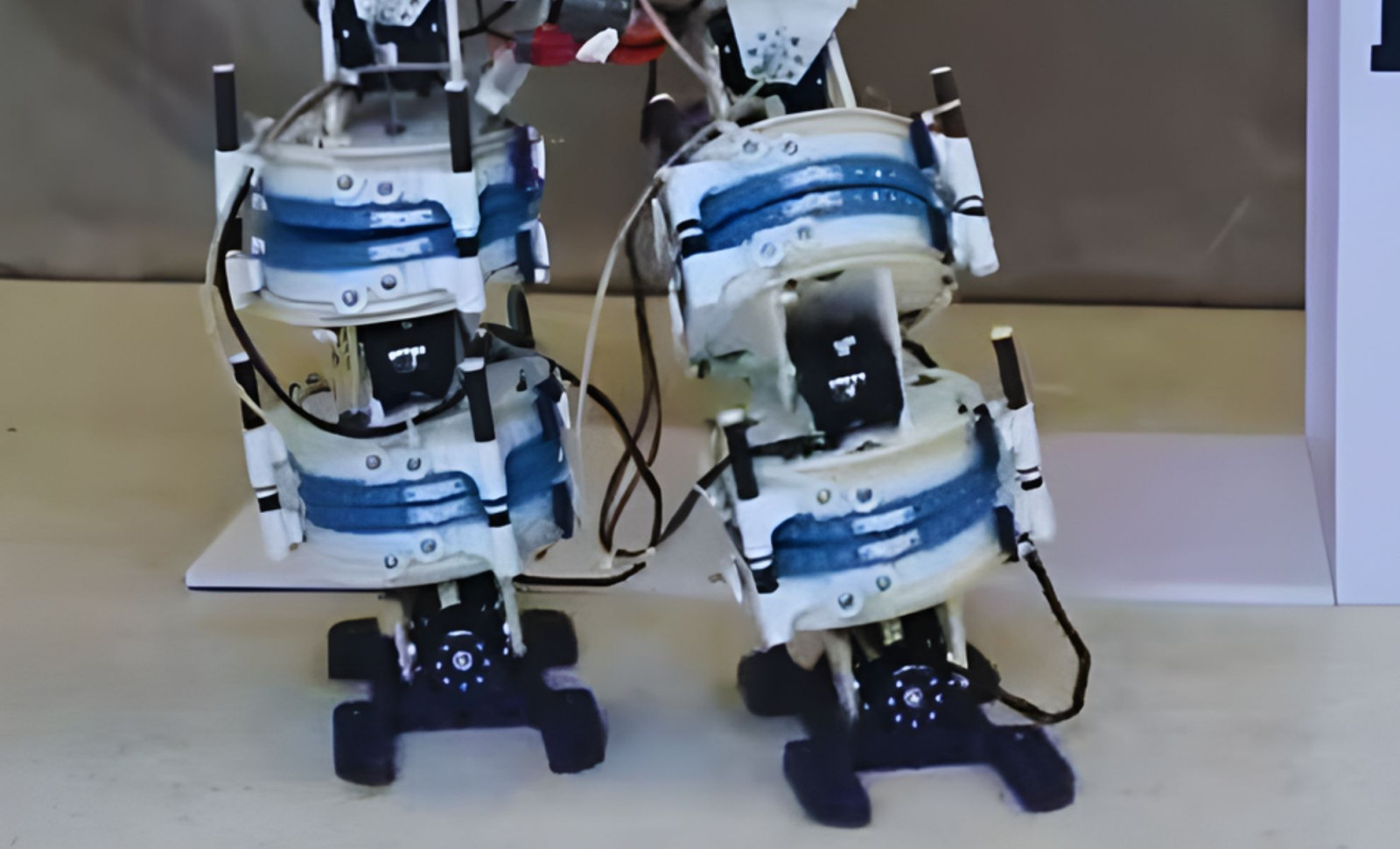
A remarkable soft-bodied humanoid robot developed in China showcases extraordinary flexibility, capable of extending its limbs to over three times their usual length, compressing to just a third of its height, and even floating or walking on water. Weighing only 4.5 kilograms, this lightweight model offers a fascinating preview of future robotic capabilities.
Engineered by scientists at the Southern University of Science and Technology (SUST) in Shenzhen, this agile robot was detailed in a recent publication in Science Advances. Its soft and elastic design allows it to adapt effortlessly to challenging environments that would typically hinder more rigid robots.
Transforming Size to Access Hard-to-Reach Places
The robot’s core innovation lies in its inflatable framework. Researchers built a network of airtight soft chambers sheathed in a tough fabric layer. By inflating these chambers, the robot’s limbs rapidly elongate, growing it to more than three times their standard reach.

To ensure stability during these adjustments, carbon-fiber guides, tension cables, and compact motors are integrated, helping the robot maintain control whether expanding or contracting. When deflated, the humanoid reduces itself to just 36 percent of its original height and 61 percent of its width, allowing it to slip under furniture or navigate narrow spaces with ease.
The research paper shares that the GrowHR system draws inspiration from natural biological growth, imitating how bones expand while staying strong and lightweight. The goal is to enable seamless transformation without compromising strength or control.
Walking and Floating on Water
Beyond stretching and shrinking, this robot can also float. Its lightweight, soft design lets it sit atop water surfaces without sinking. Impressively, the team showed that it can maneuver across water, a feat very few robots can achieve.
For enhanced versatility, tiny fans are attached to its body, enabling brief flights. Although flight isn’t its primary function, this demonstrates the robot’s structure supports diverse movement capabilities.
There is a trade-off: the waterproof coating limits its flexibility in water, making swimming more challenging. Nonetheless, its ability to shift smoothly between land, air, and water sets it apart as a highly versatile prototype machine.
A Safety-Focused Design for Human Interaction
One key priority for the developers was ensuring the robot’s safety around people. Unlike traditional robots with hard, metallic builds, this model is made from soft, elastic materials, which minimizes the risk of injury during accidental contacts.
According to the Science Advances article, the robot is described as “intrinsically safe for users, the environment, and itself.” This safety feature means it can interact closely with humans and objects without the need for additional supervision or barriers, making it an excellent candidate for everyday use.
Though still in its early development, the prototype shows strong potential for applications like search-and-rescue operations, transporting medical supplies in difficult areas, or assisting with household chores. The team refers to this innovation as a growable, multifunctional robotics concept that adapts to diverse needs.
- Categories:
- Tech









0 comments
Sign in to Comment