

Scientists at UC Santa Barbara have engineered a novel molecule that can capture sunlight and retain its energy for future heating needs. This innovation acts like a rechargeable solar battery, storing energy chemically rather than converting it into electricity as traditional solar devices do. One major limitation of solar power is its reliance on daytime, making efficient energy storage indispensable for broader renewable energy applications, particularly in heating.
The team’s work is part of the molecular solar thermal (MOST) storage field, which focuses on embedding solar energy within molecules. Although the principle has been investigated previously, achieving durable and efficient systems has proven challenging, as outlined in Science.
A Structure That Absorbs and Later Emits Sunlight Energy
The researchers synthesized a molecule named pyrimidone, which undergoes a structural transformation when exposed to sunlight. This alteration pushes the molecule into a high-energy configuration, enabling it to hold solar energy internally. Lead author Nguyen Han explained that the molecule operates like a compressed spring—storing energy when illuminated and releasing it as heat on demand. She highlighted that the system is “reusable and recyclable,” maintaining its effectiveness over many cycles without loss, as featured in Science.

“That kind of reversible change is what we’re interested in. Only instead of changing color, we want to use the same idea to store energy, release it when we need it, and then reuse the material over and over,” she said.

Integrating DNA Concepts Into Practical Molecular Design
The design process was inspired by DNA molecules along with photochromic substances like transition lenses, which can reversibly shift their structure in response to light—a quality repurposed here for energy retention.
The pyrimidone molecule imitates certain DNA elements that react to UV rays. Collaborating with UCLA’s K. N. Houk, computational analyses helped optimize the molecule’s stability and capacity to store energy.
Nguyen emphasized a minimalistic approach in refining the compound, stripping away unnecessary parts to produce a streamlined molecule efficient at solar energy storage, as documented in their report.
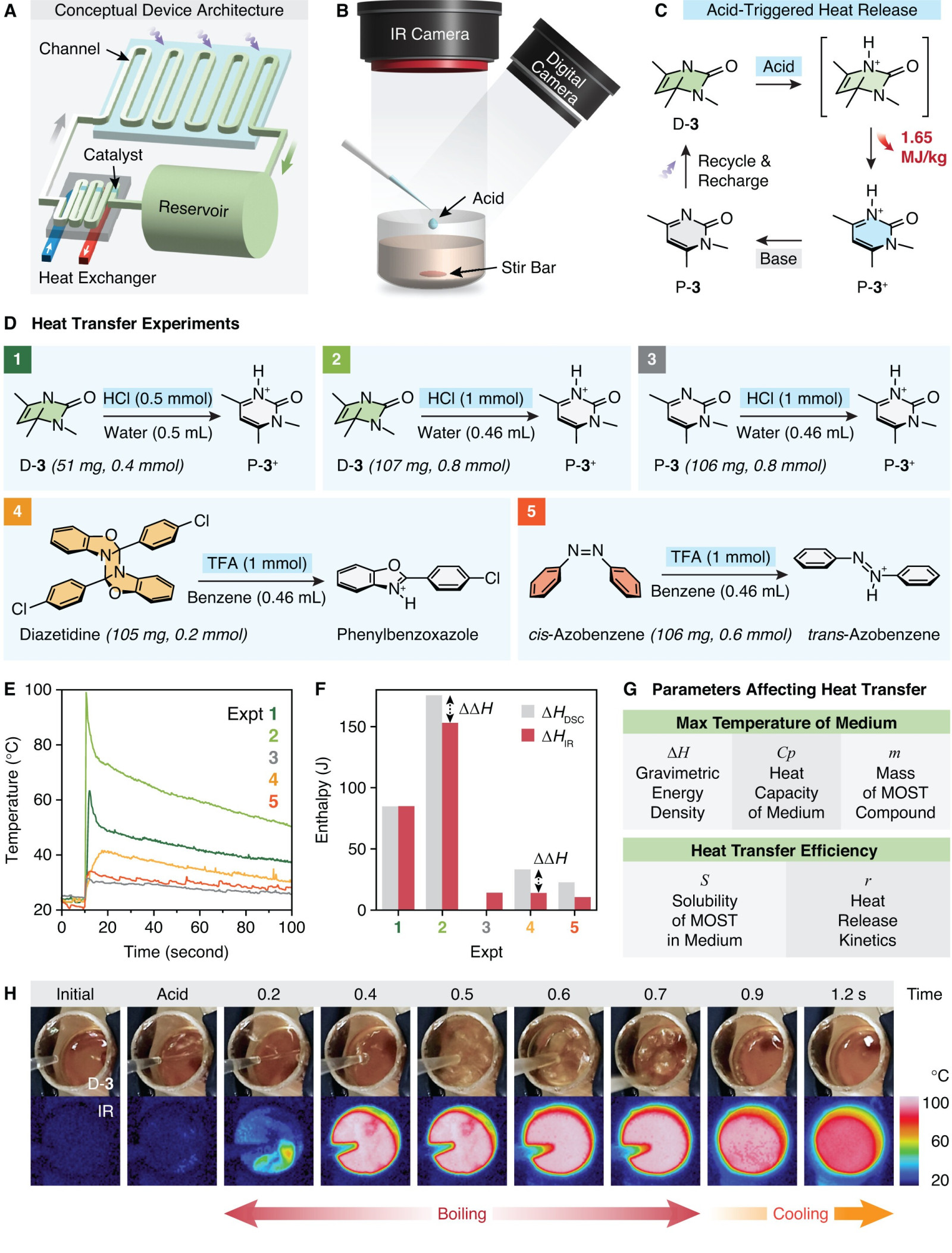
Energy Levels Sufficient to Boil Water
This material has been measured to deliver an impressive energy density of over 1.6 MJ/kg, surpassing the approximately 0.9 MJ/kg typical for lithium-ion batteries. This advancement represents a meaningful improvement in MOST technology.
“Boiling water is an energy-intensive process,” Nguyen remarked in the university statement. “The fact that we can boil water under ambient conditions is a big achievement.” This sets a rigorous standard, given the substantial energy required to vaporize water.
Because the molecule dissolves easily, it could be circulated in solar thermal systems, storing heat during sunlight hours and delivering warmth when needed. As co-author Benjamin Baker remarked:
“With solar panels, you need an additional battery system to store the energy. With molecular solar thermal energy storage, the material itself is able to store that energy from sunlight.”
- Categories:
- Physics













0 comments
Sign in to Comment