

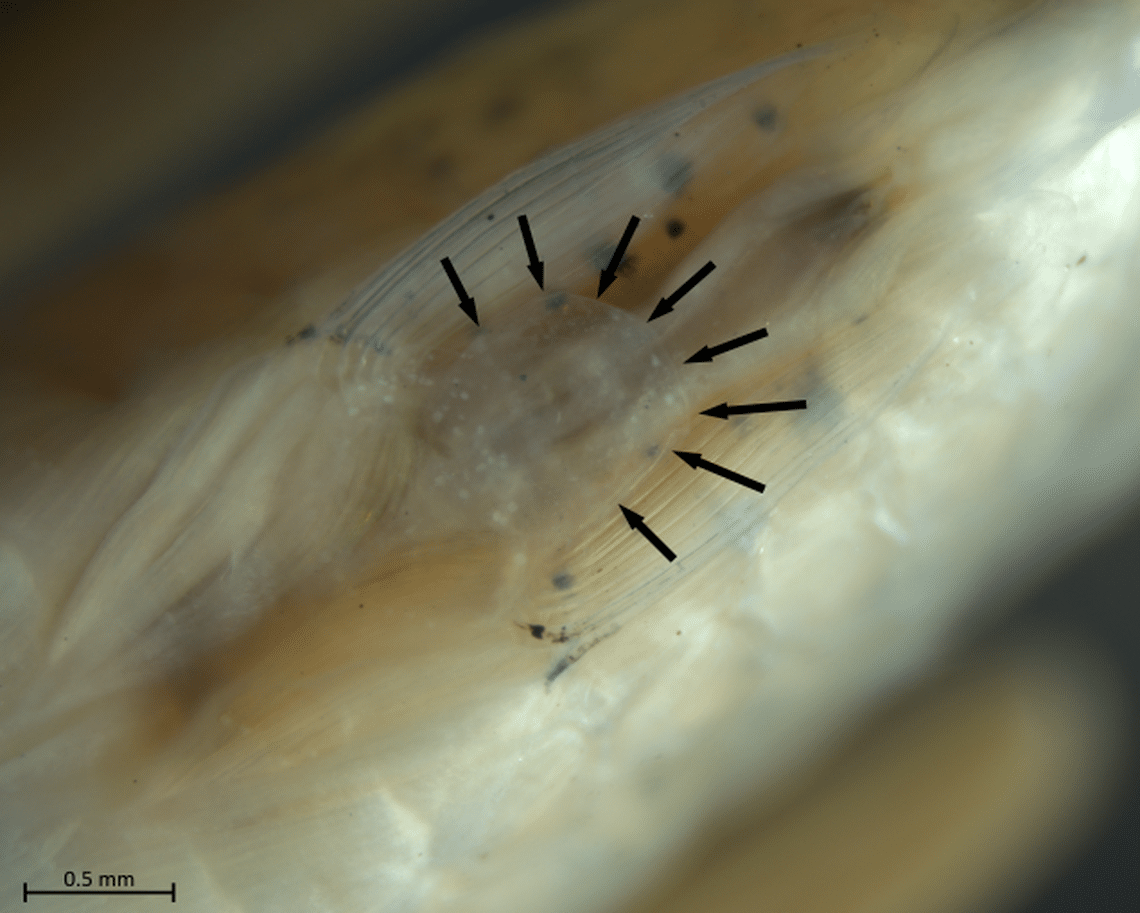
Priocharax rex, measuring only 0.8 inches, possesses an extraordinary feature previously unseen by researchers: a circular, wing-like flap of skin nestled between its pelvic fins. This distinctive fish was discovered in the dimly lit waters of a forest stream flowing into the río Putumayo in southern Colombia.
Despite the stream’s murkiness, which restricts visibility even at noon, Priocharax rex stands out with its peculiar skin flap. As the largest known member of its genus, Priocharax, its minimal size doesn’t diminish its captivating uniqueness.
A Group of Remarkably Small Fish
The species Priocharax rex is part of a family of very small tetras native to the Amazon and Orinoco river basins. These fish rarely exceed 1 inch in length and inhabit slow, shallow creeks or floodplain lakes, often concealed beneath roots and foliage where sunlight barely penetrates.

“P. rex is recorded from small, shallow (less than 3.2 feet deep), slow-flowing terra-firme dark water streams,” researchers observed.
These fishes exhibit paedomorphosis, a biological condition where they retain juvenile characteristics throughout their adult lives. Consequently, they possess features like soft larval-like pectoral fins and have less developed skeletal structures than other relatives.
What truly distinguishes this tiny fish is the enigmatic skin “wing” suspended between its pelvic fins—an anatomical novelty unknown in related species. Scientists speculate it might represent an evolutionary innovation unique to this miniature aquatic creature. For more details, visit this article.
Unraveling the Enigma of the Skin Flap
The research published in Zootaxa documents this round flap positioned between the pelvic fins, resembling a delicate curtain beneath the fish’s abdominal area. Although its function remains unknown, several hypotheses have been proposed.
“Regarding the skin flap, I think it is too soon to speculate on its function,” explained the study author George Mattox. “The main importance of this structure so far is the fact that it is unique to this species, as far as I know.”
Possible roles include helping the fish stabilize itself against water currents by modifying flow beneath its body or acting as a signaling device during mating rituals. Another theory suggests the flap may contain additional nerve endings, enhancing the fish’s sensitivity to environmental changes, though these remain unverified.
Since observations are based solely on preserved specimens, the flap’s definitive purpose is still a mystery. Nonetheless, this unusual adaptation in such a minuscule fish highlights how even the tiniest aquatic beings can develop complex, unexpected traits.
- Categories:
- Nature










0 comments
Sign in to Comment