

The Event Horizon Telescope (EHT) Collaboration has reached a remarkable milestone by capturing the most detailed images of black holes ever achieved from Earth-based observatories.
Employing light detection at a frequency of 345 GHz, the EHT has significantly enhanced the capabilities of terrestrial telescopes, enabling astronomers to examine the immediate vicinity of black holes with unprecedented clarity.
This leap forward promises not only sharper visuals but also broadens the scope for investigating the complex phenomena surrounding these cosmic enigmas.

Why Observing at 345 GHz Matters
The recent breakthrough by the EHT team is grounded in the use of very-long-baseline interferometry (VLBI) at an elevated frequency of 345 GHz. This method connects radio telescopes worldwide to form a virtual telescope the size of Earth. Earlier observations by the EHT were conducted at 230 GHz, leading to the first-ever images of black holes, including the iconic depiction of M87*, the supermassive black hole at the heart of the M87 galaxy. Although revolutionary, those initial images had limitations in resolution tied to their frequency. Transitioning to 345 GHz has boosted image clarity by roughly 50%, unveiling intricate components within the black hole's environment that were previously hidden.
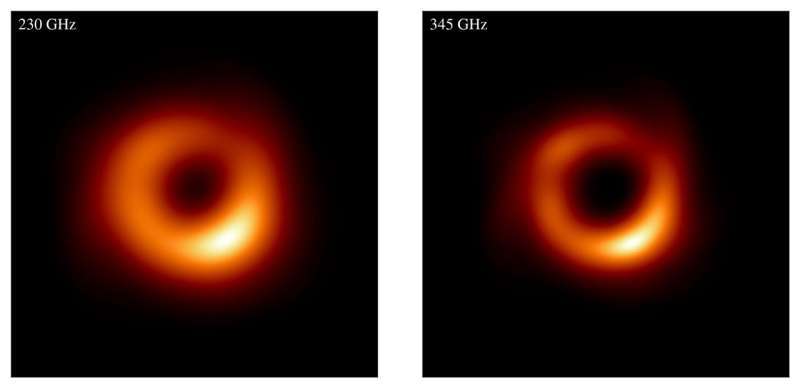
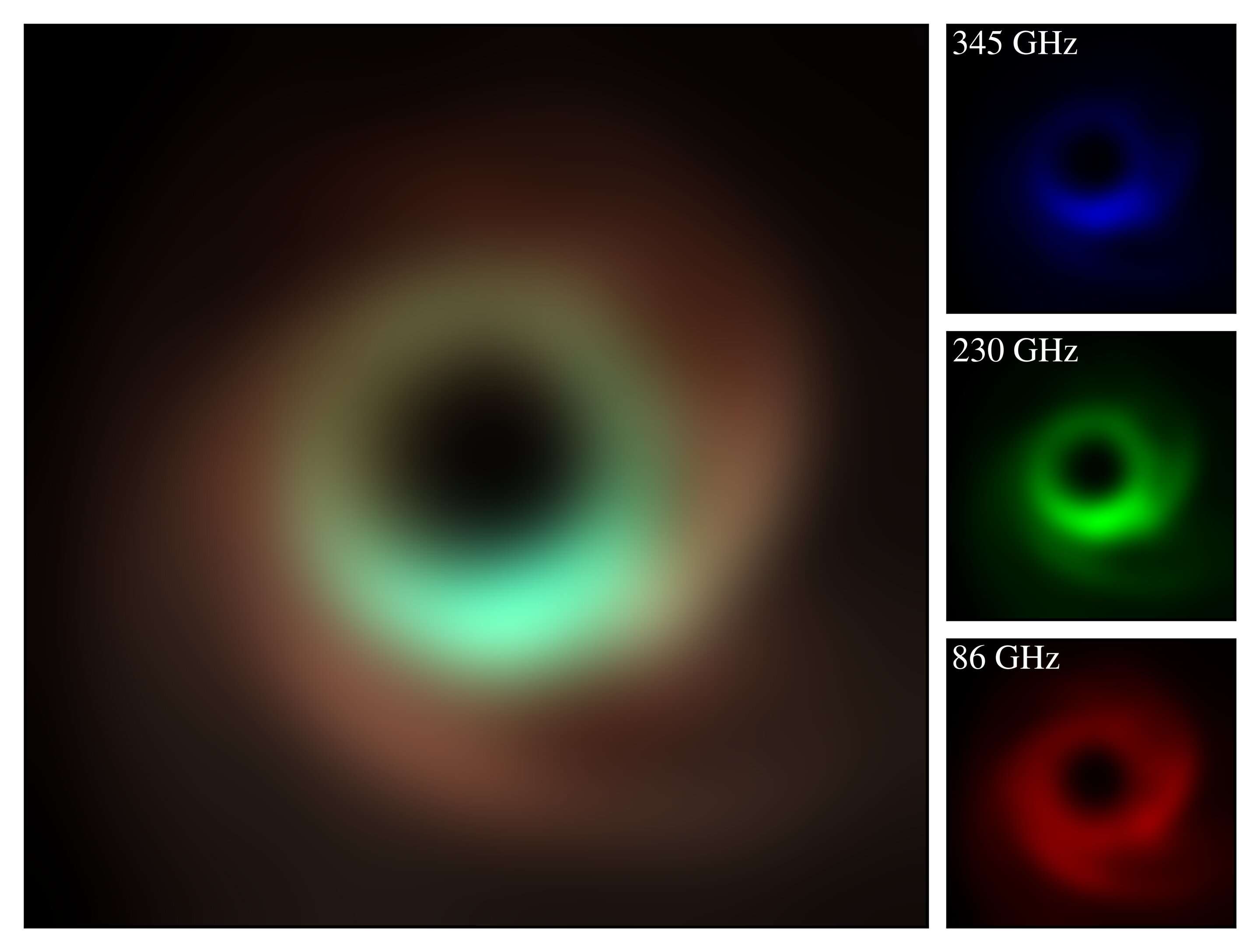
As Sheperd “Shep” Doeleman, founding director of the EHT and co-author of the publication, illustrates, this frequency upgrade is comparable to shifting from monochrome to color photography. Such enhanced “color vision” allows researchers to differentiate the influence of Einstein’s gravity from the dynamics of heated gases and magnetic fields near black holes, paving the way for novel insights into their cosmic interactions.
Navigating Challenges of High-frequency VLBI
Operating at 345 GHz brought considerable technical obstacles, primarily due to atmospheric interference. The abundance of atmospheric water vapor tends to absorb these higher-frequency signals more than those at 230 GHz, complicating the detection of the faint emissions from black holes. To counter this, the EHT team enhanced instrument sensitivity by expanding data bandwidth and carefully timing observations to coincide with optimal weather conditions across global telescope locations.
The pilot study behind these landmark observations utilized a partial EHT array, comprising major installations like the Atacama Large Millimeter/submillimeter Array (ALMA) in Chile, the IRAM 30-meter telescope in Spain, and the Submillimeter Array (SMA) in Hawaiʻi. Together, they attained a resolution of 19 microarcseconds, the sharpest ever achieved from Earth's surface—equivalent to identifying a bottle cap positioned on the Moon.
Future Prospects for Black Hole Imaging
Observations at 345 GHz have significantly deepened our grasp of black hole physics and set the stage for upcoming enhancements in astronomical imaging. The next-generation EHT (ngEHT) project plans to augment the network by adding antennas and upgrading existing ones. This will facilitate multi-frequency imaging and yield even more refined visualizations of black holes, potentially capturing real-time “movies” of matter and energy swirling near event horizons.
This breakthrough also holds far-reaching implications for astrophysics, providing unmatched clarity to study the fundamental physics of black holes. Through these observations, scientists can rigorously test predictions of general relativity and deepen understanding of phenomena such as relativistic jets that span entire galaxies.
As Lisa Kewley, Director of the Center for Astrophysics | Harvard & Smithsonian (CfA), remarked, “The EHT’s successful observation at 345 GHz is a major scientific milestone.” This achievement not only raises the bar for ground-based astrophysical research but also underlines the immense potential of future discoveries capable of transforming our cosmic perspective.
With these state-of-the-art advancements, the EHT Collaboration continues to uncover the hidden intricacies of black holes, edging closer to unraveling some of the most profound mysteries in modern science.
- Categories:
- Astronomy ,
- News ,
- Space ,
- Physics









0 comments
Sign in to Comment