
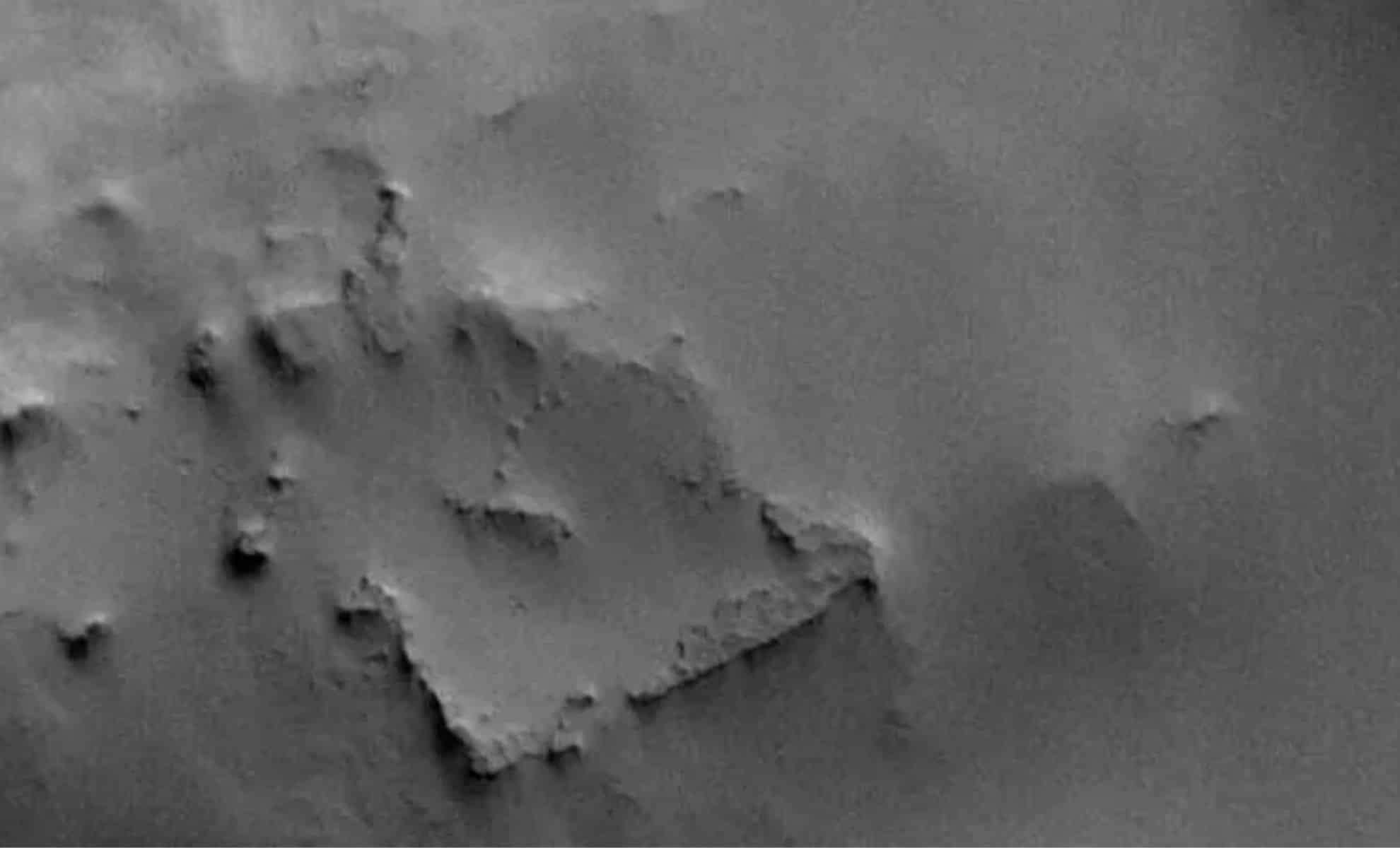
An image recently brought back into the spotlight from NASA’s Mars Global Surveyor is sparking renewed intrigue across social media. This photo shows what looks like a prominent square-shaped feature on Mars’ surface, captivating online communities and gaining endorsements from figures like Joe Rogan and Elon Musk on platform X.
The Origin of the Square Feature: What the Mars Orbiter Really Recorded
The image, identified as E1000462, was obtained by the Mars Orbiter Camera (MOC) during the Mars Global Surveyor mission, which operated between 1997 and 2006. The geometric-looking area stretches about 3 kilometers (1.9 miles) across. While the shape suggests artificial construction due to its sharp angles, close analysis reveals the “square” is an optical illusion generated by natural elements such as fractures, shadows, and erosion patterns. This kind of visual misinterpretation is a classic example of pareidolia, where human brains infer recognizable shapes in random formations, especially common in planetary images.
The rapid spread of this image was fueled by discussions on Reddit’s “Aliens” subreddit and gained traction after endorsements from public influencers Musk and Rogan, bringing it into the spotlight beyond scientific circles and stirring widespread speculation.

Humans’ Pattern Recognition and Pareidolia Explained
Researchers have long recognized that humans instinctively detect patterns, a survival skill that allowed early humans to quickly recognize danger, like predators lurking in shadows. However, on deserted landscapes such as those on Mars, this instinct leads to perceptions of faces, symbols, and man-made structures within natural formations.
The late Carl Sagan discussed this in his book The Demon-Haunted World, highlighting that our brains are wired to prefer false alarms rather than risks of missing genuine threats — a tendency that can cause us to mistake rocks for living creatures or, in this case, square geological features for ruins of alien origin.
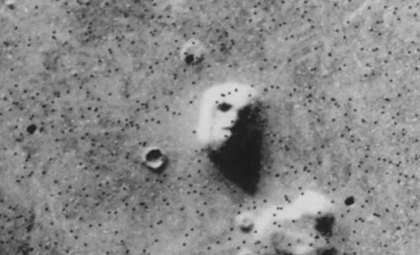
Similar incidents have occurred with other famous Martian images, including the legendary “Face on Mars” photographed by Viking 1 in 1976, and oddly shaped rocks nicknamed “avocados” or “bones”. Subsequent high-resolution imagery always confirmed natural geological causes.
Natural Geological Processes Behind Geometric Features
Planet Earth offers many examples of naturally occurring geometric patterns. One notable instance is the Giant’s Causeway in Northern Ireland, featuring remarkably hexagonal basalt pillars formed by cooling volcanic lava. Even Saturn exhibits a naturally occurring hexagonal jet stream at its north pole.
Mars’ diverse geological history shaped by volcanic activity, sediment layers, and strong winds leads to angular and linear rock features. Experts believe the square appearance in the MOC photo results from these natural mechanisms rather than artificial structures left by an intelligent species.
Additionally, image resolution, lighting angles, and shadows amplify the illusion of straight edges and corners, making the formation appear more geometric than it truly is.
Historical Fascination with Martian Artificial Structures
Interest in possible artificial features on Mars dates back to the late 1800s when astronomer Giovanni Schiaparelli reported “canali” (channels) on Mars, misunderstood by many as artificial canals. Percival Lowell popularized this concept, presenting detailed maps and claiming an intelligent Martian civilization constructed such features.
Though these ideas captivated many, advances in technology and exploration debunked them. Still, the notion of a lost Martian civilization persists culturally, and the current buzz around the “square structure” continues this intriguing legacy of speculation and hope for extraterrestrial intelligence.
The Importance of Careful Scientific Evaluation in Viral Phenomena
While these viral moments excite the public and draw attention to planetary science, they underscore the necessity of strict scientific analysis. One compelling photo alone cannot confirm alien life or constructs.
Planetary scientists meticulously eliminate natural causes before entertaining extraordinary explanations. As Carl Sagan reminded us, “Extraordinary claims require extraordinary evidence.” In this case, factors like geological context and image clarity suggest a natural origin for the formation.
Future missions, including the Mars Reconnaissance Orbiter (MRO) and the Perseverance rover, provide increasingly sharp images, helping scientists differentiate illusions from genuine anomalies on Mars.
- Categories:
- News










0 comments
Sign in to Comment