
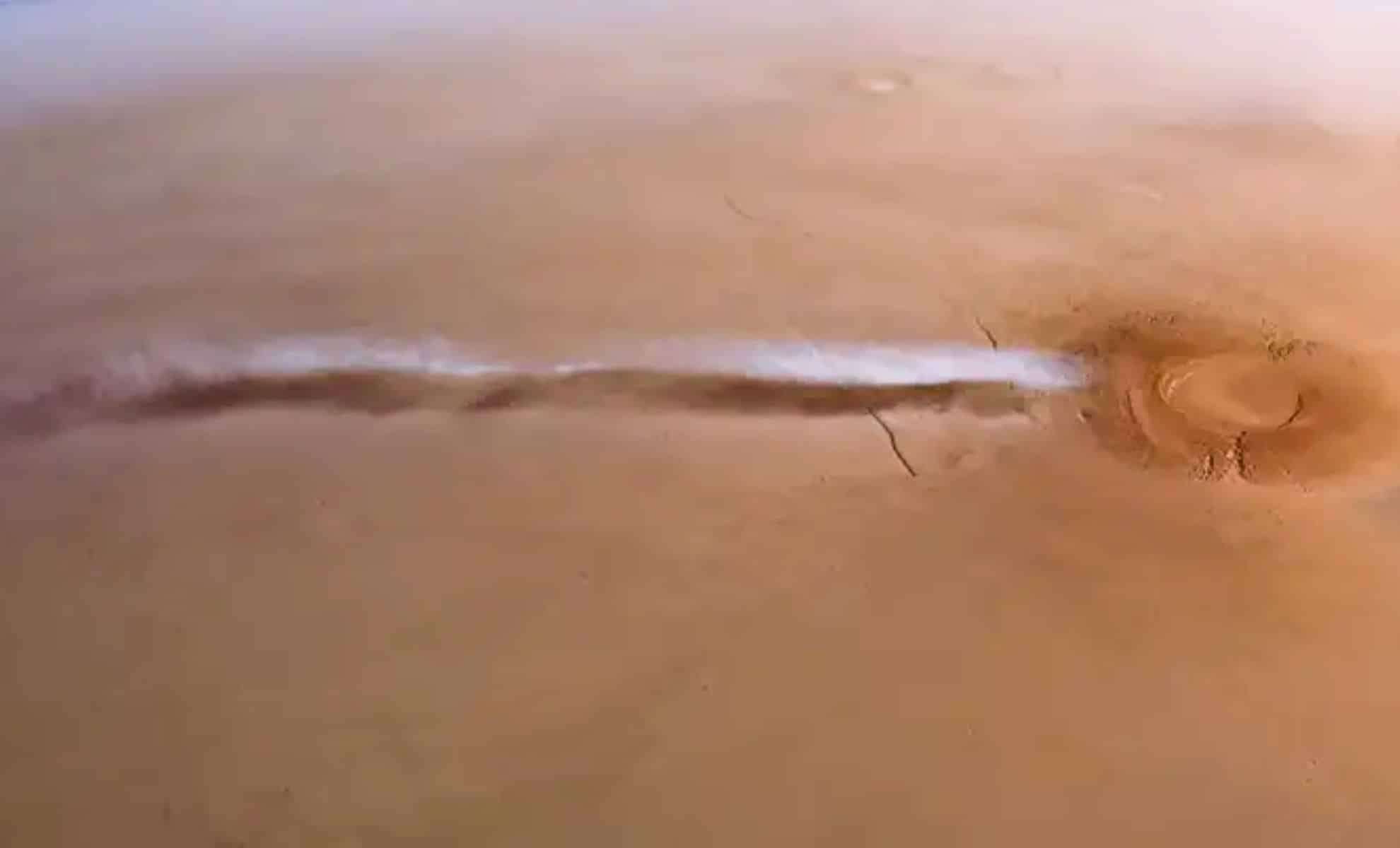
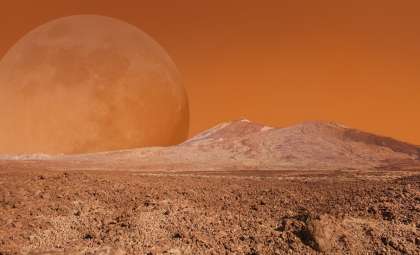
Mars is renowned for its dramatic features—massive volcanoes, expansive canyons, and relentless dust storms that shroud the planet in a rusty haze for extended periods. Yet, high above these rugged landscapes, a delicate spectacle unfolds each year: a giant cloud stretching over 1,800 kilometers across Mars’s atmosphere. The recently published Cloud Atlas of Mars, based on over 20 years of data from the Mars Express orbiter, is shedding new light on this intriguing atmospheric event.
These discoveries were unveiled at the Europlanet Science Congress (EPSC) 2024 in Berlin and documented in the Journal of Geophysical Research: Planets (AGU). The research forms part of a broader initiative by the German Aerospace Centre (DLR).
The Martian Cloud Phenomenon That Challenged Models
On Earth, clouds arise when moist air cools and condenses, often following consistent patterns. Mars, having an atmosphere roughly one hundredth the density of Earth’s and laden with fine dust particles, complicates this process. When the Arsia Mons cloud was first observed, scientists initially thought it was an anomaly—perhaps linked to local terrain or a transient weather pattern.

However, the cloud’s persistent reappearance, always emerging at dawn and drifting westward from the summit of the volcano, defied early explanations. Simulations of the Martian atmosphere under similar conditions repeatedly failed to reproduce the cloud’s distinct shape and frequency.
Breakthrough insights came when researchers considered the combined effect of Mars’s terrain and atmospheric moisture. As detailed at EPSC 2024, moist air is forced upward by the steep slopes of Arsia Mons, inducing rapid condensation. This process forms ice crystals that create a thin, elongated cloud, which appears and dissipates quickly. Due to the planet’s rotation and wind dynamics influenced by the landscape, these conditions recur daily.
An Extensive Atlas from Years of Observation
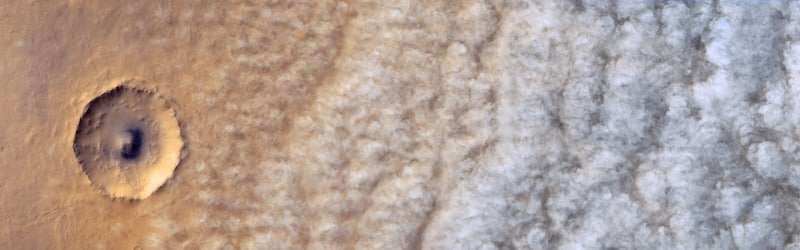
The Mars Express spacecraft, launched in 2003 by the European Space Agency (ESA), has been key to monitoring Mars’s atmospheric behavior. Equipped with the High Resolution Stereo Camera (HRSC), it has systematically recorded cloud formations, dust storms, and various meteorological events for over two decades. Scientists from the German Aerospace Centre (DLR) have now organized this extensive collection into a user-friendly HRSC Cloud Atlas.
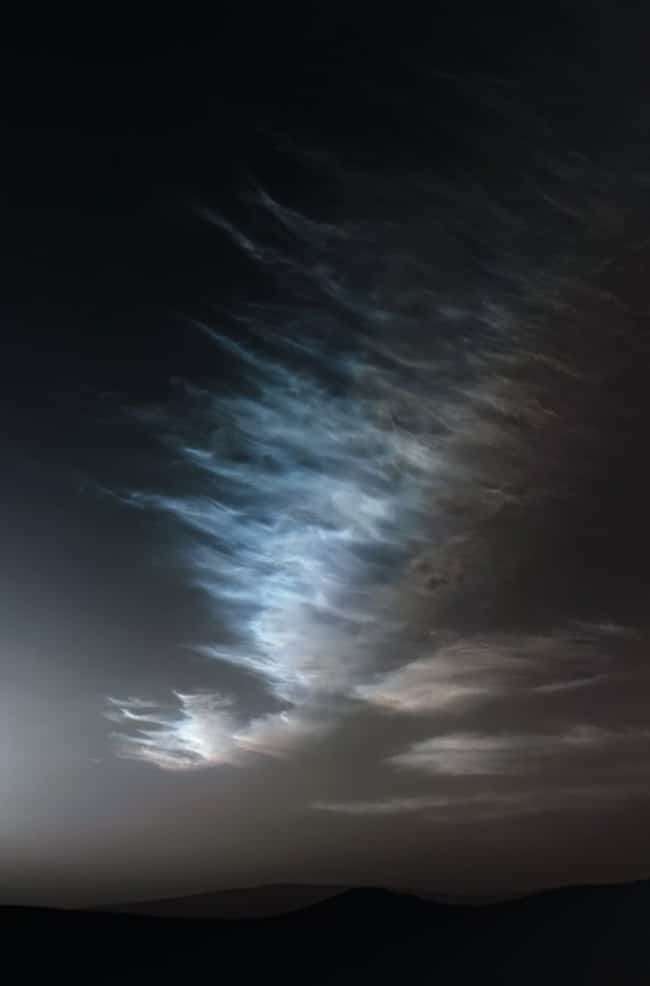
The variety of clouds on Mars is striking. Some resemble familiar terrestrial clouds, like fluffy cumulus or wispy high-altitude cirrus formations. Others are distinctively Martian, such as "cloud streets": linear bands aligned across the sky, typically appearing near the Tharsis volcanic region and the Vastitas Borealis plains, especially throughout the northern spring and summer seasons.
Additionally, Mars experiences gravity wave clouds—rippling cloud patterns formed when air masses are disturbed by the planet’s topography. These include lee wave clouds, which form downwind of mountains and create soft, fingerprint-like streaks in the atmosphere.
Mars: A Sky Shaped by Time and Terrain
Even volcanoes that have been dormant for millions of years, like Arsia Mons, influence the planet’s atmospheric dynamics. From above, the long cloud streaming from Arsia Mons’s peak can mimic signs of volcanic activity, but these mountains have remained inactive for eons.
What unfolds is an atmospheric ballet, where moisture, dust, and wind interact with ancient Martian landscapes to produce ethereal, transient clouds. As the HRSC Cloud Atlas expands, scientists look forward to combining orbital imagery with rover data to deepen our understanding of these shifting skies.
- Categories:
- News






0 comments
Sign in to Comment