
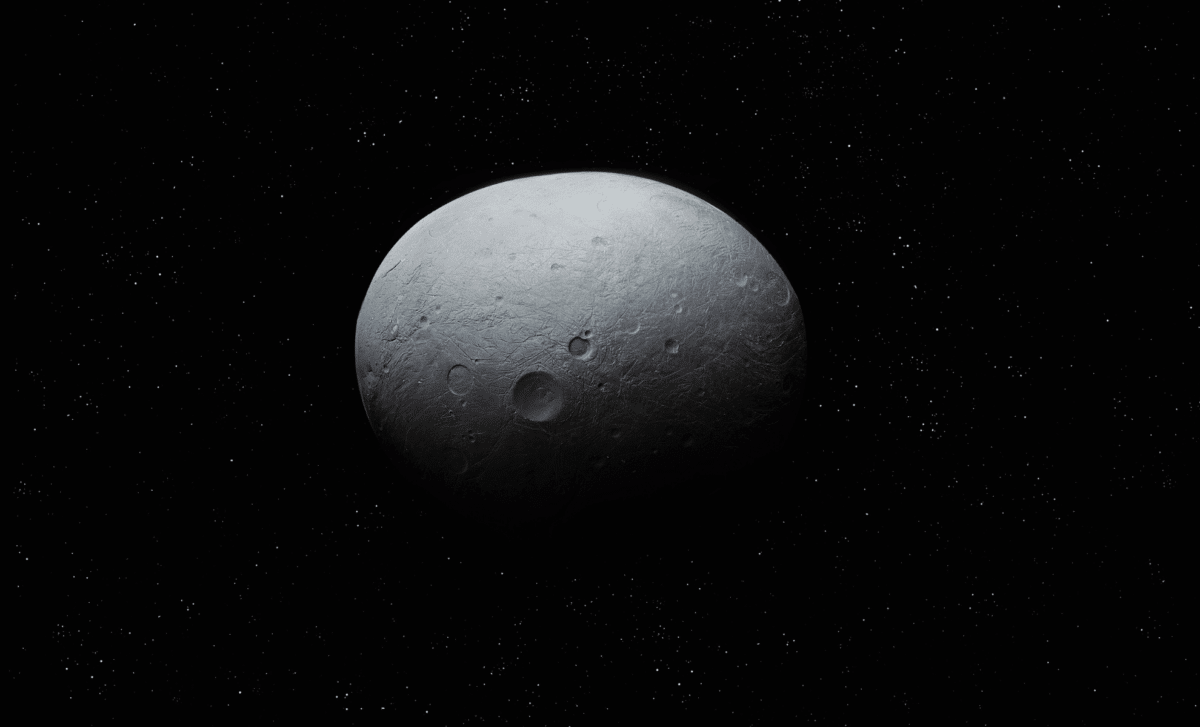
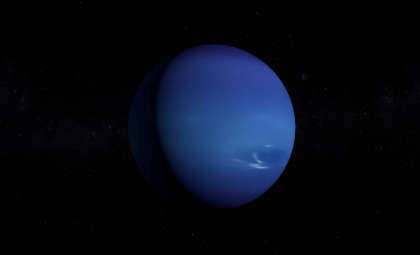
Astronomers have uncovered potential evidence of a dense formation located far beyond Neptune, offering fresh perspectives on the early history of our solar system. This finding highlights a cluster of objects within the Kuiper Belt, a remote and enigmatic region that continues to captivate researchers. The scientists behind this discovery propose that these objects belong to an exceptionally ancient and undisturbed assemblage, which could fundamentally alter prevailing theories about planetary formation. Although the research, published on arXiv, is still undergoing peer review, its implications are far-reaching.
The Kuiper Belt: Preserved Relics from the Dawn of the Solar System
The Kuiper Belt is often described as the solar system’s “third zone,” an area abundant with icy bodies left over from the solar system’s creation. Spanning approximately 30 to 50 astronomical units (AU) from the Sun, it contains numerous small objects, some extending up to 100 kilometers in diameter. NASA notes,
“The Kuiper Belt is located in the outer reaches of our solar system beyond the orbit of Neptune. It’s sometimes called the ‘third zone’ of the solar system. Astronomers think there are millions of small, icy objects in this region – including hundreds of thousands that are larger than 60 miles (100 kilometers) wide. Some of the objects, including Pluto, are over 600 miles (1,000 kilometers) wide.”
Add Cosmo Herald as a Preferred Source

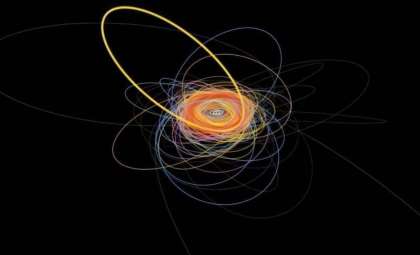
Much like the asteroid belt, the Kuiper Belt consists of primordial remnants that never merged into planets. However, unlike the relatively flat asteroid belt, the Kuiper Belt forms a thick, donut-shaped disk. This distribution has been shaped by gravitational forces exerted primarily by Neptune, sculpting the arrangement of objects in this outermost region of our solar system.
Despite ongoing discoveries, the detailed architecture of the Kuiper Belt remains only partially understood. A 2011 study revealed that the belt is a complex system featuring multiple sub-structures rather than a homogeneous collection. According to research published in The Astronomical Journal,
“We find that the classical belt is a complex region with sub-structures that go beyond the usual splitting of inner (interior to 3:2 mean-motion resonance [MMR]), main (between 3:2 and 2:1 MMR), and outer (exterior to 2:1 MMR).”
These complexities are particularly evident in the main classical belt between 40 and 47 AU, which contains distinct groups that challenge earlier models of the Kuiper Belt’s structure.
A Pristine Cluster at 43 AU Offers Clues on Solar System Formation
A research team from Princeton University, led by astrophysicist Amir Siraj, has identified a previously unrecognized structure in the Kuiper Belt near 43 AU. This may represent a “primordial cluster” of icy bodies that have remained largely untouched since the solar system’s inception. Speaking to New Scientist, Siraj noted, “That kind of orbital calmness is a signal of a very old, undisturbed structure,” emphasizing how this formation could unlock vital information about the early solar system’s evolution. The discovery might shed light on how giant planets formed and migrated to their current orbits, as well as reveal details about the solar system’s early interstellar environment.
This discovery builds upon 2011 findings that described a “kernel” component within the Kuiper Belt, characterized by objects with low eccentricities and highly stable orbits. The new structure, situated just inward of the original kernel, features even lower eccentricities, suggesting it might be older and even less disturbed. These insights point to a previously unrecognized depth of complexity in the Kuiper Belt, potentially preserving a snapshot of the solar system’s infancy.
The researchers emphasize their groundbreaking conclusions, stating,
“The main classical belt (a = 40–47 AU) needs to be modeled with at least three components: the ‘hot’ component with a wide inclination distribution and two ‘cold’ components (stirred and kernel) with much narrower inclination distributions.”
The emergence of this inner kernel at 43 AU, marked by notably low eccentricities, points to a formation within a more serene and stable environment than the rest of the Kuiper Belt.
The research is available on the arXiv preprint server and awaits confirmation from forthcoming observations, particularly those planned by the Vera C. Rubin Observatory’s Legacy Survey of Space and Time (LSST), which could decisively determine the presence of this novel structure.
Origins of the Inner Kernel Remain a Mystery
The newly identified “inner kernel” presents a perplexing puzzle. The researchers acknowledge, “It is not obvious how the inner kernel was formed.” While Neptune’s migration could explain the original kernel’s creation, it remains uncertain if this new cluster is a continuation of that structure or an entirely separate entity. Scientists anticipate that future data will help resolve these uncertainties.
What makes the inner kernel particularly fascinating is its remarkably low eccentricity, indicative of a calm, stable orbit. Such stability is rare in this region, where gravitational forces often provoke erratic motions. Forming a cluster with such tranquil orbits would require specific conditions that are not yet fully understood. As Siraj affirmed,
“That kind of orbital calmness is a signal of a very old, undisturbed structure.”
These findings raise new questions regarding the dynamic behavior of objects in the outer solar system. While the sudden migration of Neptune might explain both the original kernel and possibly the inner kernel, the exact origin of this newly observed structure remains unclear. The team further notes,
“It is yet unclear whether the inner kernel is an extension of the kernel or a distinct structure.”
- Categories:
- News


0 comments
Sign in to Comment