

Pancreatic cancer continues to be one of the most lethal malignancies, yet two separate experimental approaches have recently reported complete eradication of tumors in mouse models, according to peer-reviewed research published late in 2025. Both therapies maintained tumor disappearance over extended periods with minimal adverse effects.
One innovative technique, developed by scientists at Duke University, involves a biodegradable radioactive gel implant that delivers focused radiation directly to tumors in the pancreas. The other method, from the National Cancer Research Center (CNIO) in Madrid, Spain, consists of a three-drug combination designed to target several cancer signaling pathways simultaneously, preventing the tumor’s resistance mechanisms.
Pancreatic ductal adenocarcinoma (PDAC), the predominant form of pancreatic cancer, remains notoriously challenging to manage, with a five-year survival rate under 12 percent worldwide. Late detection and intrinsic genetic mutations contribute to its aggressive nature and therapeutic resistance.

Radioactive Gel Implant Achieves Tumor Clearance in 80% of Rodents
Published in Nature Biomedical Engineering in October 2025, a research team from Duke University demonstrated that their novel gel containing iodine-131 could successfully remove tumors in 80 percent of treated mice suffering from pancreatic cancer. This approach combines the radioactive isotope with elastin-like polypeptides (ELPs) that form a stable gel upon injection into tumor sites.
The gel localizes the radioactive particles, enabling a continuous release of beta radiation that destroys tumor cells while sparing healthy tissue. As the iodine isotope decays, the gel safely degrades and is absorbed by the body.
The detailed findings, published in Nature, also tested this implant alongside paclitaxel, a chemotherapy drug that makes tumor cells more sensitive to radiation. Together, they achieved complete tumor regression across several mouse models, including those engineered with common PDAC mutations.
Jeffrey Schaal, the principal investigator who now leads research at Durham-based biotech firm Cereius Inc., noted that this treatment demonstrated unprecedented success compared to over 1,100 previous preclinical PDAC trials. Animals tolerated the treatment well, showing no radiation toxicity and only standard chemotherapy side effects.
Future work will involve testing in large animal models using clinical endoscopic tools to assess practicality and safety before taking steps toward human clinical trials.
Madrid Researchers Halt Tumor Resistance With Multi-Drug Approach
A separate investigation, published in PNAS in December 2025, presented sustained total remission of pancreatic tumors using a three-drug targeted regimen. This study was conducted at the Centro Nacional de Investigaciones Oncológicas (CNIO) in Madrid and led by leading cancer biologist Mariano Barbacid, with co-authors Vasiliki Liaki and Carmen Guerra.
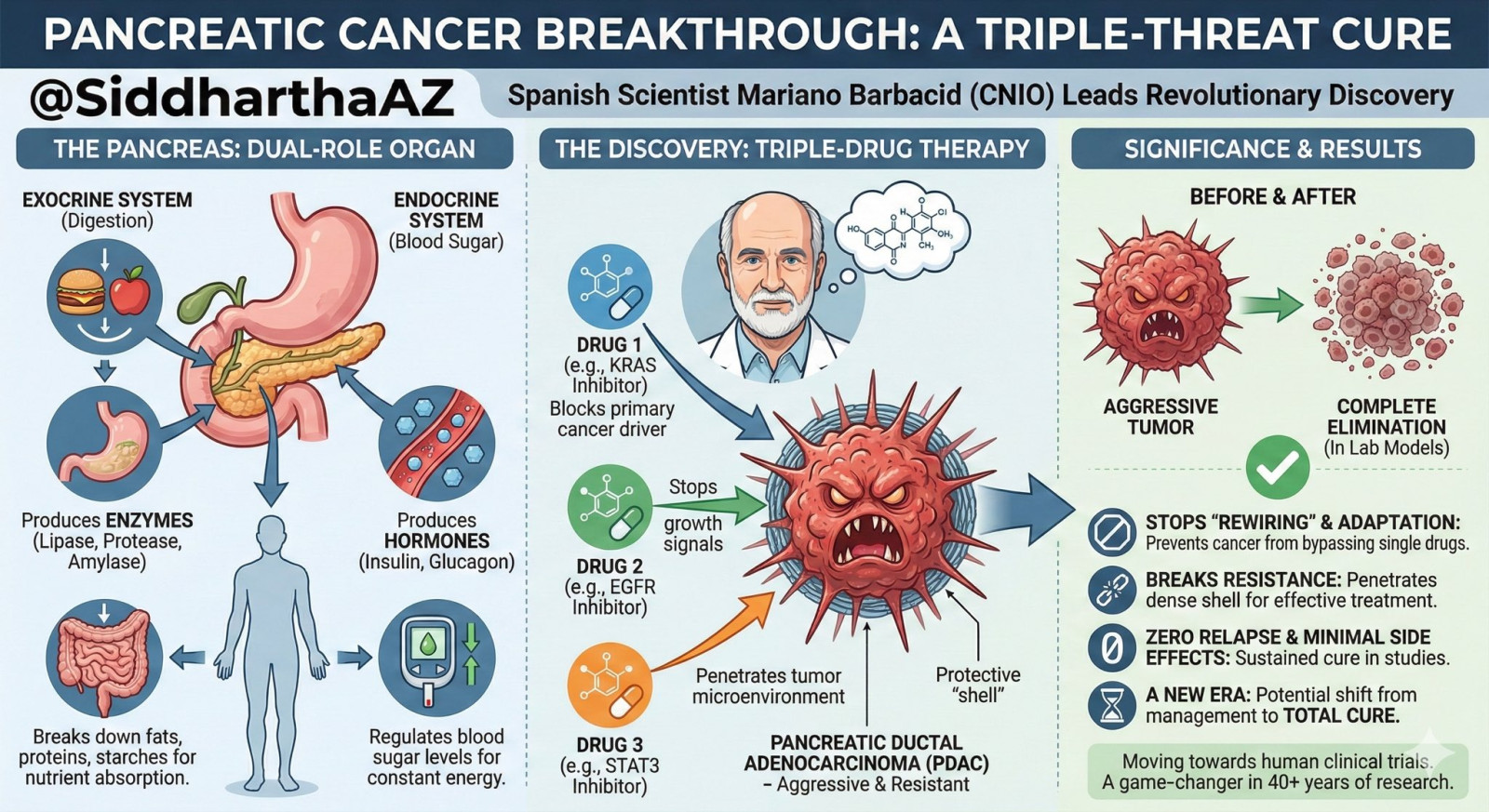
This therapy targets several key nodes in the KRAS signaling network, a main driver of PDAC known for causing single-agent treatment failures. The drugs administered include:
- Daraxonrasib (RMC-6236), a KRAS(ON) inhibitor;
- Afatinib, an irreversible blocker of EGFR/HER2 kinases;
- SD36, a PROTAC molecule that selectively degrades STAT3.
The triple-drug protocol inhibited tumor growth and eliminated cancer cells in both orthotopic mouse models and patient-derived xenografts (PDXs). Remarkably, no tumor recurrence was detected over a 200-day follow-up, marking one of the longest-lasting responses observed in pancreatic cancer preclinical studies.
Barbacid’s team further validated the drug targets using genetic deletion of EGFR, RAF1, and STAT3, confirming that both pharmacological and genetic interventions produced complete tumor elimination.
Animal models tolerated the treatment without any noticeable toxicity, underscoring its potential safety and efficacy.
Challenges for Moving Into Clinical Trials
Although these preclinical results are promising, both treatments are still expected to require several years of development before clinical application. Historically, many therapies effective in mice have failed in human trials due to differences in immune responses, tumor complexity, and side effect profiles.
Conventional external radiation therapy has struggled to deliver sufficient doses deep inside the pancreas without harming neighboring tissues. Previous devices employing titanium-encased radioactive sources faced limitations due to exposure risks to adjacent organs. The biodegradable radioactive gel from Duke aims to bypass these issues by providing sustained, localized beta radiation, degrading safely post-treatment.
Targeting the KRAS pathway has posed significant challenges in oncology. While drugs like daraxonrasib have shown encouraging results in lung and colorectal cancer, pancreatic tumors rapidly develop resistance. The CNIO team’s multi-pathway inhibition, targeting EGFR, RAF1, and STAT3, is a novel strategy designed to block tumor escape mechanisms.
Development and Regulatory Outlook
As of early 2026, neither therapy has begun Phase I clinical trials, and specific timelines for human testing are yet to be announced.
Duke researchers intend to assess the radioactive gel implant in large animal models using existing clinical endoscopy equipment to establish safety and delivery efficacy. Meanwhile, the CNIO group holds two European patents for their triple-drug therapy and is engaging in early discussions for clinical progression.
Funding for Duke’s research has been provided by the U.S. National Institutes of Health (NIH) and the National Cancer Institute (NCI). CNIO’s work received support from the European Research Council, CRIS Cancer Foundation, and various Spanish national science agencies.
Obstacles ahead include the high cost and manufacturing challenges of complex drug cocktails, ensuring regulatory approval for PROTAC-based molecules, and scalable production of biodegradable radioactive implants compliant with Good Manufacturing Practice (GMP) standards.
- Categories:
- Science










0 comments
Sign in to Comment