

New research has uncovered an unusual geological event occurring beneath the Central Anatolian Plateau in Turkey, where sections of the Earth's crust are gradually sinking into the planet's interior. This intriguing process, called lithospheric dripping, complicates traditional models of plate tectonics and may have implications for understanding planetary geology beyond Earth.
An Uncommon Phenomenon Beneath the Konya Basin
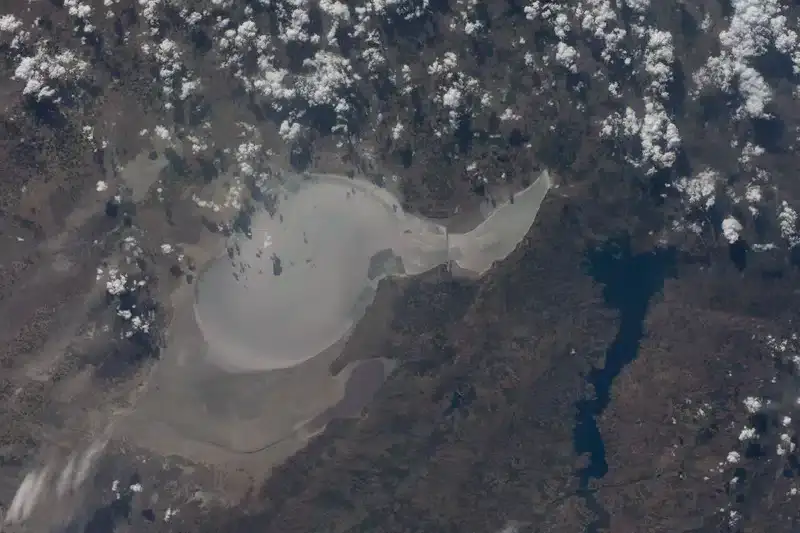
The investigation, featured in Nature Communications, focuses on the Konya Basin, a low-lying region in central Turkey. By analyzing satellite imagery and seismic measurements, researchers detected a circular signature where the crust appears to be subsiding. Evidence such as seismic irregularities and crustal thickening under the basin points to dense matter accumulating in the upper mantle layer.
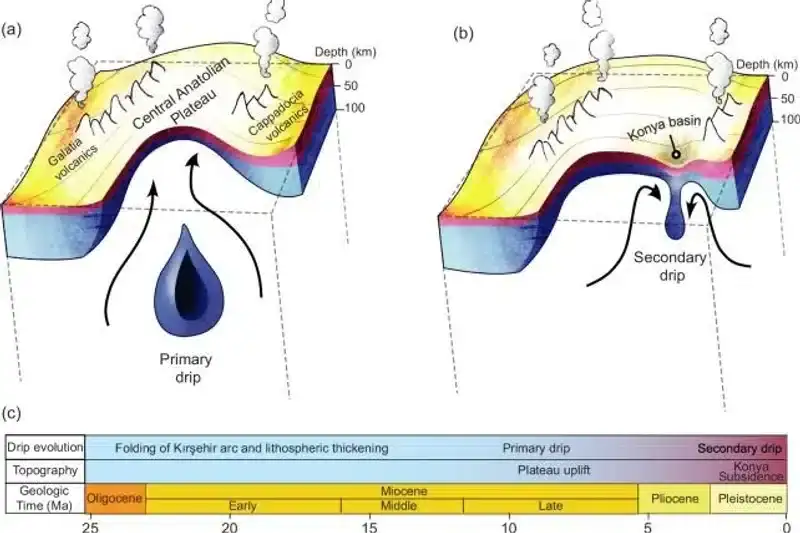
Julia Andersen, a geophysicist from the University of Toronto and the lead investigator, described this anomaly as a probable mantle lithospheric drip. In essence, the dense lower crust slowly descends like a viscous fluid, creating a blob-like mass that draws the surface downward. Following the droplet's eventual detachment, the overlying crust rebounds, resulting in surface uplift.

Gradual Crustal Deformation Reshaping Central Anatolia
The Central Anatolian Plateau has been gently elevating for millions of years, rising roughly one kilometer during the past 10 million years. However, unlike the plateau’s broad upward trend, the Konya Basin is subsiding at approximately 20 millimeters annually. Researchers attribute this to a secondary lithospheric drip occurring independently within the basin.
Russell Pysklywec of the University of Toronto explained that the initial drip likely set off “daughter events” in adjacent areas. He noted that “as the lithosphere thickened and began dripping beneath the region, it formed a basin which later rebounded when the detached material sank deeper into the mantle.” This cycle appears to be recurring, currently producing a smaller drip beneath Konya.
Laboratory Models Replicate Dripping Process
To confirm their observations, the scientists simulated lithospheric dripping in a laboratory setup. They used polydimethylsiloxane, a silicone polymer with adhesive properties, to imitate the lower mantle’s viscous behavior. The upper mantle was represented by a mixture of this polymer combined with clay, while a mixture of ceramic spheres and silica sand was used to model the crust.
A dense seed was embedded within the upper mantle analogue to initiate the dripping action. Within ten hours, a viscous droplet formed and began descending. About 50 hours into the experiment, a secondary droplet emerged. Remarkably, even without lateral forces, this secondary drip caused the crust model to lower and form a basin, demonstrating that such events can occur purely through vertical processes deep underground.
Implications for Geological Activity on Earth and Beyond
These results hold significance not only for Earth's tectonics but also for understanding similar structures elsewhere. The team identified comparisons with the Arizaro Basin in South America's Andes, where lithospheric dripping likely influenced its development.
More broadly, this study inspires investigation into analogous geological processes on other worlds like Mars and Venus. Although tectonic behaviors at the surface vary there, their deep mantle dynamics may host comparable lithospheric drip phenomena.
- Categories:
- News






0 comments
Sign in to Comment