

Using NASA’s Chandra X-ray Observatory, researchers have discovered a new cosmic channel funneling high-energy gas away from Sagittarius A* (Sgr A*), the supermassive black hole anchoring our galaxy's center.
New Pathway for Gas Identified in Galactic Center by Chandra
This recently detected outlet is linked with a chimney-like formation positioned perpendicular to the Milky Way’s disk. Chandra’s observations illustrate how matter moves outward from the galaxy’s core through this unique passage.
Across the universe, many supermassive black holes voraciously consume nearby gas, dust, and stars.

In stark contrast, Sagittarius A*, our galaxy's central black hole, is a notably light consumer. Its consumption rate is so minimal that it would metaphorically need only a grain of rice once every million years to survive. Insights from Chandra may help explain why this black hole accepts certain material while disregarding others.
The vent identified through Chandra’s X-ray measurements lies roughly 700 light-years from the precise central region, near the peak of the chimney. This feature was first detected by the European Space Agency’s XMM-Newton telescope, which also observes X-ray wavelengths like Chandra.
The combined image of the Galactic Center merges blue-hued X-ray data from Chandra with red radio signals captured by South Africa’s MeerKAT telescope.
The radio observations reveal magnetic fields shaping and confining the gas within the chimney structure.
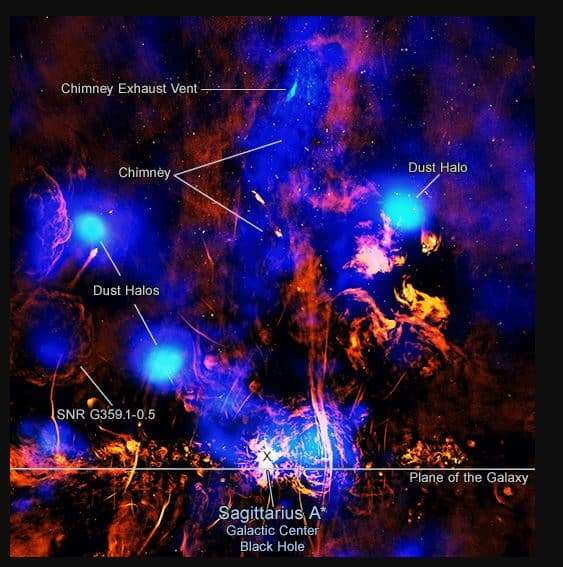
This vent shows prominently at the top of the image as a vivid blue and white streak against darker blue gas clouds.
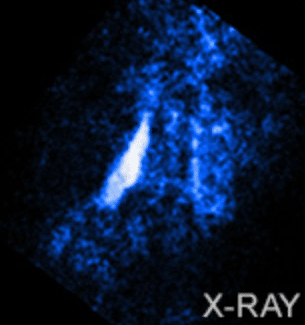
In the enhanced Chandra-only image, brighter white ridges trace the outline of what researchers interpret as a cylindrical tunnel, channeling hot gas upward, away from Sgr A* and its immediate surroundings.
Insights into the Mechanism Driving Milky Way’s Galactic Vent Near Black Hole
The research team proposes that this gas outlet forms as hot material surging up the chimney generates shockwaves when it collides with cooler gas, making the X-ray bright walls of the vent. The asymmetry in brightness—stronger on the left side—likely results from the hot gas impacting this wall more forcefully.
Where does this hot gas jet originate? Scientists theorize that material falling toward Sgr A* triggers energetic outbursts that force gas up through the chimney and out into space. However, the frequency of gas infall toward the black hole remains uncertain.
Previous studies suggest that Sgr A* and its environment produce intense X-ray flares every few decades, which could be key in propelling hot gas outward.
More sporadically, the black hole experiences dramatic feeding events approximately every 20,000 years, where it tears apart and consumes an unlucky star.
These known as “tidal disruption events” (TDEs) unleash tremendous energy, channeling stellar remnants and energy upward along the chimney. Sgr A* rejects this debris, directing it outward like cosmic leftovers.
The team’s research on Sgr A* is currently available on the arXiv platform as a pre-peer-reviewed manuscript.
- Categories:
- Astronomy ,
- News ,
- Science ,
- Space ,
- Nasa












0 comments
Sign in to Comment