
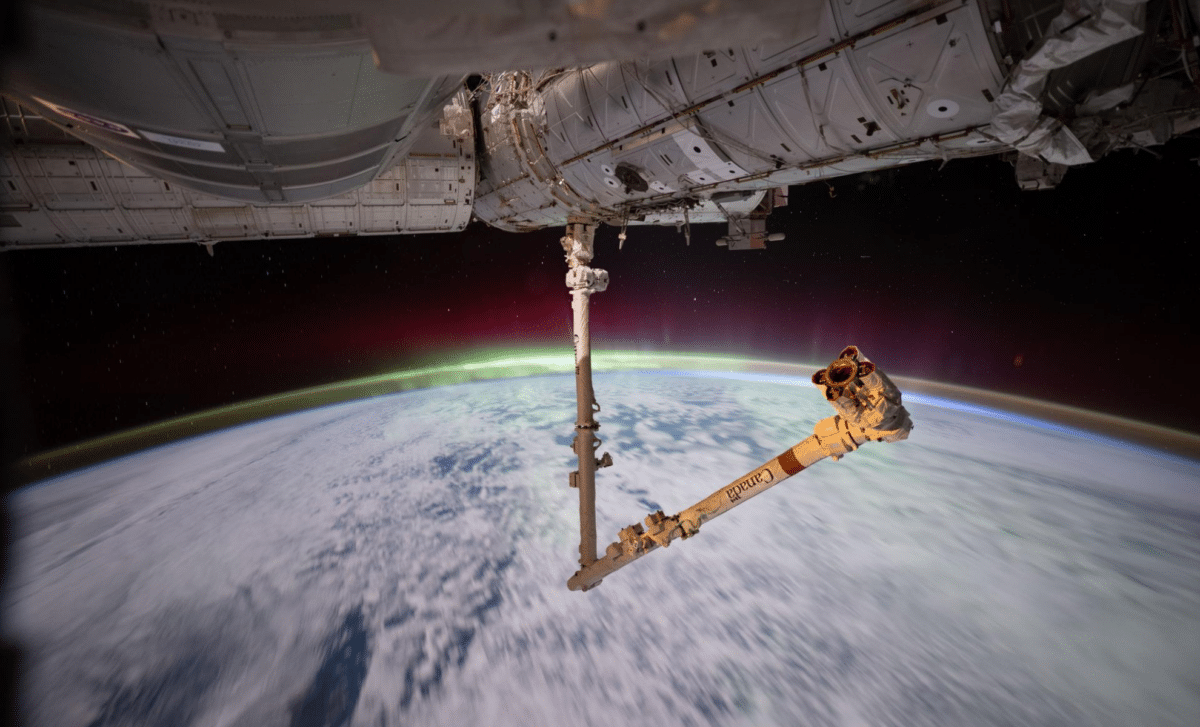
The International Space Station (ISS) experienced a dynamic day as astronauts from Expedition 74 engaged in numerous scientific trials, installed pivotal equipment, and readied for a crucial maintenance operation on the station’s Canadarm2 robotic arm. As reported by NASA, these efforts highlight the continuous skill and meticulous attention necessary to sustain humanity’s orbital outpost.
Deployment of CubeSats Marks Expansion in Mini-Satellite Research
A key moment involved setting up a deployer for compact CubeSats within the Japanese Kibo laboratory module. These small satellites are set to broaden the scope of research available to both governmental and private entities. The Hokushin-1 CubeSat, one such satellite, aims to experiment with advanced technologies such as radio frequency communication, propulsion, and solar panel efficiency. NASA flight engineer Jack Hathaway carefully installed the deployer in Kibo’s airlock, where it will be brought into space’s vacuum and controlled by the Japanese robotic arm to release the CubeSats into orbit. This task not only augments ISS research potential but reinforces the station’s status as a hub for pioneering space tech testing.
Expedition 74 spent Wednesday working on CubeSats, a science freezer, and biomedical monitoring while preparing for a Canadarm2 repair spacewalk. More… https://t.co/WLJBKiIXe1 pic.twitter.com/vc0TCDyJKw
— International Space Station (@Space_Station) June 10, 2026Add Cosmo Herald as a Preferred Source

Onboard Freezer Installation Ensures Sample Preservation
Maintaining the quality of scientific samples onboard is vital, and NASA flight engineer Jessica Meir set up a compact glovebox freezer inside the Kibo Life Science Glovebox (LSG). This freezer instantly preserves research samples post-processing, ensuring they remain viable for study both on the station and after returning to Earth. This capability supports critical biological investigations relevant to long-duration space travel, from cellular examination to tissue research, while also trialing equipment potentially useful for future Moon and Mars missions.
Biomedical Device Testing Enhances Astronaut Health Monitoring
Protecting crew health is a top priority aboard the ISS. Meir collaborated with ESA astronaut Sophie Adenot in evaluating wearable medical sensors for two biomedical experiments. Adenot first calibrated the PhysioTool by recording her blood pressure, then wore sensors to track brain oxygen levels and blood flow during cognitive challenges. These studies seek to validate technologies for ongoing health assessments on extended missions, including those to the Moon and Mars. Portable real-time health tracking is a crucial step toward enhancing astronaut safety during deep-space exploration.
Preparing for Canadarm2 Repair Spacewalk
In late May, operational checks revealed increased motor current in one of the Canadarm2 wrist joints, restricting the robotic arm’s movement. NASA and the Canadian Space Agency (CSA) concluded that a spacewalk must be performed to replace the defective joint using a spare part already on the ISS. Crew members prepared spacesuits for this upcoming EVA, ensuring all components such as limbs, helmets, and life support systems are correctly configured. The Canadarm2, essential for cargo management and robotic tasks, is currently secured with normal operations paused, reflecting the careful management of functionality and risk aboard the station.
Roscosmos Crew Conducts Microgravity Motion Studies
Meanwhile, Roscosmos cosmonauts Sergey Kud-Sverchkov and Sergei Mikaev carried out physics experiments inside the Zvezda service module to investigate movement behavior in microgravity. By observing spheres of various sizes floating freely without external forces, the cosmonauts aim to improve understanding of crew mobility, robot tool design, and motion dynamics in orbit. Results from these experiments contribute practical knowledge that supports robotics development, station ergonomics, and overall mission safety.
Station Orbit Boosts Ensure Upcoming Crew Dockings
The station’s altitude was raised by 1.9 miles following an eight-minute thruster burn executed by the Progress 95 cargo vehicle. This orbital reboost is designed to optimize the trajectory for the Soyuz MS-29 crew spacecraft, which is scheduled to launch mid-July. Such maneuvers are routine but vital for ensuring station stability, safe spacecraft docking, and long-term orbital integrity, demonstrating the meticulous orbital management necessary to support astronauts and sensitive equipment aboard.
- Categories:
- Nasa


0 comments
Sign in to Comment