

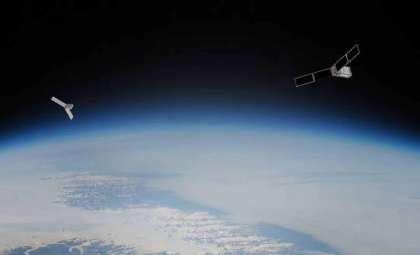
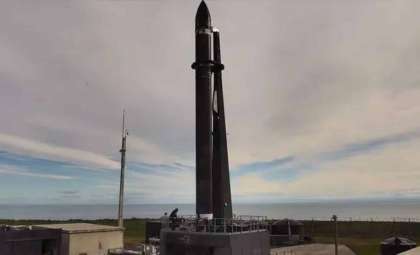
Firefly Aerospace’s Alpha vehicle is poised to send eight CubeSats into orbit under NASA’s Educational Launch of Nanosatellites (ELaNa) 43 campaign.
The launch, initially planned for Monday evening, was postponed due to a ground system malfunction and is now set for no earlier than Tuesday, July 2, at 9:03 p.m. PDT from the Space Launch Complex 2 at Vandenberg Space Force Base in California.
Overview of the Mission and Its Goals
Termed the Noise of Summer mission, this marks Firefly Aerospace’s fifth attempt to launch the Alpha rocket. The mission’s main goal is deploying eight CubeSats into a sun-synchronous orbit, part of NASA’s CubeSat Launch Initiative (CSLI), which supports educational institutions and nonprofits in gaining satellite flight opportunities. Firefly is among three companies awarded contracts under NASA’s Launch Services Program Venture-Class Launch Services Demonstration 2 (VCLS Demo 2) agreement, established in December 2020.

The Alpha rocket, standing 29.48 meters (96.7 feet) tall and featuring two stages, will carry CubeSats from various universities and NASA centers into the designated orbit. The initial launch countdown halted at T-8 seconds due to a "ground support issue," forcing teams to recycle to T-19 minutes before a second abort at T-10 minutes and 12 seconds led to a scrub. Firefly shared via social media that the issue has been identified and the team is preparing for the upcoming launch window on July 2.
Payload Details
The eight CubeSats flying on this mission are part of NASA’s CubeSat Launch Initiative, featuring a range of educational and technology-focused experiments. These include:
- CatSat (University of Arizona), which will showcase a deployable antenna designed to enhance high-speed communications for small satellites.
- KUbeSat-1 (University of Kansas) aims to study cosmic rays, investigating their energy and composition as they enter Earth's atmosphere.
- MESAT-1 (University of Maine) will monitor water temperatures to forecast algal blooms using multispectral imaging of phytoplankton concentrations.
- R5-S4 and R5-S2-2.0 (NASA Johnson Space Center) seek to advance CubeSat development processes to allow faster, more cost-effective production of high-performing satellites. Sam Pedrotty, managing the R5 project, stated, "In the near term, R5 hopes to demonstrate new processes that allow for faster and cheaper development of high-performance CubeSats. The cost and schedule improvements will allow R5 to provide higher-risk ride options to low-Technology Readiness Levels payloads so more can be demonstrated on-orbit."
- Serenity (Teachers in Space) will carry educational experiments accessible via ham radio, enabling public data and image retrieval from the satellite.
- SOC-i (University of Washington) is designed to test attitude control systems, utilizing the SOAR guidance to prevent instruments from pointing at the Sun while keeping solar panels optimally powered.
- TechEdSat-11 (NASA Ames) includes tech demonstrations like an exo-brake for satellite deorbiting, advanced communication systems, and radiation sensors.
Advancing Firefly’s Launch Operations
Firefly Aerospace is broadening its launch infrastructure with facilities planned in Virginia and Sweden to boost launch frequency and offer clients access to preferred orbits. The company anticipates completing four Alpha launches this year, servicing both commercial and governmental customers.
The expansion involves establishing a new launch site at Wallops Island, Virginia, expected to be active by early 2025, and collaborating with the Swedish Space Corporation for operations at the Esrange Space Center in Sweden starting 2026.
This growth strategy aims to ease launch congestion and enhance cadence. Charlotta Sund, CEO of SSC, commented, "We’re pleased to announce this historic collaboration that will have a huge impact on the global launch market, not least in Europe and the U.S. Reducing the current gap of orbital launch sites in Europe, this collaboration strengthens the transatlantic link between Sweden and the U.S. whilst offering unique space capabilities for the Swedish NATO membership."
- Categories:
- Astronomy ,
- News ,
- Nasa ,
- Aircraft






0 comments
Sign in to Comment