

Scientists at Brookhaven National Laboratory in Upton, New York, have uncovered a novel phase of matter within a magnetic material, characterized by a peculiar internal structure that flips between two states over a minute temperature interval. Their results, featured in the December 31, 2024 issue of Physical Review Letters, introduce a new avenue for comprehending and manipulating phase transitions in select materials.
This unique phase, termed “half ice, half fire,” consists of two contrasting groups of electron spins coexisting simultaneously inside the same substance. One group exhibits a high degree of order, labeled “cold,” while the other is highly disordered, called “hot.” Electron spins, tiny magnetic moments intrinsic to electrons, can orient either up or down, and their arrangement governs a material's magnetic and thermal quantum behaviors. The nickname vividly conveys this stark disparity.
What distinguishes this phase from other exotic matter states is the extreme sharpness of its transition. Generally, phase changes in materials occur gradually, limiting their effectiveness in technologies demanding rapid, precise switching between states. Here, the transformation happens within an ultranarrow temperature range, linking this discovery to applications in quantum computing, spintronics, and magnetic refrigeration.

The Ferrimagnetic Compound Under Intense Study
The phase was detected in Sr3CuIrO6, a compound comprised of strontium, copper, iridium, and oxygen, categorized among ferrimagnets. Unlike conventional magnets, ferrimagnets have atoms with opposing magnetic moments that fail to fully neutralize one another, yielding a residual magnetization. Brookhaven physicists Weiguo Yin and Alexei Tsvelik have been investigating this material since 2012, following pioneering measurement efforts led by John Hill during a collaborative project.
The 2016 breakthrough revealed a related phase named “half fire, half ice,” where disordered hot spins occupy the copper lattice sites and ordered cold spins the iridium sites. This state only emerges when subjected to a critical magnetic field. Tsvelik later admitted that, despite deep study, applications of this phase remained elusive: “We were still missing pieces of the puzzle.”
The newly identified “half ice, half fire” phase inverses this configuration. Here, the roles of hot and cold spins switch places on the atomic sites, and unlike the previous discovery, its emergence does not rely on an external magnetic field. It naturally occurs at a fixed temperature inside the material. Detecting this phase demanded innovative theoretical approaches and revisiting over a decade's worth of data on the compound.
This finding also challenges a longstanding theoretical barrier. For more than 100 years, the one-dimensional Ising model of ferromagnetism was believed incapable of exhibiting phase transitions at finite temperature, hindering practical exploitation of such states. Yin's work demonstrated that an ultranarrow crossover near a specific temperature indeed approaches this prohibited transition, unlocking the theoretical foundation for this discovery.
Narrow Temperature Switch Between Two Contrasting States
The transition between the “half fire, half ice” and “half ice, half fire” states happens within a strikingly narrow temperature margin, setting it apart from the typically gradual phase changes in magnetic materials. This sharp switching enables distinct and unambiguous boundaries between configurations, beneficial for clean control. The Physical Review Letters article elaborates on this transition and the theoretical constructs underpinning both phases.
Accompanying the transition is a pronounced magnetic entropy change, quantifying the variation in spin disorder. A rapid and significant entropy shift within a tight temperature span produces a notable thermodynamic effect. In Sr3CuIrO6, this combination results in transition characteristics unmatched by conventional magnetic materials.
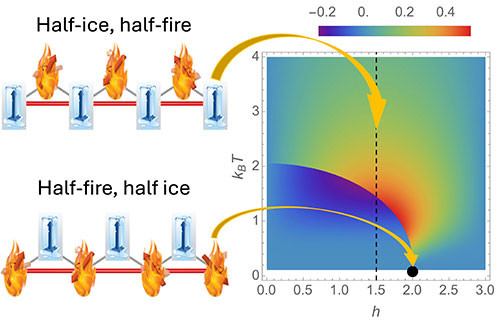
The hidden “half ice, half fire” phase presents an additional challenge. While its counterpart manifests at a distinct critical point under an external magnetic field, this phase occupies a broader temperature-field domain, concealed rather than confined to a single point. Discovering it relied on precise theoretical insight into ultranarrow crossover dynamics and meticulous analysis of longstanding data.
Together, these two distinct phases are connected through a unique, sharp switching mechanism, providing the Brookhaven team’s principal advancement.
Potential Impact on Quantum Tech and Cooling
Yin and Tsvelik foresee two main application areas stemming from the observed phase characteristics. First is magnetic refrigeration, which benefits from brisk, substantial changes in magnetic entropy. When spin disorder shifts quickly across a narrow temperature range, it drives efficient heat exchange, positioning Sr3CuIrO6 as a promising refrigerant.
The second application targets quantum information storage. The coexisting phases represent two distinct and stable material states that could encode binary data, serving as bits in an innovative quantum memory. Unlike conventional qubits relying on individual particles, this approach leverages bulk phase behaviors for data encoding.
These developments align with broader goals in condensed matter physics and materials science. “Identifying new states with exceptional properties and mastering their phase transitions are central challenges in these fields,” Yin noted in the Brookhaven Lab announcement. “Addressing them could revolutionize technologies such as quantum computing and spintronics.”
Spintronics exploits electron spin instead of charge for information processing, offering a path forward beyond traditional silicon-based technologies.
- Categories:
- Science













0 comments
Sign in to Comment