
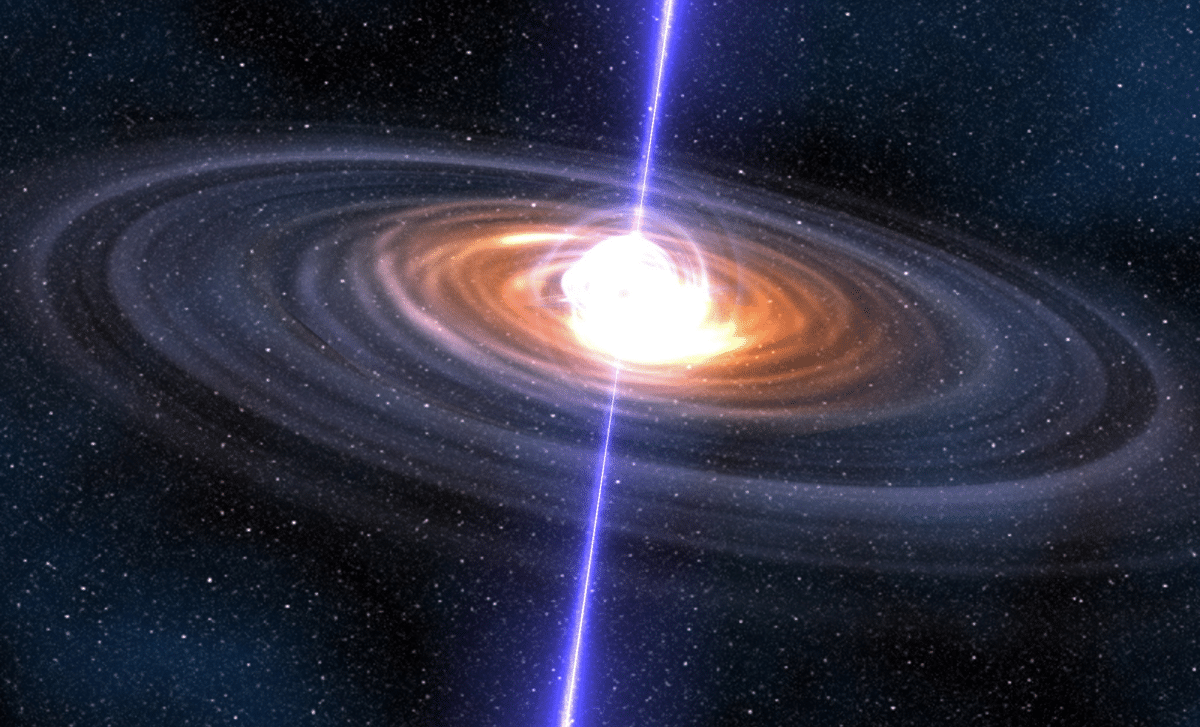
Astronomers have verified the presence of gamma-ray pulsations emanating from PSR J0435+3233, an exceptionally rapid millisecond pulsar situated nearly 3,900 light-years from our planet. The findings, detailed in a recent arXiv publication, reveal this pulsar as a rare gamma-ray source that challenges prevailing neutron star theories.
Discovery of a Pulsar with Unique Characteristics
Identified in 2026 via the Five-hundred-meter Aperture Spherical radio Telescope (FAST), PSR J0435+3233 is distinguished by its extraordinary spin rate. This pulsar, part of a binary system, completes a rotation roughly every 3.2 milliseconds, spinning more than 300 times per second.
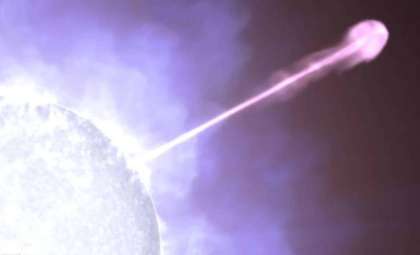
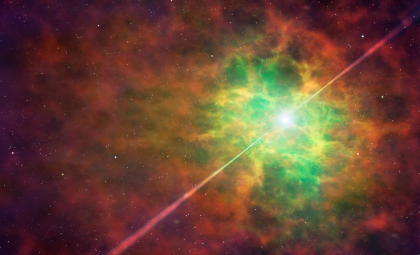
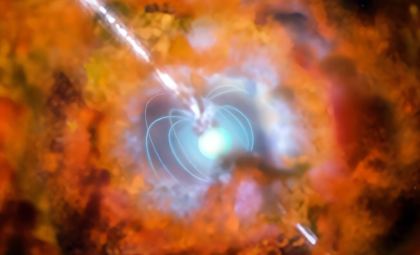
Millisecond pulsars are neutron stars that have been sped up through a recycling process, where accretion from a companion star boosts their rotational velocity. This rapid spinning transforms them into intense cosmic lighthouses emitting beams of electromagnetic radiation.

This particular pulsar exhibits an unusually high period derivative — a measure of how fast its spin is decelerating — at levels that exceed most comparable pulsars by over two orders of magnitude.
Additionally, PSR J0435+3233 boasts a remarkable spin-down luminosity of approximately 58.9 undecillion erg per second, ranking it among the most energetic objects in its category. Its magnetic field strength at the surface is about 12.6 billion Gauss, further underlying its singular nature.
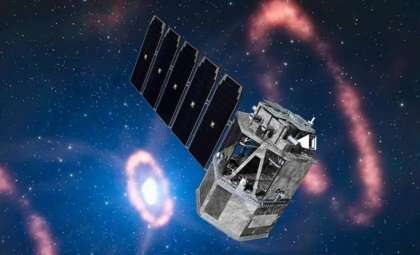
Given these exceptional attributes, scientists anticipated that this pulsar might emit detectable gamma rays, prompting them to scrutinize data from NASA’s Fermi Gamma-ray Space Telescope.
Gamma Rays Illuminate Hidden Emission Source
Leading the investigation, Mengqing Zhang from Yunnan University analyzed close to 17.7 years of observations recorded by the Fermi-Large Area Telescope (Fermi-LAT). The study focused on gamma-ray energies spanning 0.1 to 500 GeV to detect emissions linked to this pulsar.
“Motivated by these properties, we analyzed about 17.7 years of Fermi-LAT (Fermi-Large Area Telescope) observations in the 0.1–500 GeV energy range for this pulsar,” the researchers wrote in the paper.
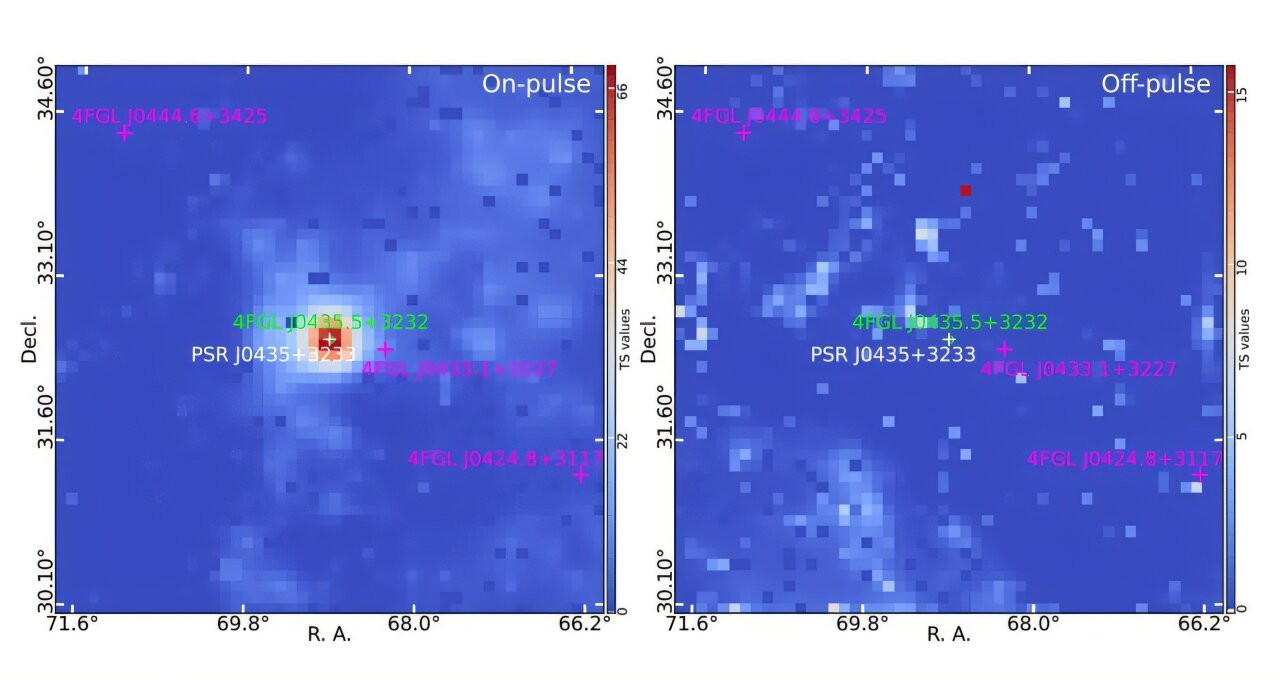
The analysis uncovered a gamma-ray emitter designated 4FGL J0435.5+3232, situated within 0.01 degrees of the known radio position of PSR J0435+3233. This close proximity strongly suggests that both sources correspond to the same astronomical object.
Scientists then detected pulsating gamma rays that occur at the exact rotation period of the pulsar. This emission was not uniform throughout its spin; instead, the majority of gamma rays were observed between phase 0.44 and 0.69, with no significant signals outside this interval.
This phase-dependent pattern confirms that the gamma-ray emission originates from PSR J0435+3233 rather than from unrelated nearby sources. The timing and signal match the characteristics expected from a rotating neutron star generating radiation within its magnetosphere.
These findings validate PSR J0435+3233 as a confirmed gamma-ray millisecond pulsar, contributing a rare and extreme example to the catalog of highly energetic neutron stars.
A Gamma-Ray Pulsar That Defies Expectations
The study reveals an intriguing discrepancy. Despite PSR J0435+3233 possessing spin-down energy comparable to young, powerful pulsars, its gamma-ray output appears strikingly faint.
Calculations show a gamma-ray luminosity near 0.626 decillion erg per second, leading to an estimated gamma-ray efficiency of only about 0.00001. This implies that a mere fraction of the pulsar’s rotational energy converts into gamma-ray emission.
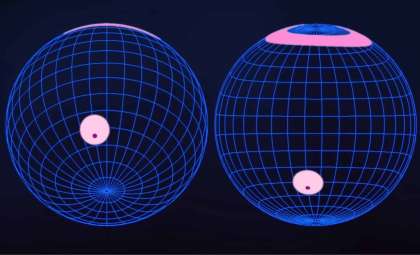
This mismatch raises critical questions about particle acceleration dynamics within the magnetospheres of such rapidly spinning neutron stars. The observed gamma radiation may depend heavily on factors like emission beam shape and the angle between Earth and the pulsar’s rotation axis.
The researchers emphasize that their discovery opens new pathways to investigate the underpinning physics of millisecond pulsars.
“Our detection establishes PSR J0435+3233 as a gamma-ray MSP, and the striking combination of its high spin-down power and low apparent gamma-ray efficiency provides a new probe of particle acceleration, radiation beaming, and viewing geometry in the magnetospheres of millisecond pulsars with extreme rotational properties,” the scientists wrote.
Published on arXiv, this research deepens our understanding of how neutron stars generate energetic radiation. Pulsars like PSR J0435+3233 allow scientists to test models regarding magnetic fields, particle acceleration, and energetic processes surrounding some of the densest cosmic bodies.
A Valuable Subject for Upcoming Studies
The confirmed gamma-ray pulsations in PSR J0435+3233 present an exceptional opportunity for exploring extreme stellar environments. Its rapid spin, intense magnetic field, and unusual energy profile separate it from most millisecond pulsars known.
Upcoming multi-wavelength observations could unveil more about its magnetospheric structure and why its gamma-ray output is comparatively subdued despite its immense rotational power.
As astronomical instruments improve their sensitivity, other extreme pulsars may be discovered, enriching our understanding of neutron star evolution, particle acceleration mechanisms, and energy emissions paced across the universe.
- Categories:
- Astronomy


0 comments
Sign in to Comment