

Amid typical school activities like math classes and lunchroom conversations, numerous teenagers are forming unexpected emotional connections with artificial intelligence entities. For many young individuals, AI chatbots have evolved into trusted allies—and occasionally, even romantic interests. This emerging behavior has surprised educators and families, as the technology originally intended to assist learning is now serving unanticipated emotional roles.
A comprehensive survey by the Center for Democracy and Technology (CDT) revealed that one in five high school students either engaged in or knew someone involved in a romantic involvement with an AI-powered chatbot. Additionally, 42% confessed to relying on chatbots for emotional comfort, escapism, or substituting genuine human relationships. This October 2025 report illustrates how students increasingly turn to algorithmic entities for companionship, solace, and intimacy.
These AI interactions typically happen away from adult eyes. While many schools incorporate AI tools for customized tutoring and academic help, students also engage with these systems at home. Especially those struggling with loneliness, social anxiety, or identity challenges often find AI to be a safer alternative to real-world relationships. These programs are ever-present, nonjudgmental, and infinitely patient, thus creating appealing substitutes for human contact.

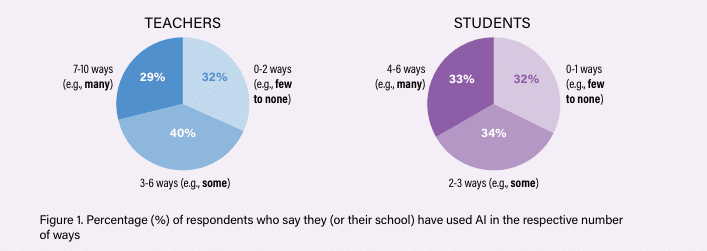
However, researchers and child psychologists warn of serious dangers tied to this dependence. While AI chatbots can simulate sympathy and dialogue, they do not truly comprehend emotions or ethical responsibilities. “They don’t experience emotions,” explains Elizabeth Laird, a co-author of the study. “It is crucial students recognize they are interacting with technology—not a human.” Laird and fellow experts fear that young users’ emotional investments in AI may warp their perspectives on relationships, delay social growth, and in extreme cases, cause psychological damage.
Problems related to AI misuse have already surfaced. The report shows that 36% of students encountered non-consensual deepfake images, commonly depicting peers in sexualized contexts, underscoring generative AI’s dark role in cyberbullying and harassment. The full findings also reveal that only 23% of teachers received training to handle such issues, leaving educators underprepared to manage these complex challenges.
Blurring the Borders Between Assistance and Relationship
AI’s presence in educational settings has expanded rapidly over recent years. Tools such as Khanmigo, Google Classroom AI aids, and GPT-driven writing assistants are now common. Teachers appreciate their ability to adapt learning material for diverse students, yet ethical guidelines are still developing.
The CDT survey indicated that 31% of pupils used school-endorsed AI for non-academic purposes. Without clear boundaries, the line separating a learning aid from a personal confidant becomes easily blurred. Some chatbots, especially those designed for companionship like Replika or Character.AI, encourage more intimate and even romantic exchanges.
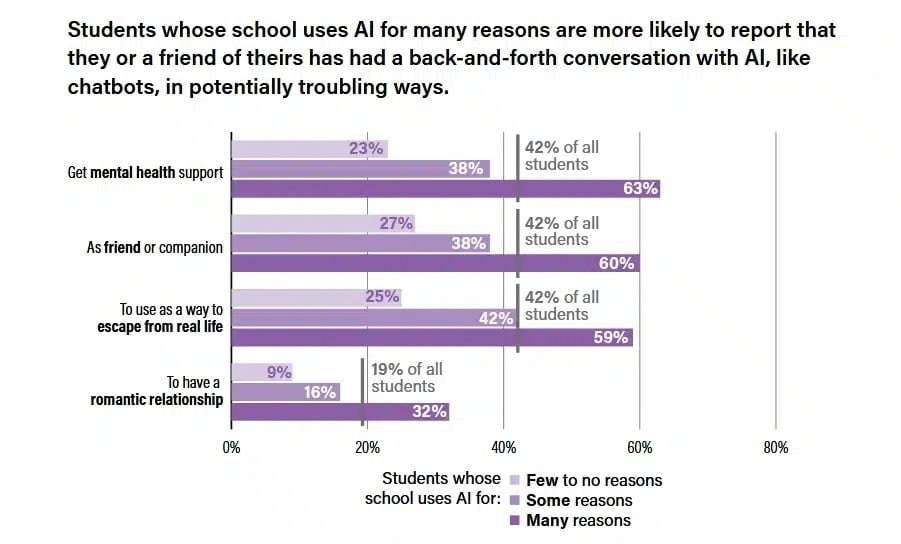
This trend unfolds amid a broader youth mental health crisis. Data from the CDC shows that over 40% of high schoolers reported persistent feelings of sadness or hopelessness as early as 2021. While AI chatbots provide nonjudgmental and on-demand conversation, they are no substitute for professional mental health care. Furthermore, many students remain unaware of what personal data these platforms collect.
A Policy Gap Behind the Scenes
The CDT’s polling of 1,030 students, 1,018 parents, and 806 educators found that 86% of students used AI during the previous academic year, yet most had little to no education about its risks. Parents also lacked awareness. Meanwhile, incidents involving data breaches connected to AI in schools—including unauthorized data gathering and ransomware attacks—are on the rise.
Privacy matters are especially critical for vulnerable groups. The study highlights risks regarding activity tracking of transgender and immigrant students, whose behaviors may be disproportionately monitored or flagged by AI surveillance systems. Though these tools aim to enhance safety, they often fail to respect complex issues of identity and informed consent.
Despite AI’s potential benefits in education, the Hand in Hand report cautions that without proper safeguards, young users risk emotional exploitation, digital vulnerability, and unpreparedness to deal with technologies that can imitate empathy but lack genuine care.
- Categories:
- News













0 comments
Sign in to Comment