

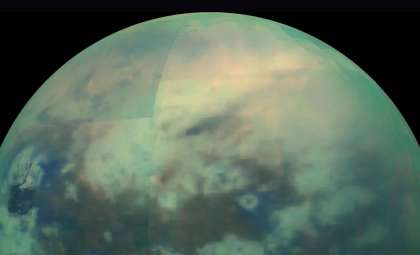
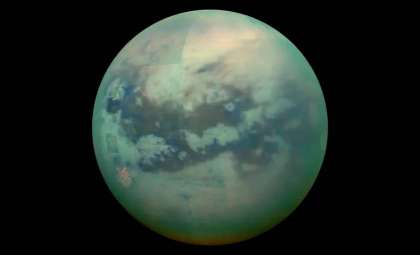
Saturn’s moon Titan stands out in our Solar System due to its dense, nitrogen-rich atmosphere, which has long captivated scientists. A recent study by researchers at the University of Bristol, examining data collected by NASA’s Cassini mission, has revealed an even more puzzling behavior within Titan’s atmospheric dynamics. Refer to their published findings for detailed insights.
The Singular Nature of Titan’s Thick Atmosphere
Not only is Titan Saturn’s largest moon, but it also uniquely possesses a substantial atmosphere unlike any other moon in our Solar System. This thick atmospheric envelope is a prime focus for scientists seeking to broaden our knowledge of planetary atmospheres beyond Earth. Titan’s atmosphere displays an unusual trait: it remains tilted and shifts independently of the moon’s own rotation, defying expectations based on terrestrial atmospheric behavior.
Lucy Wright, the principal investigator of this research, describes the distinctive atmospheric motion: “Titan’s atmospheric tilt is remarkably odd!” Her team found that the atmosphere behaves similarly to a gyroscope, maintaining its orientation in space while the moon itself spins underneath. This exceptional property offers fresh perspectives on the complex climate processes that influence Titan.


Exploring Titan’s Atmospheric Gyroscopic Wobble
Titan’s atmosphere rotates out of sync with its solid ground, displaying what scientists call a “gyroscopic wobble.” This tilt varies with Titan’s seasons, each lasting roughly 30 Earth years. Such behavior differs drastically from Earth, marking Titan’s atmosphere as a captivating subject. Wright notes, “We suspect an earlier event dislodged the atmosphere from its original spin axis, creating this wobble.”
These findings contradict prior beliefs that Titan’s atmospheric movement would closely follow its rotation like Earth. The seasonal tilt fluctuations add complexity to the forces governing Titan’s atmosphere, enhancing its scientific significance.
Unraveling the Stability of Titan’s Atmospheric Tilt
A key enigma is that Titan’s atmosphere remains oriented consistently in space, unaffected by the gravitational pulls of the Sun or Saturn. As Professor Nick Teanby explains,
“What’s puzzling is how the tilt direction remains fixed in space, rather than being influenced by the Sun or Saturn. That would’ve given us clues to the cause. Instead, we’ve got a new mystery on our hands.”
Scientists are now entertaining alternative theories about the forces impacting Titan’s atmospheric behavior, including the potential influence of unknown factors or historical events that may have altered its dynamics.
This behavior distinguishes Titan from other bodies, where solar and planetary gravitational effects typically cause atmospheric shifts aligned with their axial tilts or orbital positions. The atmosphere’s fixed spatial orientation hints that Titan’s geological or atmospheric past may hold answers to this rare phenomenon.
- Categories:
- News








0 comments
Sign in to Comment