
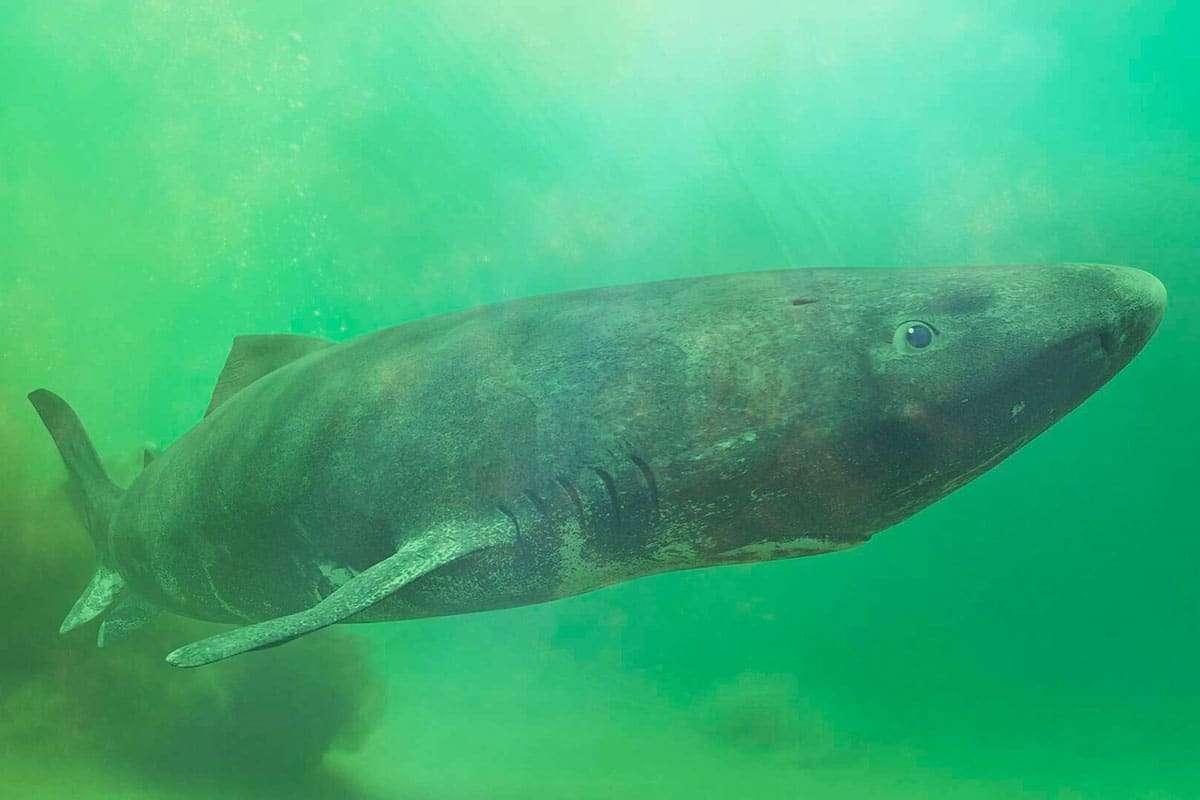
Deep within the chilly Arctic Ocean lurks a creature renowned for its astounding lifespan. The Greenland shark (Somniosus microcephalus) can live for more than 400 years, captivating researchers with its impressive longevity and unique adaptations that allow it to survive in some of the planet’s harshest waters. Despite vast environmental shifts over the centuries, this deep-sea giant has persisted largely unchanged, prompting scientists to explore the secrets behind its extraordinary endurance.
Metabolism on Ice: A Natural Timekeeper
Marine biologist Dr. Marie Dupont from the University of Copenhagen notes, “Greenland sharks owe their exceptional lifespan to a blend of extreme habitat conditions and specialized physiological traits.” Occupying the frigid depths of the Arctic and North Atlantic, these sharks exist in an environment where water temperatures often hover below freezing, resulting in an incredibly slowed pace of life.
Unlike warm-blooded animals that maintain steady internal temperatures, the Greenland shark’s physiology adapts to the cold by significantly reducing its metabolic rate. Dr. Dupont describes this as a form of sustained dormancy, which minimizes cellular damage and enables the shark to function effectively for several centuries.

The Glacial Rhythm of Life as Reflected in the Heartbeat
One striking feature of the Greenland shark is its remarkably slow heartbeat. Investigations reveal it pulses between 4 and 6 beats per minute, drastically slower than an average resting human heart that beats 60 to 100 times per minute.
Professor John Smith from the Arctic Research Center explains, “According to the pace-of-life hypothesis, a sluggish metabolism corresponds to a longer life expectancy.” Yet he adds, “Other Arctic species with similarly slow heart rates do not enjoy comparable lifespans. Greenland sharks likely possess a rare physiological makeup that extends beyond this theory and is still being deciphered.”
A Storied Survivor Facing New Threats
Despite their remarkable adaptations, Greenland sharks face serious challenges in today’s rapidly warming oceans. Climate change threatens to disturb the delicate equilibrium these sharks have depended on for thousands of years.
Climate expert Dr. Emily Johnson from the Polar Institute cautions, “Rising temperatures could speed up their metabolic processes and significantly shorten their lifespan. These sharks have evolved over millions of years for stable, cold conditions. Swift environmental shifts could endanger their survival.”
Adding to the concern is the species’ slow reproductive rate; sexual maturity occurs only around 150 years. Dr. Johnson stresses, “If the environment changes faster than their reproduction cycle, population decline could occur within just a few generations — which for Greenland sharks, spans centuries.”
The Paradox of Endurance
The Greenland shark exemplifies the fragile paradox of longevity. As the longest-lived vertebrate known, its lifespan is impressive yet leaves the species vulnerable to rapid environmental upheaval.
Marine conservation specialist Dr. David Lee emphasizes, “Studying Greenland sharks teaches us about resilience but also underscores the urgency in protecting their ecosystems. They connect us to the Earth’s ancient past, but their future is uncertain.”
Urgent Scientific Endeavors
Researchers and conservationists are racing against the clock to learn more about these ancient dwellers. Utilizing advanced technologies like satellite tracking and genomic sequencing, the International Greenland Shark Project aims to map their movements and better understand their social structure.
These investigations are not isolated to a single species; they are vital to safeguarding Arctic marine ecosystems. As an apex predator, the Greenland shark plays a fundamental role in sustaining environmental balance. Their disappearance could ripple through the marine food web with profound effects.
Symbols of Survival and Fragility
In the context of escalating climate change impacts, Greenland sharks serve as emblems of both incredible resilience and vulnerability. They have endured historic climate shifts but face unprecedented challenges today.
Reflecting on their story, Dr. Thompson remarks, “Greenland sharks highlight how tightly linked ecosystems are. Their long-term adaptations are extraordinary, but we must consider whether we are altering the planet faster than even these resilient animals can endure.”
The outcome for Greenland sharks—whether they continue to navigate the Arctic depths for centuries or become casualties of a transformed world—remains uncertain. Only future science and conservation efforts will reveal their fate.










0 comments
Sign in to Comment