

Groundbreaking research reveals that dark matter, the enigmatic substance constituting much of the cosmos, might interact with ordinary matter beyond gravitational effects.
Traditionally, scientists have understood dark matter as influencing the universe solely through gravity, shaping galaxies and the cosmic web. However, emerging data suggest that there may be faint, previously unnoticed interactions between dark matter and normal matter, offering fresh perspectives on this cosmic mystery.
Understanding the Mystery of Dark Matter
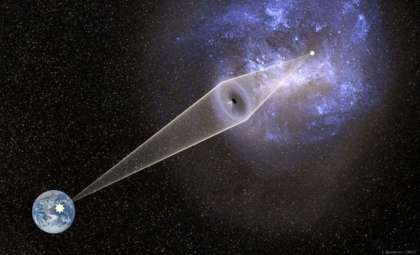
Dark matter has baffled researchers because, unlike ordinary matter, it does not interact with electromagnetic forces—it neither emits nor absorbs light, rendering it invisible. Its presence has only been inferred from gravitational effects, such as gravitational lensing, where light from distant galaxies bends due to dark matter's gravitational field, enabling scientists to chart dark matter's distribution indirectly.

Because it doesn't interact with light, dark matter remains undetectable by traditional telescopes, setting it apart from luminous molecular clouds which absorb or block light. Our current models revolve around the premise that dark matter engages with the cosmos exclusively via gravity. The new study, appearing in The Astrophysical Journal Letters, challenges this assumption by proposing potential non-gravitational exchanges between dark and regular matter, which could revolutionize our comprehension of the universe's mass makeup and dark matter’s fundamental properties.
Insights from Ultrafaint Dwarf Galaxies
Evidence supporting these interactions stems from analyzing ultrafaint dwarf galaxies (UFDs), small satellite galaxies of the Milky Way whose mass is predominantly dark matter with comparatively few stars. Their relatively straightforward structure makes them prime candidates to study dark matter’s behavior without complications from large amounts of baryonic matter such as gas and stars.
Researchers examined six UFDs by investigating star distribution patterns. If dark matter only affected matter through gravity, stars would cluster densely at galaxy centers, where dark matter concentrations peak, dispersing toward the periphery. However, simulations incorporating a slight interaction between dark matter and baryonic matter predicted a more even star distribution across the galaxies.
The simulation outcomes aligned better with the model that includes these subtle non-gravitational interactions, indicating that dark matter may interact with normal matter in more complex ways than previously assumed, affecting star placement within these galaxies.
Implications for Dark Matter Research
This study marks a departure from the classical view of dark matter as entirely “collisionless”, interacting only via gravity. Recognizing even minimal interactions between dark and ordinary matter hints at a fundamental shift in cosmological models and could guide future research toward identifying new signatures of dark matter's presence.
One thrilling consequence is the possibility of developing novel detection methods for dark matter. Up to now, dark matter’s presence has been inferred through indirect phenomena like gravitational lensing. If it also affects ordinary matter in measurable ways, researchers might detect these interactions in galactic or stellar behaviors previously unexplained.
Since dark matter accounts for roughly 85% of the universe's total mass, unveiling fresh interaction pathways could deepen our understanding of cosmic evolution, galaxy formation, and the large-scale fabric of the universe.
Charting the Future Path in Dark Matter Studies
Though initial, these insights suggest the need for a major rethink of the standard cosmological model, which assumes dark matter’s strictly gravitational role. Validating these findings would transform how researchers model the universe and focus dark matter detection efforts.
Future investigations will likely refine observations of ultrafaint dwarf galaxies and similar systems dominated by dark matter. Enhanced computational models and continued direct detection experiments—whether underground or using particle accelerators—may benefit from incorporating these novel interaction considerations.
In summary, this research represents progress toward cracking the enigma of dark matter. Far from being completely hidden, this substance might subtly influence normal matter in unexpected ways, shedding light on one of the cosmos’ greatest secrets.
- Categories:
- Astronomy ,
- News ,
- Science ,
- Physics









0 comments
Sign in to Comment