
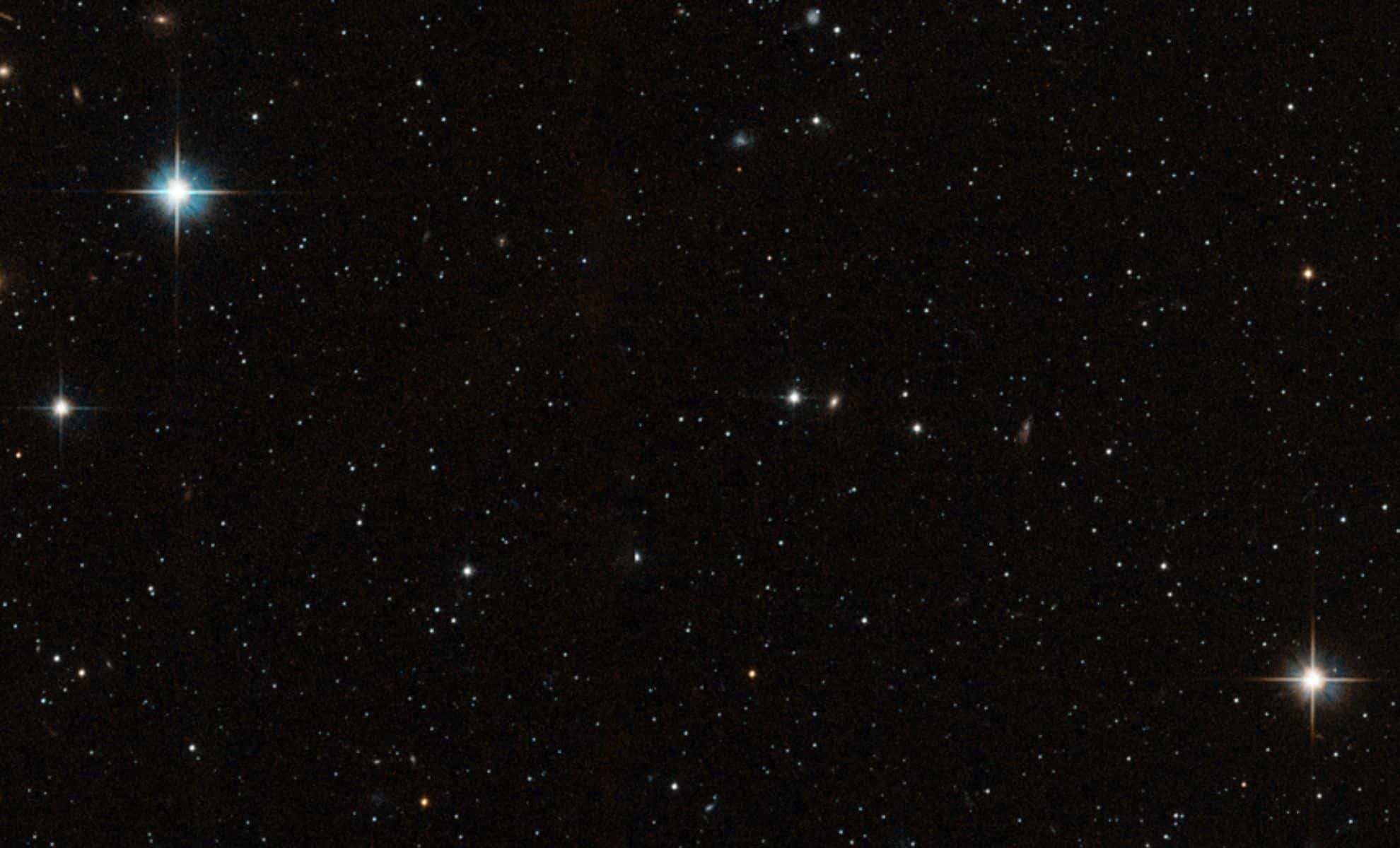
NASA’s Hubble Space Telescope has detected a substantial dark matter concentration at the heart of the Draco Dwarf Galaxy.
This finding offers fresh insights into the elusive characteristics of dark matter and its spatial arrangement within galaxies.
Decoding Dark Matter Patterns
Dark matter, often described as the unseen force holding the universe together, continues to puzzle scientists. Its omnipresence is acknowledged, yet mapping how it spreads throughout galaxies has proven to be a complex challenge.

Simulations have typically predicted that dark matter amasses sharply at galactic centers, forming what is known as a density cusp. Contrarily, many observational studies suggest a more uniform dispersion of dark matter across galaxies.
To resolve this uncertainty, researchers utilized the Hubble Space Telescope to meticulously examine the stellar motion within the Draco Dwarf Galaxy, located roughly 250,000 light-years from Earth. Eduardo Vitral from the Space Telescope Science Institute (STScI) in Baltimore, who led the research, commented, “Our findings lean towards a cuspy dark matter profile, aligning well with theoretical cosmological predictions. While we cannot definitively confirm this structure across all galaxies, having such precise data surpasses previous capabilities.”

Mapping Stellar Dynamics
The team used an advanced strategy to study dark matter by tracking the movements of stars within the Draco Dwarf Galaxy. By monitoring stars' radial velocities along with their side-to-side shifts (proper motion), scientists achieved an unprecedented 3D view of stellar movements. This comprehensive dataset fostered the development of a refined model illustrating the dark matter’s layout within the galaxy.
Roeland van der Marel, also from STScI and a co-author who initiated the study over ten years ago, highlighted the importance of detailed data. “As data quality and modeling techniques evolve side-by-side, richer datasets demand more sophisticated models. Simplistic models suffice for limited, one-dimensional data, but capturing nuanced behaviors requires complex approaches,” he explained.
The Draco Dwarf Galaxy as an Ideal Laboratory
The relatively small, spheroidal Draco Dwarf Galaxy provided an excellent environment for this investigation. Known for its high dark matter fraction compared to larger galaxies, dwarf systems offer unique opportunities to scrutinize dark matter properties. Accurate tracking of stellar positions over an 18-year span minimized errors and enhanced precision.
Sangmo Tony Sohn, a lead investigator at STScI, detailed the approach: “Proper motion measurements rely on noting a star’s location at two epochs separated by many years. The longer the interval, the more precisely we can assess its movement.”
The lengthy observation baseline—from 2004 to 2022—enabled reducing uncertainty in measuring stars’ proper motions to an extraordinary scale, comparable to detecting a yearly shift smaller than the width of a golf ball viewed from Earth to the Moon.
Shaping Future Dark Matter Research
The techniques and models forged through this analysis of the Draco Dwarf Galaxy are expected to guide additional investigations of other dwarf galaxies. Currently, Hubble observations of the Sculptor and Ursa Minor dwarfs are under review. Furthermore, NASA’s upcoming Nancy Grace Roman Space Telescope will expand dark matter research capabilities by surveying wide areas of the sky, unveiling deeper insights into dark matter distribution across diverse galaxies.
Vitral added a reflective note: “This work represents a long-term commitment demanding patience. The rich dataset and insights result from years of meticulous planning and the dedication of a large team of researchers.”
- Categories:
- Astronomy ,
- News ,
- Space ,
- Nasa






0 comments
Sign in to Comment