

Scientists have detected two previously unknown satellite galaxies, Virgo III and Sextans II, orbiting our Milky Way, prompting fresh questions about dark matter and galactic architecture.
Surprising Additions to the Milky Way Family
The recently spotted dwarf galaxies were identified through the Hyper Suprime-Cam (HSC) Subaru Strategic Program (SSP), increasing the count of known Milky Way satellites beyond 60. This finding clashes with predictions made by the lambda cold dark matter (ΛCDM) paradigm, which estimates roughly four dwarf galaxies in this surveyed area. With Virgo III and Sextans II included, the total rises to nine, presenting what researchers call a “too many satellites” issue.
Daisuke Homma from the National Astronomical Observatory of Japan expressed the unexpected nature of this result: “Including the four satellites already identified, we now observe nine within the area covered by HSC-SSP. The frequency of these ultra-faint dwarfs far exceeds expectations derived from current cold dark matter population models for Milky Way satellites, suggesting a significant surplus of satellites.”

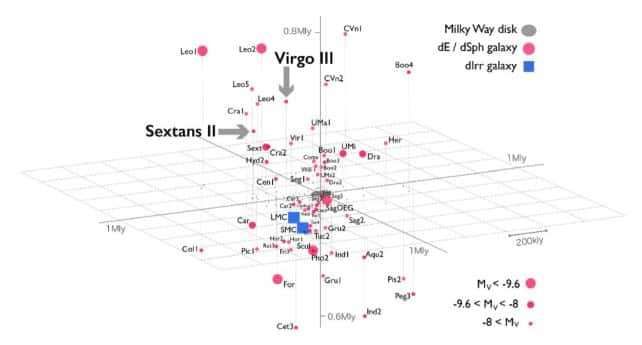
Rethinking Dark Matter Predictions
Dark matter – the unseen mass influencing galactic rotations and satellite dynamics – plays a key role in the ΛCDM framework. The appearance of more dwarf galaxies than expected in a specific region puts that framework to the test. While astronomers had anticipated discovering many more Milky Way satellites, the results instead highlight a mismatch between theory and observation.
Homma’s team employed data from the HSC Subaru Strategic Program (SSP) to unearth these faint companion galaxies, finding the count within the surveyed area rises to nine—far beyond the predicted number.
Looking Forward: Advanced Observatories and Expanded Searches
Addressing this challenge requires more comprehensive sky surveys. Masashi Chiba of Tohoku University noted the significance of advanced instruments: “The forthcoming phase involves utilizing more capable telescopes to capture wider sky regions. Next year, the Vera C. Rubin Observatory in Chile will serve this purpose. We expect numerous new satellite galaxies to come to light.”
If the current detection rate extrapolates across the entire sky, the total tally of dwarf galaxies orbiting the Milky Way could approach 500—dramatically exceeding the approximately 220 satellites forecasted by existing models. Data from the Vera C. Rubin Observatory will be crucial for refining the ΛCDM framework.

Attempts to reconcile discrepancies by omitting certain classical dwarf galaxies like Sextans or applying alternative satellite count models have yet to resolve the tensions.
Broader Impact on Our Cosmic Understanding
The identification of Virgo III and Sextans II reshapes not only our knowledge of the Milky Way but also cosmology as a whole. Larger-than-expected dwarf galaxy populations imply that current dark matter theories may need substantial adjustment, which could influence prevailing concepts of galaxy formation and evolution.
Research led by Homma and Chiba, published in the Publications of the Astronomical Society of Japan, showcases the ever-evolving nature of astrophysics. These insights remind us how each astronomical breakthrough deepens our grasp of the cosmos, while simultaneously revealing new mysteries.
Ongoing efforts underscore the necessity for cutting-edge technology and continued exploration, as every discovery both solves and sparks further scientific inquiry.
- Categories:
- Astronomy ,
- News









0 comments
Sign in to Comment