

Are Americans becoming less intellectually sharp? This provocative question arises from a recent analysis showing a notable drop in IQ levels across multiple thinking abilities. The research highlights what’s called the reverse Flynn Effect, indicating that the steady increase in intelligence test scores seen during the last century might be slowing or reversing. What does the data really indicate? Let’s explore the findings.
The Reverse Flynn Effect: What It Means
For decades, global IQ test results showed consistent improvement, a pattern labeled the Flynn Effect, with average scores rising by about three to five points every ten years.
Yet, a study led by Northwestern University has uncovered evidence of a possible reversal in the United States. Between 2006 and 2018, there was a marked downturn in IQ performance across four out of five key cognitive domains.

What’s behind these declines? Are Americans really experiencing a decrease in intelligence, or is there another explanation?
Cognitive Skills Experiencing Declines
Examining data from nearly 400,000 participants, researchers identified drops in these four core areas:
- Verbal reasoning—including language comprehension and logic.
- Matrix reasoning—involving pattern recognition and visual problem solving.
- Letter and number series—covering mathematical thinking and calculation.
- Verbal memory—the ability to recall words.
Interestingly, spatial reasoning skills, which involve mental rotation of 3D objects, actually improved slightly from 2011 to 2018. This inconsistency raises questions about the overall interpretation of declining intelligence.
Potential Causes Behind the Drop
Experts suggest no single factor fully explains the trend. Contributing elements might include declining nutrition, worsening health conditions, or the impact of increased exposure to media. Another possibility is shifts in the emphasis within education. Over recent decades, a greater focus on STEM subjects—science, technology, engineering, and math—could have reduced attention on other critical cognitive skills like abstract reasoning.
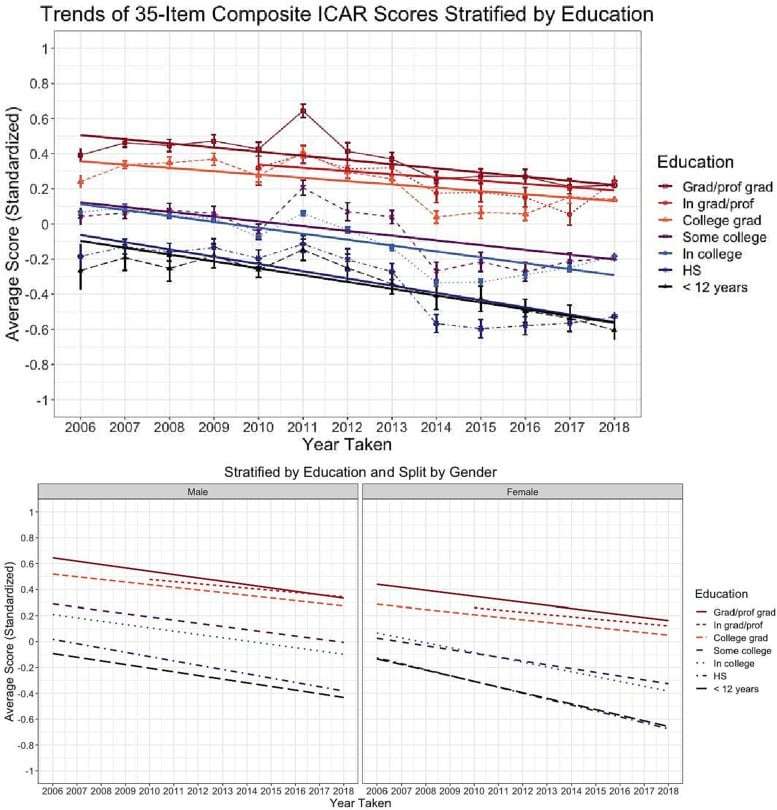
Another theory highlights the possibility that Americans might simply be less skilled at solving the particular question types featured in these tests. According to Elizabeth Dworak, a lead author on the study, lower scores might reflect less engagement or interest in these cognitive challenges rather than diminished mental capacity.
She notes that participants who complete online instruments like the SAPA Project, used in this research, may be motivated by curiosity about personality insights instead of cognitive performance.
Summary of Score Changes by Cognitive Domain
Are Americans Truly Experiencing an IQ Decline?
While the downward trend is clear, the researchers warn against interpreting the results as definitive evidence of a drop in overall intellect. Instead, changes in test design, test-taking behavior, or shifting educational priorities could be influencing outcomes.
The results might also reflect larger cultural shifts. As STEM disciplines gain prominence, other mental abilities might not be nurtured as effectively. However, this study did not explore why scores declined—it only mapped the change over time. Further investigation is required to uncover underlying factors.
What Lies Ahead?
The team at Northwestern University plans to extend their analysis with data spanning four decades, aiming to better understand this worrisome pattern. Meanwhile, ongoing changes in technology use and media consumption might also reshape how people think and learn.
The research is published in Intelligence.













0 comments
Sign in to Comment