

Groundbreaking findings indicate that the Earth's inner core—a blazing, dense sphere composed primarily of iron and nickel—is rotating at a slower rate compared to the planet's surface.
This important discovery prompts fresh inquiries into Earth’s internal dynamics and could influence our understanding of both the planet's magnetic field durability and the duration of Earth's days.
Tracking the Deceleration of the Inner Core
Researchers from the University of Southern California (USC) have provided strong evidence that the Earth's inner core began to decelerate approximately around 2010. Positioned more than 4,800 kilometers beneath the Earth's crust, direct observation of the inner core remains elusive. Scientists instead depend on seismic wave patterns created by earthquakes to deduce its movement.

John Vidale, USC’s Dean’s Professor of Earth Sciences, alongside his team, examined data from 121 repeating seismic events recorded between 1991 and 2023 near the South Sandwich Islands in the South Atlantic Ocean. These recurring earthquakes generate near-identical seismic waves, offering a rare chance to observe gradual shifts in the inner core’s rotation over decades.
The analysis also incorporated archival data from Soviet nuclear detonations carried out between 1971 and 1974, complemented by records from French and American nuclear tests. Vidale remarked, “Initially, the seismogram signals were baffling. However, after identifying over twenty supporting observations with a consistent pattern, the conclusion became undeniable: the inner core has slowed down for the first time in many decades.” This careful study revealed that what was once thought to be a slightly faster spin of the inner core relative to the Earth's surface is now decreasing behind, marking a notable change in its rotational behavior.
Underlying Causes and Broader Effects
The team attributes this deceleration to the dynamic behavior of the liquid outer core, which envelops the solid inner core. This molten outer layer—responsible for generating Earth's magnetic field—is influenced by gravitational forces from dense sections of the overlying rocky mantle. Vidale emphasized that the interplay between the inner and outer cores is fundamental to deciphering Earth's inner dynamics.
This rotational slowdown could gradually affect the planet’s overall spin rate, potentially lengthening the length of a day by tiny fractions of a second. Vidale commented, “The effect is minuscule, on the order of a thousandth of a second, easily masked by the turbulence of oceans and the atmosphere.”
The findings carry significant implications. The rotation of the inner core is crucial to the geodynamo mechanism that sustains Earth’s magnetic field. Alterations in this rotation might influence the field's intensity and stability, which in turn shields Earth from hazardous solar radiation.
A weakening magnetic field could have widespread consequences, such as elevated radiation exposure at the surface and disruptions to satellite functionalities and communication networks. Understanding these transformations is vital for forecasting and managing their impact on natural and technological systems.
Impact on Earth's Protective Magnetic Shield
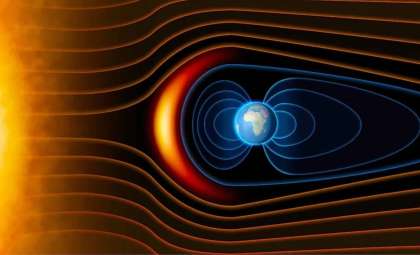
The spin of the inner core plays a vital role in maintaining Earth's magnetic field. The complex interaction between the solid inner core and surrounding fluid outer core generates critical magnetic forces that protect the planet from solar radiation.
Changes in the inner core’s rotation may affect the magnetic field's strength and persistence, though exact outcomes are still being investigated. This topic has gained urgency as observations show Earth’s magnetic field has been weakening over recent centuries, raising concerns about its future stability.
The potential ramifications for Earth's magnetic field highlight the importance of these new insights. This field serves as a shield against cosmic radiation and charged solar particles. Its stability is essential for preserving the atmosphere and sustaining life on Earth.
Researchers now face the challenge of understanding how the decelerating inner core will influence the geodynamo process and what consequences may arise for the magnetic field in the coming decades and centuries.
- Categories:
- News ,
- Science ,
- Climate change ,
- Physics








0 comments
Sign in to Comment