
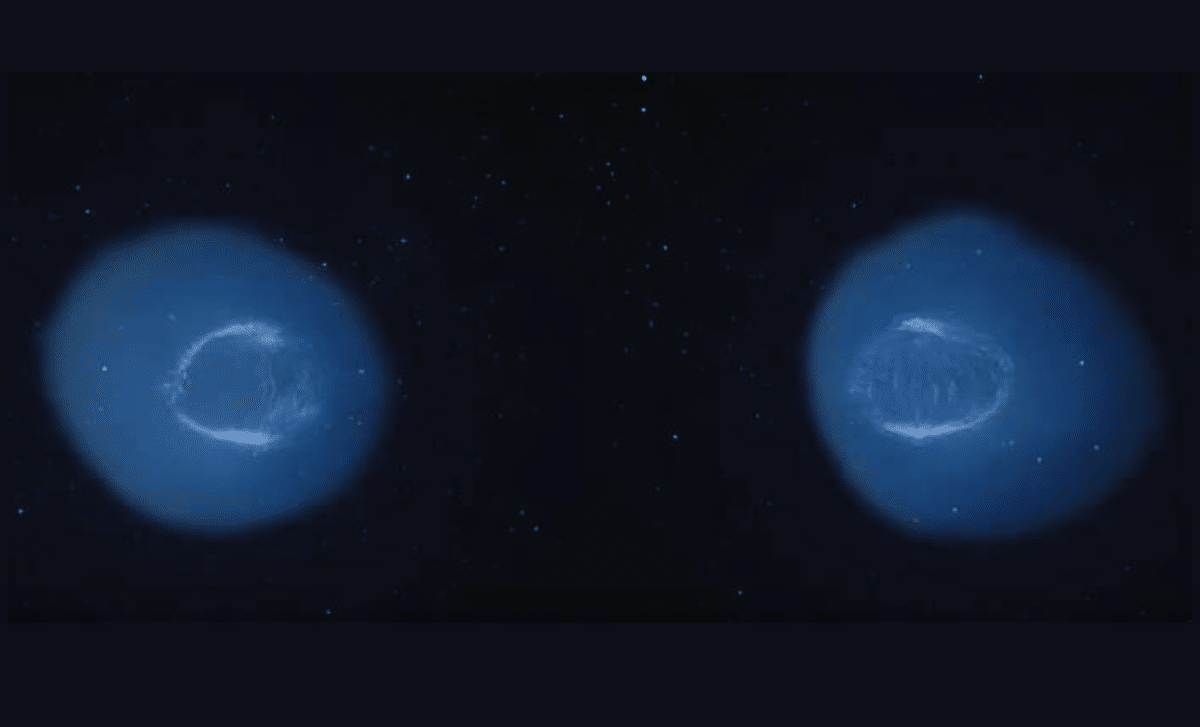
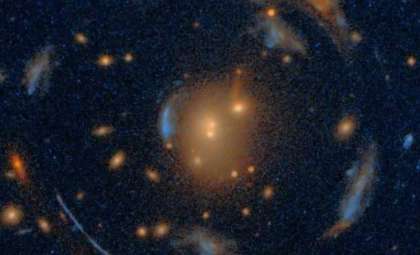
Scientists have detected a dim galaxy about 45 million light-years away that appears devoid of dark matter, making it the third known galaxy of this type aligned in a distinctive cosmic formation, as detailed in The Astrophysical Journal. This discovery challenges prevailing theories about galaxy formation and the essential role of dark matter in the universe's structure. Remarkably, these three dark matter-lacking galaxies line up in a slender arrangement stretching across vast distances, hinting at a common and dramatic origin.
Unusual Linear Arrangement of Dark Matter-Free Galaxies Discovered
Researchers investigating a faint dwarf galaxy called NGC 1052-DF9 have classified it as the third member in an extraordinary series of galaxies lacking dark matter. Positioned along the same continuum as DF2 and DF4, both previously recognized galaxies share a similar absence of dark matter. This straight chain of diffuse galaxies is unique among observed cosmic structures and challenges current models of galactic distribution.
The team found that DF9 is not just an isolated case but part of a larger system of galaxies aligned in a narrow formation, suggesting they originated from a shared event rather than forming independently. Deep observations using sensitive instruments capable of detecting faint stellar populations revealed DF9's physical traits and kinematics closely correspond with the other galaxies in the sequence.

“A line of galaxies lacking dark matter has never been seen before,” said Michael Keim, a Ph.D. student in astrophysics in Yale’s Graduate School of Arts and Sciences and first author of the new study. “The discovery provides some of the strongest evidence yet that these galaxies formed through an extreme and previously unseen process and offers a rare new window into the nature of dark matter itself.”
The study suggests this alignment is not random but represents the debris of a large-scale event that simultaneously shaped multiple galaxies under atypical conditions.
NGC 1052-DF9’s Key Role Within the Galactic Sequence
Initially mistaken for a supermassive black hole candidate, NGC 1052-DF9 was later identified as an ultra-diffuse dwarf galaxy. Its inclusion among the dark matter-deficient galaxies reinforces the idea that DF2 and DF4 are not isolated phenomena but part of a broader astrophysical process. Consistent stellar velocity data across all three galaxies supports a scenario involving a unified formation mechanism instead of independent evolutionary paths.
By assessing the motions of stars in DF9, scientists inferred a total mass roughly equal to 100 million suns, corresponding closely to the mass expected from visible matter alone. This leaves little to no detectable dark matter in contrast to typical galaxies of similar sizes, which usually contain dark matter masses vastly exceeding their visible components. This discrepancy is fueling deeper discussions about the true nature of dark matter and its role in cosmic evolution.
Data From Keck Observatory Strengthens Findings
Using the W. M. Keck Observatory’s Cosmic Web Imager in Hawaii, researchers gathered precise measurements of faint light emissions from DF9, allowing them to chart stellar velocities and estimate mass distribution accurately. The close match between visible mass and gravitational influence supports the conclusion that dark matter is missing in this system.
Published in The Astrophysical Journal, the research contributes to a growing body of evidence questioning whether dark matter halos are always a prerequisite for galaxy formation. The presence of three such galaxies suggests this phenomenon, though rare, is reproducible and likely results from extreme astrophysical events, such as high-speed galaxy collisions.
Collision Hypothesis Explains Dark Matter Absence
One proposed explanation involves an ancient high-velocity encounter between galaxies that separated normal gas from dark matter. This allowed the gaseous material to collapse and form galaxies largely devoid of dark matter, leaving behind a faint, linear pattern of baryonic structures stretching across space.
“Previously it was thought galaxies always formed inside dark matter 'halos,'” Keim explained. “This system proves star and galaxy formation can occur outside these halos during extreme events, confirming dark matter as a physical substance distinct from normal matter or gas and challenging alternative theories that dark matter is a manifestation of gravity alone.” This scenario directly challenges models avoiding dark matter as a separate entity, reinforcing the idea that dark matter behaves independently within cosmic architecture.
Future Observations and Research Directions
Astronomers are now extending their search for additional remnants linked to this unusual event, such as faint gas trails left by the original collision. Upcoming observations with advanced telescopes aim to detect ultra-low brightness features and uncover the full scope of this galactic alignment. Furthermore, researchers are refining theoretical models to determine if similar dark matter-free linear structures exist elsewhere but remain hidden due to their extreme faintness.
The discovery of DF2, DF4, and DF9 forms a unique testing ground for dark matter and galaxy formation theories. Each new data point strengthens the possibility that cataclysmic galactic interactions can produce systems that fundamentally depart from typical models. As observational techniques improve, this rare cosmic arrangement may become vital for understanding when and how dark matter governs the formation of cosmic structures or when alternate processes take precedence under extraordinary conditions.
- Categories:
- Astronomy


0 comments
Sign in to Comment