
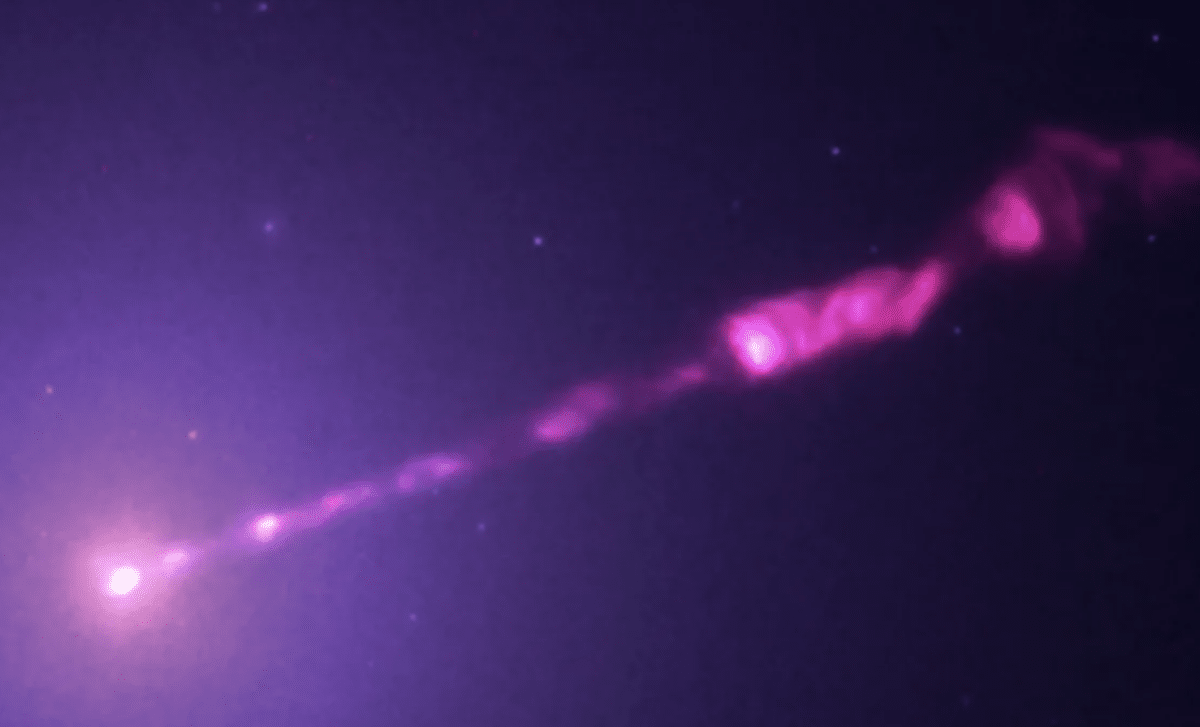
M87*, the supermassive black hole at the heart of the galaxy Messier 87, has once again provided groundbreaking insights into cosmic phenomena after NASA’s Chandra X-ray Observatory captured the most intricate observations yet of its powerful relativistic jet. Positioned about 55 million light-years away, this black hole, which famously provided the first-ever image of a black hole’s shadow in 2019, continues to fuel energetic outflows reaching across cosmic distances.
Comprehensive Study and Decade-Long Observations
Published on arXiv, the research consolidates over ten years of Chandra’s X-ray data to reveal subtle yet significant changes in the jet’s structure. These extended observations allowed astronomers to detect dynamic variations in how matter is accelerated along the black hole’s axis, showcasing areas where the jet brightens, shifts, and reorganizes. Such long-term analysis is critical for uncovering behaviors that short-term investigations might miss.
By piecing together repeated X-ray snapshots, the team reconstructed how energy moves outward from the black hole’s core into the surrounding space. The results highlight that the jet’s energy flow is far from constant, instead exhibiting fluctuations that provide key insights into the processes operating in extreme relativistic environments.

Relativistic Jet Movement Approaching Light Speed
A remarkable discovery from these observations is the jet’s apparent superluminal motion, where knots within the jet seem to travel faster than light. This illusion arises because the plasma jets are directed almost directly at Earth and move close to light speed, causing relativistic effects to amplify their apparent velocity.
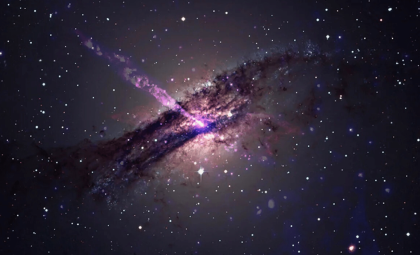
The jet is powered by infalling material heating up and channeling along magnetic fields aligned with M87*’s spin axis. This process ejects matter at tremendous speeds, creating a collimated beam far exceeding the host galaxy’s dimensions. Chandra’s data reveal that the jet’s structure is complex, composed of shifting knots and filaments whose brightness varies over time. These observations imply ongoing turbulent activity and energy input, painting the jet as a dynamic plasma system rather than a uniform stream.
Gradual Structural Evolution Over Years
Tracking M87*’s jet over many years has uncovered evolving patterns in its structure. Certain segments intensify while others diminish, highlighting a constantly changing energy landscape. Thanks to Chandra’s high sensitivity and long operational history, scientists can now distinguish individual features previously unresolved.
Leading the investigation, Camille Poitras, a doctoral candidate at Laval University, remarked:
“We could already see changes in the jet, but never with this level of detail in X-rays,” she said. “Structures that previously appeared blended together can now be distinguished, allowing us to better follow the jet’s evolution over more than a decade of observations.”
These developments confirm that M87*’s activity unfolds on accessible timescales for human observation.
Galactic Influence and Energy Distribution
The jet’s role extends far beyond the black hole’s immediate surroundings, acting as a conveyor of energy and matter that impacts the broader galactic environment. As the jet streams outward, it interacts with interstellar and intergalactic gas, affecting star formation and shaping galaxy development. These X-ray insights shed light on the mechanisms by which energy emitted near the event horizon spreads across millions of light-years.
Gerrit Schellenberger, an astrophysicist at the Center for Astrophysics | Harvard & Smithsonian, emphasized the importance of these observations: “These results demonstrate how uniquely powerful Chandra remains for tracking the evolution of extreme phenomena over long timescales,” he commented. “They help us better understand how energy released near a supermassive black hole is carried through its jet and deposited into the surrounding galaxy.” This nexus between black hole physics and galactic-scale structures continues to challenge astrophysicists, and the fresh data from M87* offers critical new clues.
- Categories:
- Space



0 comments
Sign in to Comment