
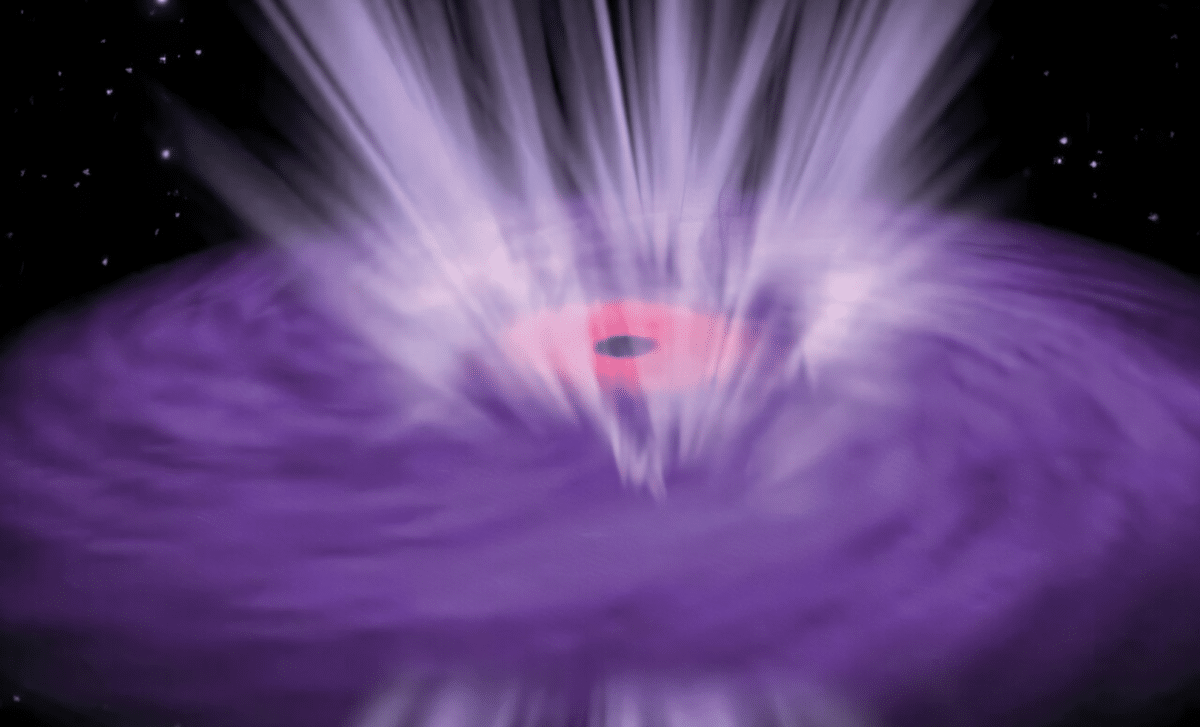
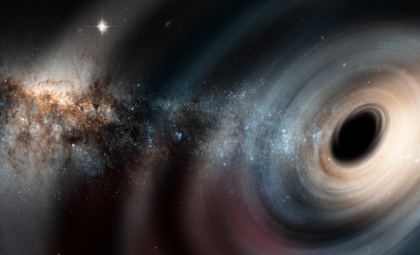
Researchers have identified one of the most intense ultra-fast outflows ever traced emanating from a supermassive black hole, featuring a complex, two-tiered wind hurtling through space at a large fraction of the speed of light. This breakthrough comes from thorough X-ray measurements of a luminous quasar during the universe’s peak growth era and was recently uploaded to the arXiv preprint archive. These outflows offer an extraordinary look at how black holes influence their host galaxies amid rapid development.
The Significance of Ultra-Fast Outflows in Space
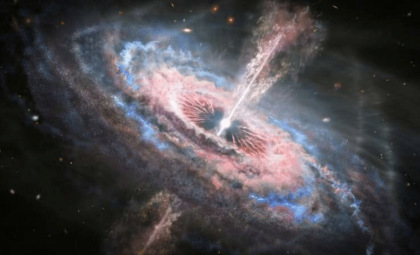
Black holes that voraciously consume matter do more than just absorb their environment; they actively modify it. Ultra-fast outflows (UFOs) are streams of gas propelled at speeds exceeding 10% of light speed. These energetic winds inject vast amounts of energy into surrounding material, heating interstellar gas, stifling star birth, and potentially arresting the growth of galaxies altogether. The cosmic noon era, spanning roughly 1.6 to 3.5 billion years post-Big Bang, marks the height of galaxy and black hole growth, making it the ideal period to explore these dynamics.
UFOs appear in X-ray spectra as absorption signatures from highly ionized iron, which absorbs X-rays at specific energies. Due to their rapid outward motion, these lines are blueshifted to higher energy levels. Previously, many high-redshift UFOs were spotted mainly in gravitationally lensed quasars, where foreground galaxies amplify quasar light. Although beneficial, lensing complicates precise assessments of these outflows’ true properties.

Revealing a Two-Component Wind Structure
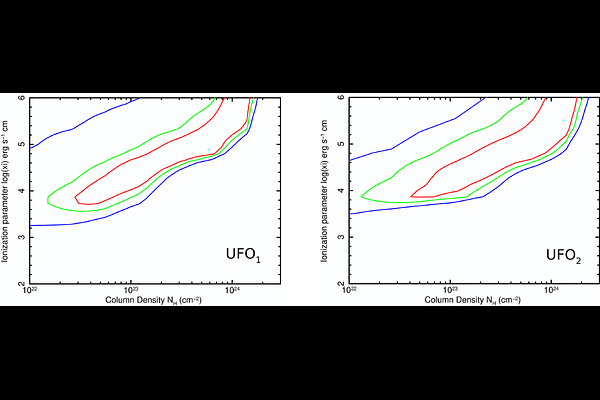
The WISSHFUL survey, headed by Giorgio Lanzuisi from INAF Bologna, examined 15 ultra-bright quasars to detect UFOs in systems free from lensing effects. Its initial focus, WISSH13, a quasar at redshift 3.294, contains a black hole massing around two billion suns and glowing threefold brighter than typical for its size. By integrating XMM-Newton and NuSTAR data from October 2024 with archived 2017 observations, the scientists produced a detailed X-ray spectrum that uncovered two distinct absorption features.
Further analysis showed these features correspond to two separate segments of the identical UFO, traveling at near 10% and 30% of light speed.
“The detection of two distinct velocity components (∼0.1c and ∼0.3c) with different variability patterns suggests a complex, stratified outflow,” the team writes.
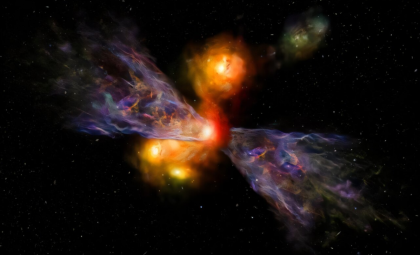
This layered setup — a swift “core” springing from the innermost accretion disk, surrounded by a slower “sheath” from outer regions — closely matches theoretical models. Together, these winds expel 21 and 24 solar masses yearly, placing them among the most energetic and massive UFOs documented.
Consequences for the Development of Galaxies
The staggering power of these winds holds profound consequences for galaxy formation. By transferring energy to adjacent gas, the outflows govern both the central black hole’s growth and star creation within the host galaxy. Notably, although WISSH13 lies at an extreme redshift, its winds obey the same scaling relations seen in lower-redshift active galaxies, echoing findings from the arXiv report. This consistency hints at enduring physical processes shaping galaxies throughout cosmic time, offering vital insights into their evolutionary journeys.
- Categories:
- Astronomy



0 comments
Sign in to Comment