

Researchers have uncovered an extraordinary cosmic arrangement known as the “Carousel Lens,” a rare sequence of galaxies that offers fresh opportunities to delve into the enigmas of dark matter and dark energy. This spectacular event was witnessed as a colossal galaxy cluster in the foreground bent and amplified the light from seven remote galaxies situated between 7.6 and 12 billion light-years from Earth.
The team identified the largest Einstein Cross to date, where the gravitational influence of the lensing galaxy cluster caused light from a single background galaxy to split into four separate images. This unique configuration promises to deepen our knowledge of the universe’s most elusive phenomena.
A Unique Galactic Alignment: The Creation of the “Carousel Lens”
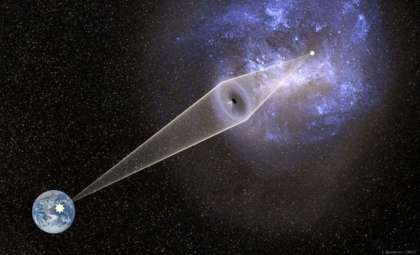
The Carousel Lens represents an exceptionally rare galactic configuration, enabling scientists to study gravitational lensing with unparalleled clarity. Predicted by Albert Einstein in 1915 via his general theory of relativity, gravitational lensing arises when a massive object like a galaxy cluster distorts and intensifies light from objects far behind it. In this scenario, a galaxy cluster located about 5 billion light-years away acts as a lens, warping the light from seven even more distant galaxies positioned at the cosmic frontier. These distant galaxies are stretched and bent by the lensing effect, producing multiple distorted images that resemble a cosmic "carousel."

“This remarkable alignment is like finding a single needle in a haystack, but in our case, it's eight needles perfectly lined up,” explained David Schlegel, a senior scientist at Berkeley Lab’s Physics Division and co-author of the study. He noted the extraordinary rarity of this alignment provides an exceptional observational window to explore how light traverses the gravitational fields of massive galaxy clusters.

Gravitational Lensing and the Most Extensive Einstein Cross Recorded
A standout feature of the Carousel Lens is the identification of the largest known Einstein Cross. This phenomenon occurs when the gravity of a massive foreground object bends the light from a single distant galaxy, creating four images arranged in a cross-like pattern. Here, the light from galaxy 4 in the Carousel Lens splits into four distinct spots—4a, 4b, 4c, and 4d—due to the gravitational influence of the lensing cluster, resulting in the largest Einstein Cross ever documented.
This discovery is vital because it vividly illustrates the mass symmetry within the galaxy cluster, highlighting the critical role of dark matter. Constituting roughly 80% of all matter in the universe, dark matter is invisible and does not emit or absorb light but exerts gravitational effects detectable through such lensing phenomena, making it a prime method for mapping dark matter’s distribution.
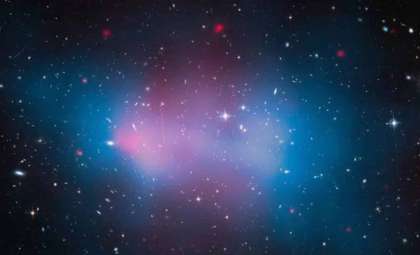
“The Carousel Lens is an extraordinary alignment where seven galaxies, grouped into five clusters, are nearly perfectly aligned behind the foreground lens,” said Xiaosheng Huang, a physicist and astronomer at the University of San Francisco. Huang’s team utilized observations from the Hubble Space Telescope alongside computational simulations run on NERSC’s Perlmutter supercomputer to precisely model the lensing effect, enabling researchers to visualize the dark matter layout hidden within the cluster.
Gravitational Lensing: Illuminating the Invisible Universe
Beyond its striking visuals, the Carousel Lens is a powerful scientific resource. Gravitational lensing functions as a cosmic magnifier, allowing astronomers to study galaxies too distant and faint to see directly. It occurs because a massive object’s gravitational pull bends spacetime, steering light along curved trajectories—a phenomenon first described by Albert Einstein’s theory of general relativity. The greater an object’s mass, the stronger the curvature of spacetime, intensifying the lensing.
In this case, the light from the seven distant galaxies traces various routes around the galaxy cluster, producing multiple images and stretched arcs akin to a cosmic “funhouse mirror.” For instance, galaxy 4 generates an Einstein Cross pattern with four symmetrically arranged images. Such precise configurations are rare, rendering the Carousel Lens an unparalleled system to investigate the spatial distribution of matter, especially dark matter.
Probing the Universe’s Dark Components: Dark Matter and Dark Energy
The Carousel Lens offers more than a captivating view—it is a vital instrument to examine two profound cosmic mysteries: dark matter and dark energy. Since dark matter neither emits nor reflects light, it can only be observed via its gravitational effects. By closely examining distortions in the light from those background galaxies, astronomers can infer how dark matter spreads throughout the lensing cluster, shedding light on its influence on cosmic structures.
Additionally, the Carousel Lens provides fresh avenues for investigating dark energy, the mysterious force accelerating the universe’s expansion. Dark energy’s nature remains largely unknown, but high-precision measurements enabled by this system could reveal its behavior on vast scales, offering new clues about fundamental cosmic forces shaping our universe.
“This is an exceptionally rare alignment providing a valuable testbed for cosmological research,” stated Nathalie Palanque-Delabrouille, director of the Physics Division at Berkeley Lab. She added that imaging from DESI can be applied beyond its initial scope, helping probe dark matter distributions and the universe’s accelerated expansion driven by dark energy.
A Landmark in Cosmology and Future Prospects
Discovering the Carousel Lens marks a major advance in cosmology, creating a unique natural laboratory to test ideas about the universe’s large-scale composition and structure. The detailed information extracted from this rare alignment will improve models of dark matter and dark energy and may lead to groundbreaking insights into the fundamental workings of the cosmos. Published in The Astrophysical Journal, the research underscores the vital role of collaborative efforts and advanced technologies in pushing the boundaries of cosmic understanding.
As analysis continues, findings from the Carousel Lens promise to fuel new discoveries and tighten constraints on the nature of the dark universe, keeping astronomers engaged for years ahead. Lead author William Sheu, a doctoral student at UCLA, commented, “The Carousel Lens represents a once-in-a-lifetime finding that opens exciting paths for exploring the universe’s deepest mysteries.”
This achievement not only enhances our grasp of the universe’s unseen components but also paves the way for future breakthroughs that could transform our comprehension of dark matter, dark energy, and the fabric of space-time itself.
- Categories:
- Astronomy ,
- News ,
- Science ,
- Nasa







0 comments
Sign in to Comment