
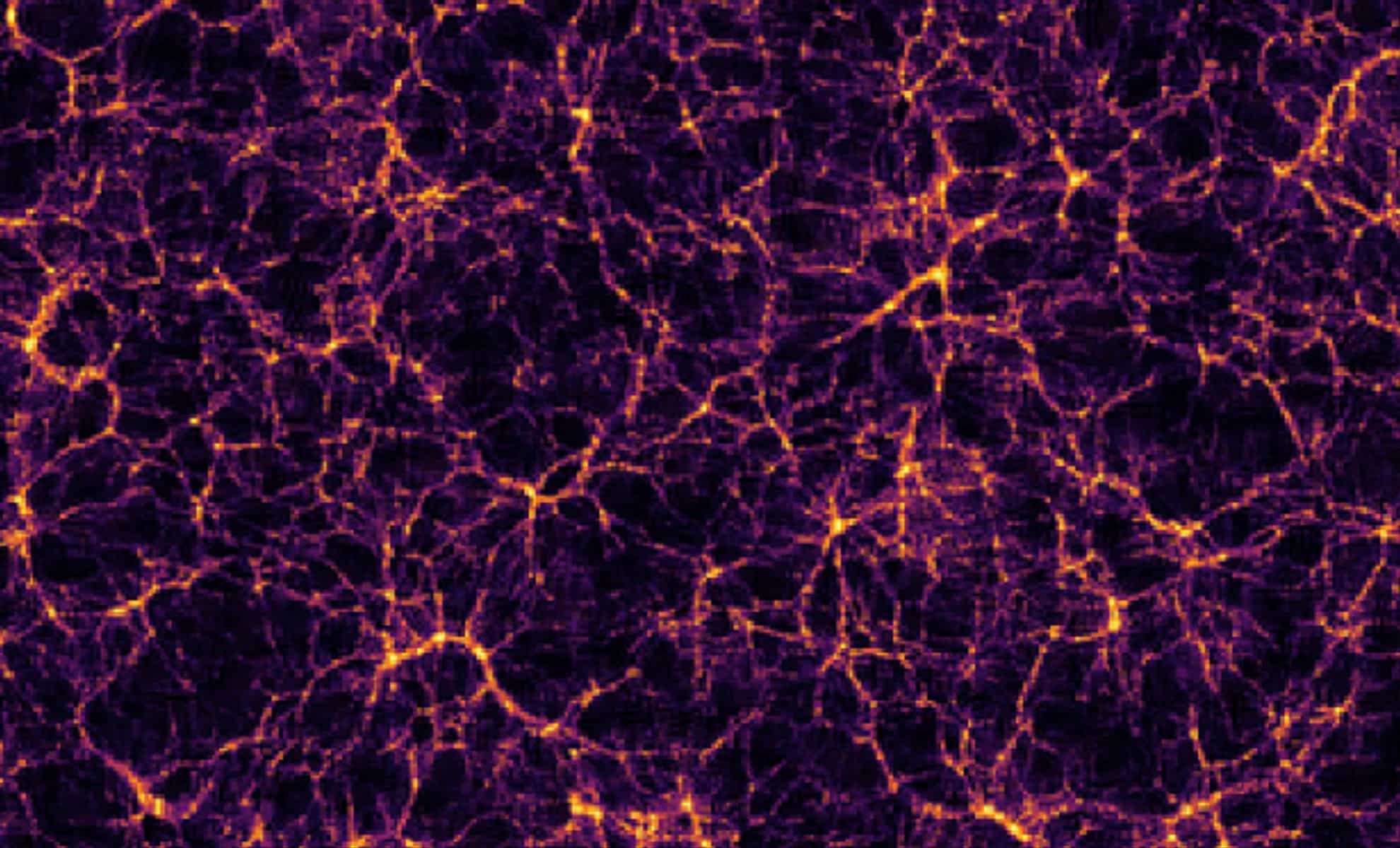
Researchers are making significant strides in illuminating the universe's elusive component: dark matter, which constitutes around 27% of the universe’s mass. Leveraging advanced 3D galaxy mapping combined with a groundbreaking technique known as field-level inference (FLI), scientists are now able to chart the detailed configuration of dark matter that controls galaxy formation and cosmic evolution. This achievement merges sophisticated computational models with empirical observations to produce the most refined depictions of the dark matter environment to date.
Although unseen, dark matter exerts substantial gravitational influence shaping the universe’s large-scale architecture. Historically, research was confined to analyzing statistical patterns of galaxy locations or deduced effects like gravitational lensing. In contrast, FLI offers a novel, direct analysis. “In field-level inference, our approach utilizes a comprehensive 3D representation of galaxy positions,” stated Anh Quyen Nguyen, the study’s principal investigator from the Max Planck Institute for Astrophysics. This state-of-the-art method empowers detailed examination of the full spectrum of galaxy and dark matter distributions.
Transforming Dark Matter Research with Field-Level Inference
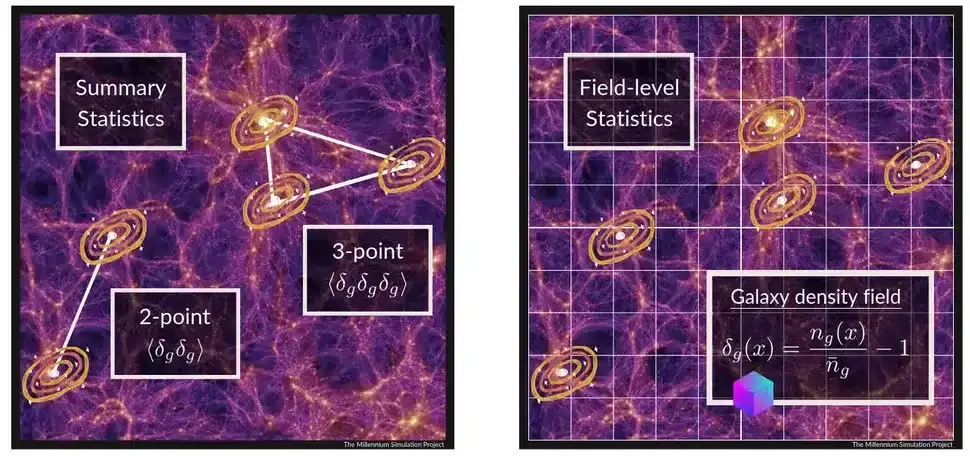
Conventional dark matter research traditionally emphasized broad galaxy clustering patterns and cosmic structures. While useful, such strategies often overlook nuanced, localized fluctuations in the dark matter landscape. Field-level inference redefines this by directly utilizing 3D maps of galaxies to reconstruct dark matter’s underlying distribution with greater fidelity.

Nguyen elaborated, “Employing advanced algorithms, FLI compares theoretical predictions with observed galaxy arrangement across every coordinate of the 3D grid.” This process simulates interactions between dark and visible matter, refining models through successive iterations that increasingly match observational data, resulting in highly precise dark matter maps.
Executing this approach demands exceptional computational resources. Mapping galaxy and dark matter dispersal within a 3D lattice incorporates an enormous range of variables. However, recent progress in machine learning and optimization algorithms has rendered this task feasible. “Sophisticated computer methods now accelerate the exploration of such extensive parameter spaces,” Nguyen remarked. These innovations facilitate handling vast datasets, revealing dark matter’s concealed patterns with extraordinary accuracy.
The Critical Role of 3D Galaxy Surveys
Utilizing 3D galaxy charts offers a distinct advantage by enabling detection of localized dark matter effects that might otherwise remain hidden with classical approaches. Methods based on n-point correlation functions typically average out subtle local variations, dulling intricate details within the dark matter structure.
Nguyen pointed out, “Gaining access to the comprehensive dark matter field tied to observed galaxies potentially enhances our sensitivity to localized phenomena.” This heightened sensitivity assists researchers in exploring how dark matter influences galaxy formation and arrangement across small and medium scales.
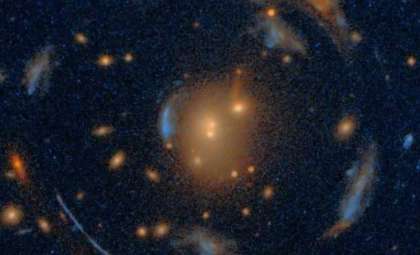
Complementing gravitational lensing—which measures light distorting effects caused by massive bodies—the FLI-based 3D reconstructions infer dark matter distribution directly from galaxy placements. “This synergy is particularly exciting, considering dark matter’s invisibility, providing a complementary perspective to lensing-derived maps,” noted co-author Fabian Schmidt.
Revealing the Universe’s Hidden Framework
Field-level inference-generated maps deliver an intricate visualization of dark matter’s role in shaping cosmic structures at every scale. From the vast network of filaments and voids in the cosmic web to the detailed environments around galaxy clusters, these maps unveil the hidden framework underlying the cosmos.
Dark matter’s gravitational influence is fundamental to drawing normal matter together to form observed galaxies and stars scattered across space. The precision mapping of dark matter deepens theoretical tests regarding its constitution—whether it involves elusive entities like WIMPs (Weakly Interacting Massive Particles) or necessitates alternative physics such as gravity modifications.
Additionally, by detecting local dark matter variances, FLI opens avenues for studying interactions at previously inaccessible scales, shedding light on dark matter’s properties and dynamics within small galaxy groups.
How Computational Innovations Propel Discovery
Advances in computing power and algorithm design underpin the success of field-level inference. Simulating dark matter and galaxy distributions within volumetric regions requires extraordinary processing alongside intelligent parameter exploration strategies.
These computational frameworks enable simulations of cosmic evolution over billions of years which are contrasted with actual observational data. Iterative refinement hones models until they accurately replicate galaxy spatial patterns.
Linking sophisticated simulations with empirical observations allows scientists to not only uncover the cosmos’ hidden dark matter structures but also enrich astrophysical research in broader areas such as dark energy, black hole physics, and early universe studies.
Ushering in a New Age of Cosmic Investigation
The integration of 3D galaxy mapping with field-level inference marks a pivotal advance in cosmic exploration. This approach goes beyond traditional statistics to expose detailed dark matter configurations that were previously beyond reach.
“Accessing the full underlying dark matter distribution associated with galaxies greatly enhances detection of local cosmic features,” Nguyen emphasized. These developments are revolutionizing our understanding of dark matter and reshaping astrophysical methodologies.
With ongoing growth in computational capacities, these techniques promise even finer insights into the dark universe. From tracing galaxy origins to probing fundamental physics, such research expands our cosmic horizons. Each new finding brings us closer to deciphering the universe’s invisible scaffolding, illuminating the dark cosmos in unprecedented clarity.
- Categories:
- Astronomy










0 comments
Sign in to Comment