
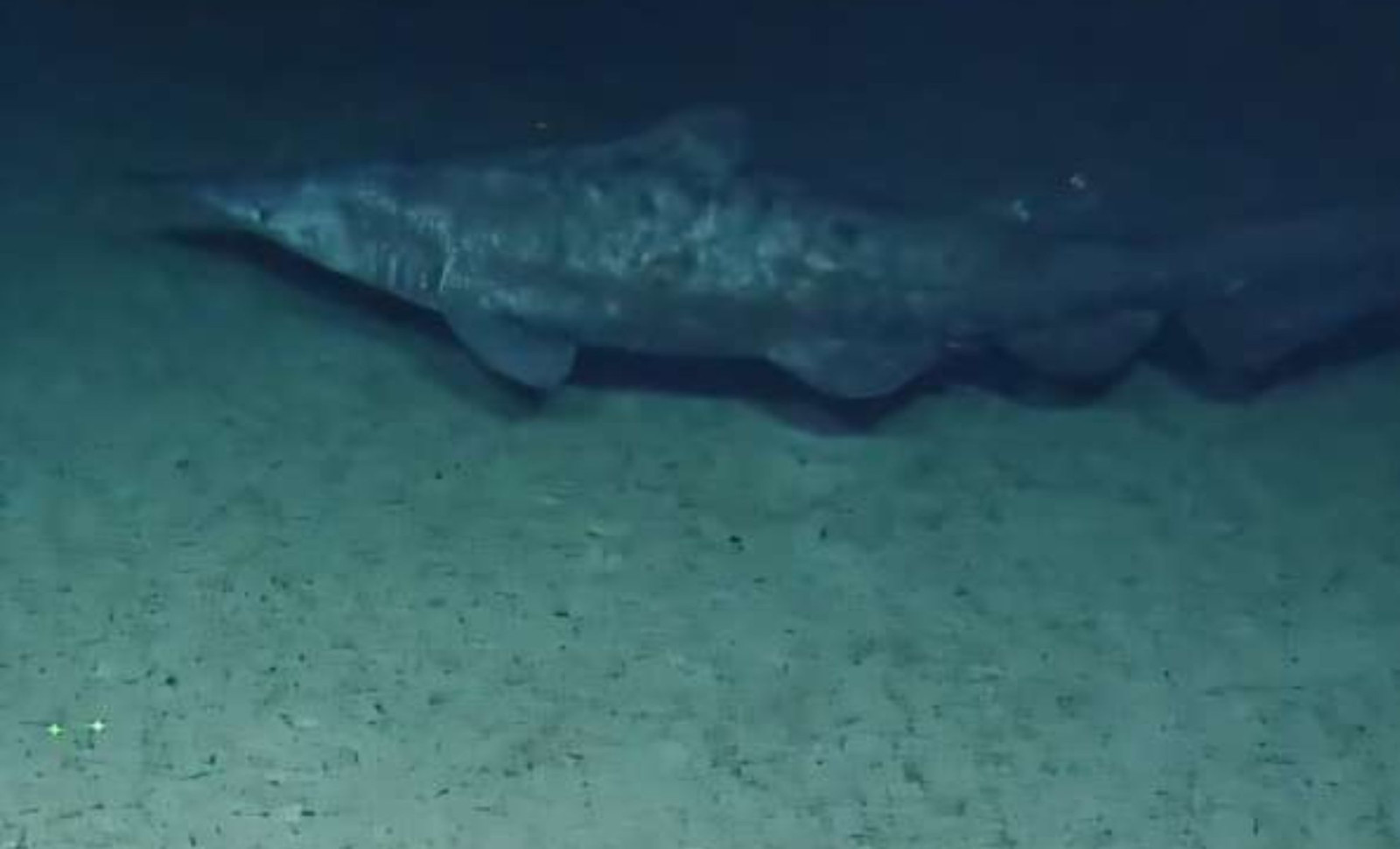
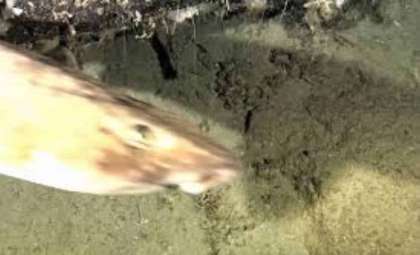
For the first time, researchers have recorded live footage of goblin sharks thriving in their natural deep-sea environment. These sightings, near Jarvis Island and the Tonga Trench, provide fresh insights into one of the ocean’s most elusive shark species while expanding its known distribution in the Pacific.
The goblin shark (Mitsukurina owstoni) is a captivating creature with its distinctively elongated snout and ancient evolutionary roots, earning it the title of “living fossil.” Despite its notoriety among marine scientists, details about its lifestyle in the deep ocean remain scarce.
Previously, goblin sharks had only been observed when accidentally caught and surfaced by fishermen. A new study in the Journal of Fish Biology now reports healthy individuals filmed freely swimming at depth.

Two Extraordinary Encounters in the Central Pacific
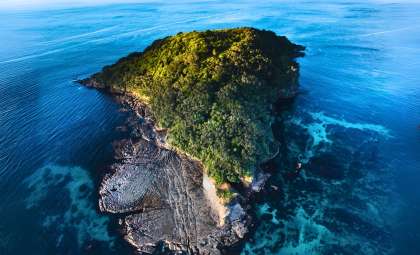
The initial sighting occurred near a seamount northwest of Jarvis Island, while another was documented along the slope of the Tonga Trench. Both locations are within the central Pacific, a region where goblin sharks had never been previously observed.
Doctoral researcher Aaron Judah from the University of Hawai‘i at Mānoa described the significance of these discoveries.
“Seeing the most iconic of all the deep-sea sharks alive and looking healthy in its natural habitat is a unique honor,” he said.
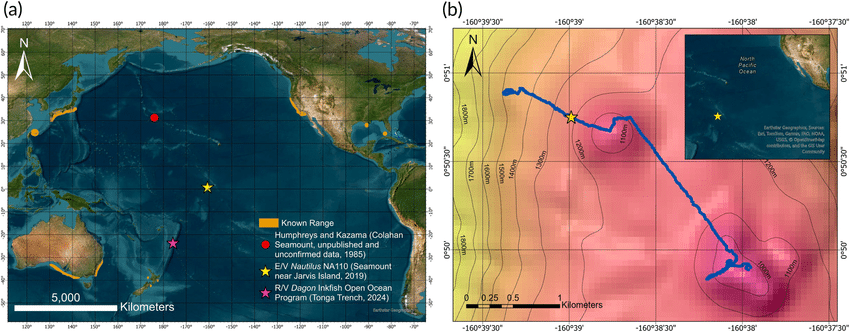
The Tonga Trench observation was particularly notable, with the shark encountered almost 700 meters deeper than any previous record. This also sets a new depth milestone for Lamniformes, the shark order that includes great whites and makos.
Although goblin sharks are rarely seen, even a small number of field observations contribute significantly to understanding their deep-sea range.
Uncovering a Hidden Discovery in Archived Recordings
Interestingly, one goblin shark was spotted not during a fresh expedition, but through analysis of archival footage acquired years earlier.
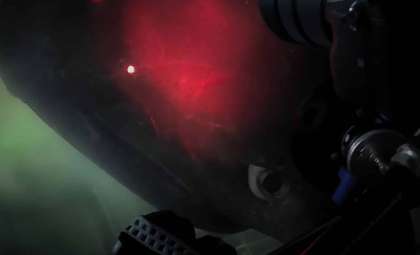
In 2025, researchers at the Deep-Sea Animal Research Center (DARC) alerted Judah about a potential goblin shark captured on video during a 2019 E/V Nautilus expedition investigating seafloor ecosystems near Kingman Reef, Palmyra Atoll, and Jarvis Island.
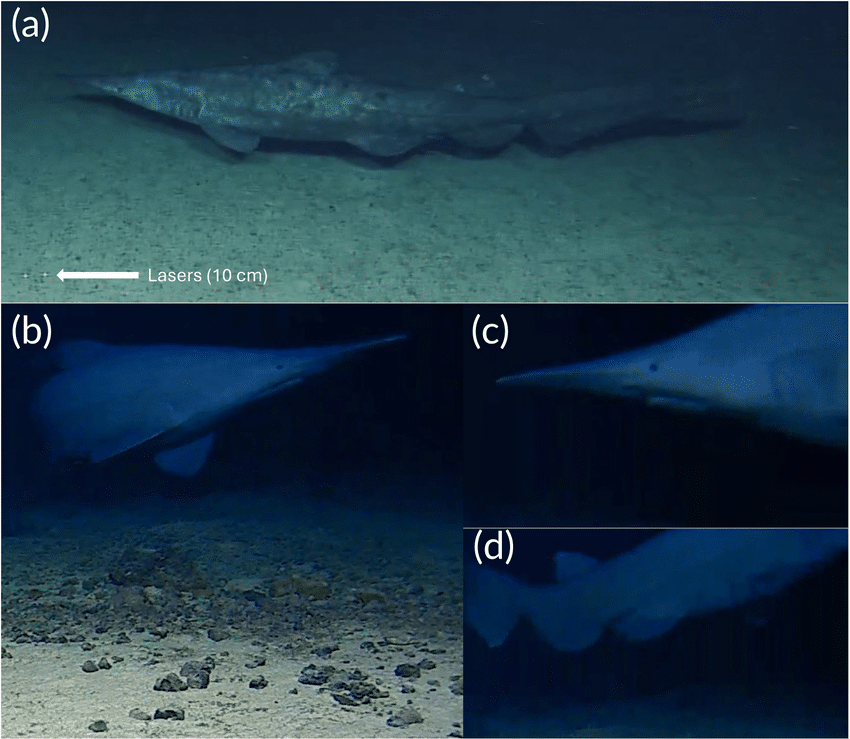
Recorded by the remotely operated vehicle Hercules and preserved in public archives, the footage was later confirmed by Judah to show a genuine goblin shark.
“I was shocked to hear this because this species was not known to be in the Central Pacific,” he said.
Expanding Known Habitats Far Beyond Previous Records
The second goblin shark was discovered during a 2024 expedition to the Tonga Trench aboard the R/V Dagon, part of the Inkfish Open Ocean Expedition. Scientists from the Minderoo-UWA Deep-Sea Research Center recorded the shark using a baited camera deployed from a bottom lander.
Co-author Alan Jamieson expressed his amazement at witnessing the rare deep-sea predator alive.
“The Goblin Shark is one of these deep-sea charismatic animals that I never thought we’d see alive, and then to do so was amazing, but to then learn that colleagues in Hawai‘i also saw one was just incredible,” he noted.
Until now, goblin sharks were primarily known from limited areas around Japan, Australia, and the western United States, with some isolated sightings in the Atlantic and Indian Oceans. According to the recent research, the new citations considerably broaden their recognized distribution across the central Pacific.
Judah highlighted that species must be accounted for in regional biodiversity data and conservation planning only if their presence is documented.
“New discoveries like this demonstrate that there is still so much to explore in our deep-ocean home,” Judah said.
- Categories:
- Science

0 comments
Sign in to Comment