

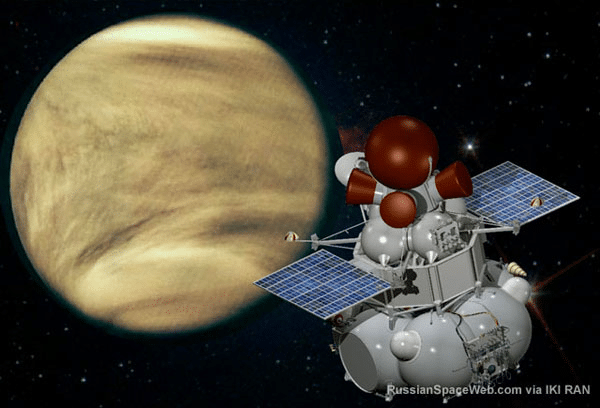
Russia has announced plans for the 2036 deployment of the Venera-D mission to Venus, featuring a lander, orbiter, and atmospheric balloon. This initiative marks a significant effort to revisit one of the solar system’s most extreme planets. Decades after the Soviet Union first accomplished landing spacecraft on Venus’ scorching surface, Russia is now poised to advance planetary science with modern technology and renewed ambition.
Venera-D: A Major Leap for Russian Space Exploration
Scheduled for launch in 2036, the Venera-D mission represents a pivotal step in reinforcing Russia’s role within the global space landscape. The mission will involve three spacecraft: a balloon to explore Venus’ dense, toxic atmosphere; an orbiter to analyze the planet’s terrain; and a lander designed to endure Venus’ notoriously harsh surface conditions.
This endeavor comes amid Russia’s ongoing efforts to revitalize its space program following post-Soviet difficulties. Despite evolving international partnerships and a reduction in collaboration with NASA and the European Space Agency, Russia remains determined. Denis Manturov, Russia’s First Deputy Prime Minister, highlighted, “Let me remind you that back in 1970, our country succeeded in successfully landing a spacecraft on another planet in the solar system. And that was Venus. Therefore, we will probably move in this direction first,” as cited by Space.com.

The mission is driven not only by technological advancements but also by a desire to recreate the prestige Russia once held in space exploration. The Soviet Union’s pioneering Venera missions were historic, successfully landing on Venus and transmitting critical data back to Earth. The Venera-D mission aims to expand this legacy, investigating Venus’ extreme environment and potentially probing the clouds for signs of microbial life.
The Venera Program: Russia’s Early Triumphs on Venus
Beginning in the 1960s, the Soviet Union’s Venera program achieved notable successes in planetary exploration. The 1970 Venera 7 mission was the first to safely land on Venus and relay data back despite the planet’s extreme heat and pressure. This feat, followed by subsequent Venera missions, made Russia the pioneer—and so far the only nation—to successfully land on Venus, delivering the first images revealing a volcanic and rocky surface.
Moving forward, the Venera-D mission seeks to build upon this foundation using advanced technologies. The orbiter will conduct comprehensive surface analysis, while the balloon will traverse Venus' dense clouds to collect atmospheric information. Central to the mission is the lander, which will confront the planet’s brutal surface conditions exceeding 900 degrees Fahrenheit and pressures over 90 times those on Earth.
Unlike earlier missions largely focused on Venus’ physical characteristics, Venera-D will explore new scientific frontiers, including the search for life. Recent detections of phosphine and ammonia in Venus’ atmosphere, gases typically linked to biological activity, have sparked new debate about microbial life existing within the clouds. Venera-D is designed to investigate this intriguing hypothesis, adding to the mission’s significance.
Global Contest to Explore Venus Intensifies
Russia is competing alongside other nations intent on Venus exploration. According to Space.com, agencies such as the European Space Agency, NASA, and India have Venus missions planned or underway. NASA’s VERITAS and DAVINCI missions continue despite budget pressures, highlighting the fierce international interest in studying this harsh world.
Private organizations are also joining the effort. For example, MIT, collaborating with Rocket Lab, aims to dispatch a spacecraft to Venus soon, and India has slated its own mission for launch in 2028. Amid this intensified activity, Russia’s Venera-D—with its trio of orbiter, balloon, and lander—offers a distinctive approach that could deepen our understanding of Venus' complex environment.
- Categories:
- News











0 comments
Sign in to Comment