

The Moon continues to fascinate researchers with its ever-changing visage and elusive far side. Despite being the only extraterrestrial body visited by humans, much about the Moon remains unknown. A recent breakthrough reveals a colossal underground feature that could transform how we perceive our lunar companion.
Giant Structure Found Below the South Pole-Aitken Basin
Deep beneath the South Pole-Aitken Basin—a vast and ancient crater—scientists have identified a massive structure weighing an extraordinary 2.18 billion kilograms. Stretching over 2,000 kilometers across and descending more than 300 kilometers deep, this immense geological anomaly has captivated planetary scientists worldwide. Its sheer size promises significant insights yet to be fully grasped.
The South Pole-Aitken Basin is renowned for its scientific significance, providing clues about the Moon’s inner composition and historical events. Experts speculate that this buried formation may uncover crucial details about the Moon’s origins and even offer perspectives on the early days of our solar system.

What Is Behind This Enigmatic Formation?
Peter B. James, lead author of the research from Baylor University, proposes intriguing possibilities for the nature of this hefty mass. One hypothesis suggests it might be metallic remnants from an asteroid that struck the Moon, creating the crater. Alternatively, it could consist of oxides created during the cooling and crystallization of an ancient lunar magma ocean, dating back billions of years.
To illustrate the magnitude, James compares the mass to a metal deposit “five times the size of Hawaii’s Big Island.” Such proportions are astounding and highlight a rare glimpse into the Moon’s hidden interior, which remains largely mysterious.
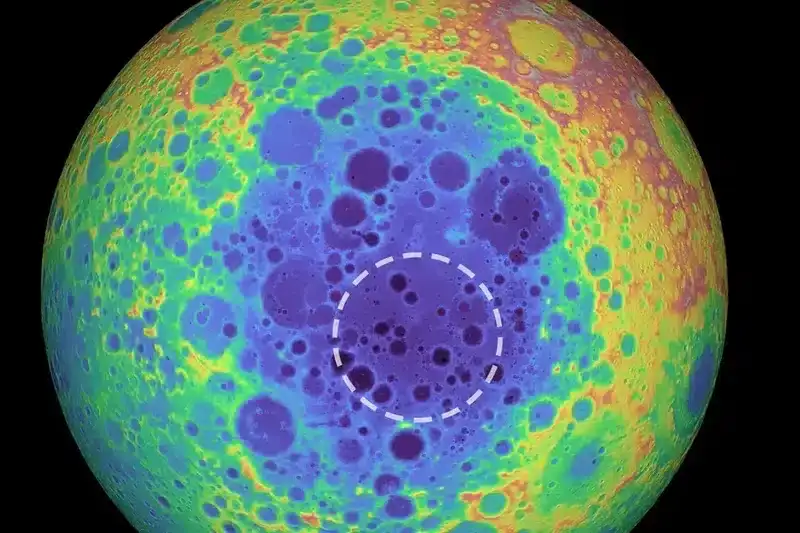
NASA’s GRAIL Mission: Key to Unveiling Lunar Secrets
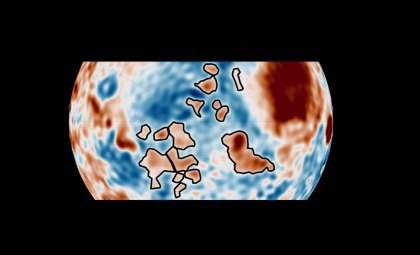
This remarkable discovery was facilitated by NASA’s Gravity Recovery and Interior Laboratory (GRAIL) mission, which maps subtle variations in the Moon’s gravitational field. Such data unveils detailed features of its inner composition and allowed the identification of gravitational abnormalities like the one underneath the South Pole-Aitken Basin.
Gravitational irregularities have long intrigued scientists studying the Moon, and GRAIL’s findings enable unprecedented exploration of its subsurface makeup. These revelations shed light on the Moon’s formation and its dynamic history over billions of years.
Continuing to focus on the South Pole-Aitken Basin is critical, as it stands as one of the lunar surface’s oldest and largest impact sites. Studying it could provide pivotal answers about the Moon and enrich our understanding of Earth’s nearest celestial neighbor.
- Categories:
- News






0 comments
Sign in to Comment